Tell the Story and Explain Why It Matters
Build a clear story with cause and importance before opening the question of narrative power.
สร้างเรื่องที่ชัดเจนพร้อมเหตุและความสำคัญ ก่อนเปิดคำถามเรื่องอำนาจในการเล่าเรื่อง

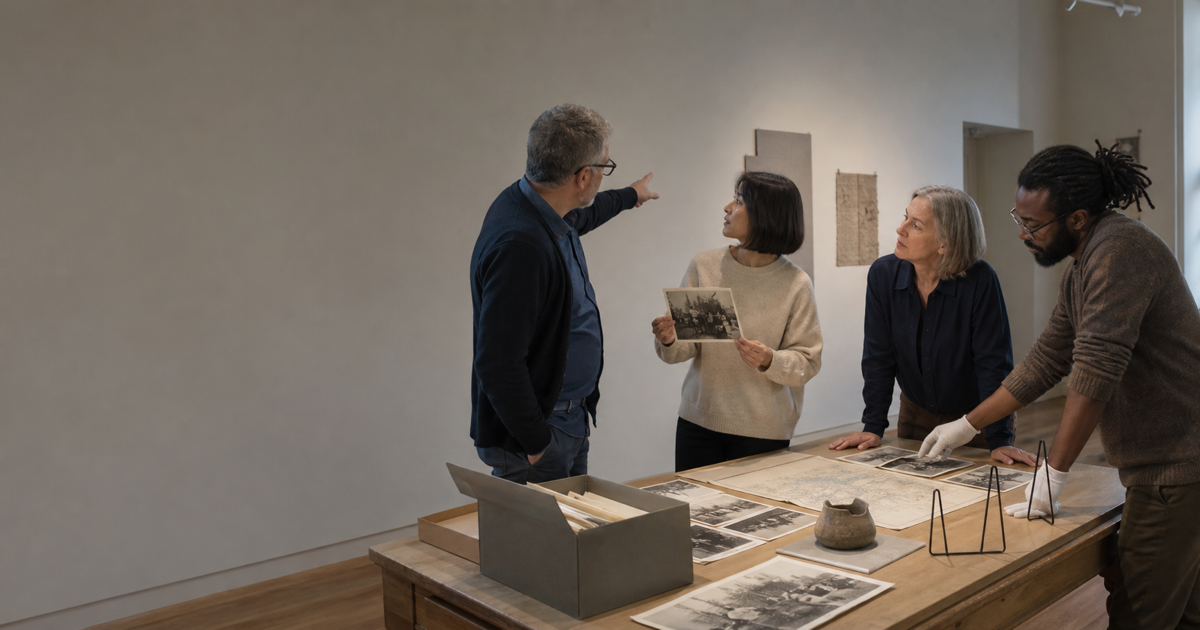
Look closely, question what is missing and let your own ideas lead the discussion.
For learners: Move from telling one meaningful story to questioning who selects, frames and omits public cultural or historical narratives.
For teachers: A visual-first, learner-led route separates observation from inference, opens optional language and imagination, tests omissions and trade-offs, then ends with independent discussion and refinement.
สำหรับผู้เรียน: ต่อยอดจากการเล่าเรื่องที่มีความหมาย ไปสู่การตั้งคำถามว่าใครเป็นผู้เลือก จัดกรอบ และละเว้นเรื่องเล่าวัฒนธรรมหรือประวัติศาสตร์สาธารณะ
สำหรับครู: เส้นทางที่เริ่มจากภาพและให้ผู้เรียนนำ แยกการสังเกตจากการตีความ เปิดภาษาและจินตนาการแบบเลือกใช้ ทดสอบสิ่งที่หายไปกับข้อแลกเปลี่ยน แล้วจบด้วยการสนทนาและปรับความคิดอิสระ
Sustain a learner-led discussion about who selects, frames and omits public stories; distinguish observation, inference and absence; explore power and practical trade-offs; then extend and refine one position independently.
นำการสนทนาด้วยตนเองเกี่ยวกับผู้ที่เลือก จัดกรอบ และละเว้นเรื่องราวสาธารณะ แยกสิ่งที่เห็น การตีความ และสิ่งที่หายไป สำรวจอำนาจกับข้อแลกเปลี่ยน และปรับข้อคิดเห็นหนึ่งจุดให้แม่นขึ้น
| Time | Teacher does | Learner does | Evidence |
|---|---|---|---|
| 0–3 | Invites observation without naming the scene. | Describes details and separates seeing from guessing. | Observation and inference. |
| 3–7 | Offers optional precision language from learner ideas. | Selects only useful words or phrasal verbs. | Self-selected language. |
| 7–11 | Follows one imagined possibility. | Builds a plausible story and identifies uncertainty. | Qualified interpretation. |
| 11–16 | Asks about selection, omission and authority. | Tests one initial reading against a missing voice. | Critical extension. |
| 16–20 | Introduces practical constraints without forcing a position. | Weighs access, care, space and representation. | Trade-off reasoning. |
| 20–25 | Lets learner questions control the discussion. | Leads, follows up and changes direction naturally. | Independent talk. |
| 25–30 | Scores IDEA/LANG/TALK and gives one focused prompt. | Reflects, extends one claim and retries independently. | Final evidence. |
Echo learner language and ask “What in the picture supports that?” Do not reveal a correct interpretation; the image is deliberately open.
bring out a hidden detail · pass down a story · leave out a voice · open up a debate
Choose only words that help your current idea. You do not need to use them all.
Offer language after the learner has an idea. Ask for one original sentence; avoid turning the stage into a vocabulary test.
Keep imagined content clearly marked with phrases such as “One possibility is…” or “The image may suggest…”. Follow the learner’s chosen path.
Who decides what counts as evidence or significance?
Can an empty space make a missing voice visible, or does it repeat the omission?
Ask for limits and alternatives, not a politically preferred answer. Keep claims tied to the image or explicitly framed as broader speculation.
More voices can improve fairness and complexity.
Space, care, privacy, consent and evidence may constrain a display.
Invite weighing, not a binary answer. Ask “What would change your mind?” or “Who carries the cost of that choice?”
You control the direction. Build from one idea, ask your own question, respond to the answer and decide whether to deepen, challenge or change direction.
Speak less. Use genuine follow-ups and let silence work. Do not require every prompt, word or phrasal verb.
Lead a three-minute discussion from the image and your own questions.
Target: 5/6 with TALK = 2. Name one success, choose one claim to refine and retry only that extension.
Score the discussion, not agreement with a viewpoint. Give one focused prompt and require an independent extension rather than a scripted full restart.
เริ่มจากสิ่งที่มองเห็น แยกการสังเกตออกจากการตีความ เลือกคำที่ช่วยให้ความคิดแม่นขึ้น แล้วตั้งคำถามต่อผู้ที่มีอำนาจเลือกเรื่อง สิ่งที่ถูกละเว้น และข้อจำกัดจริง คุณไม่ต้องตอบทุกคำถาม เป้าหมายคือให้ความคิดของคุณนำการสนทนาและปรับข้อคิดเห็นหนึ่งจุดให้ดีขึ้นหลังได้รับ feedback
Build a clear story with cause and importance before opening the question of narrative power.
สร้างเรื่องที่ชัดเจนพร้อมเหตุและความสำคัญ ก่อนเปิดคำถามเรื่องอำนาจในการเล่าเรื่อง
Compare how different accounts frame the same historical event.
เปรียบเทียบวิธีที่เรื่องเล่าต่างกันจัดกรอบเหตุการณ์ประวัติศาสตร์เดียวกัน
Extend the discussion into what societies choose to remember.
ต่อยอดการสนทนาไปสู่สิ่งที่สังคมเลือกจดจำ
Explore how traditions are preserved, adapted or ended.
สำรวจว่าธรรมเนียมถูกเก็บรักษา ปรับเปลี่ยน หรือยุติอย่างไร