
Connect each word to a clear situation or visual clue.
← Back to General English lessons
Vocabulary Builder · A1 Core → A2 Bridge
Vocabulary Builder: Feelings and Reactions
Move beyond good, bad, and tired by choosing a more precise feeling and connecting it to a reason and reaction.
Why this lesson matters · เหตุผลที่เรียนบทนี้
For learners: Expand beyond basic feeling words so learners can choose a precise emotion, explain its cause, and describe a reaction.
For teachers: Learners group words by meaning and intensity, retrieve them from situations, listen for cause and reaction, then create and retry an independent response.
สำหรับผู้เรียน: ขยายจากคำบอกความรู้สึกพื้นฐาน เพื่อเลือกอารมณ์ที่แม่นยำ อธิบายสาเหตุ และบอกปฏิกิริยาได้
สำหรับครู: ผู้เรียนจัดกลุ่มคำตามความหมายและระดับ เรียกคืนคำจากสถานการณ์ ฟังหาสาเหตุและปฏิกิริยา แล้วสร้างและลองคำตอบแบบอิสระอีกครั้ง
Your goal
By the end of this lesson, you can choose an appropriate feeling word, explain its cause, and describe your reaction in four familiar situations.
ดูคำอธิบายเป้าหมายภาษาไทย — เปิดเมื่อจำเป็น
เลือกคำตาม “ประเภท” และ “ความเข้ม” ของอารมณ์ เช่น annoyed คือรำคาญหรือไม่พอใจ ส่วน frustrated มักเกิดเมื่อพยายามแล้วติดปัญหาหรือควบคุมสถานการณ์ไม่ได้ relieved ใช้เมื่อความกังวลหรือปัญหาลดลง ไม่ได้แปลเพียงว่ามีความสุข
Why these words matter
Precise feeling words help a listener understand not only whether an experience was positive or negative, but also its cause, strength, and likely reaction. This makes everyday responses clearer and more empathetic.
Active set today: Choose 6 feeling words across at least three families for active use. Treat the other words as recognition support until the next review.
Progress focusVRFP
VR · Vocabulary RangeChoose words that match the intended meaning and use them in original phrases or sentences rather than only recognising a list.
FP · Functional PerformanceComplete the real communication outcome without the teacher supplying the key sentence or decision.
Your progress path
Separate close meanings and select the word that fits the speaker’s intention.
Create original sentences and use the words in a practical speaking task.
30-minute lesson route
3 minSituation & prediction
5 minNotice meaning
6 minChoose precisely
6 minBuild sentences
6 minCommunicate
4 minFeedback & retry
1. Build feeling families
Notice meaning and intensity. Add a situation from your life only if you are comfortable sharing it.
Positive result
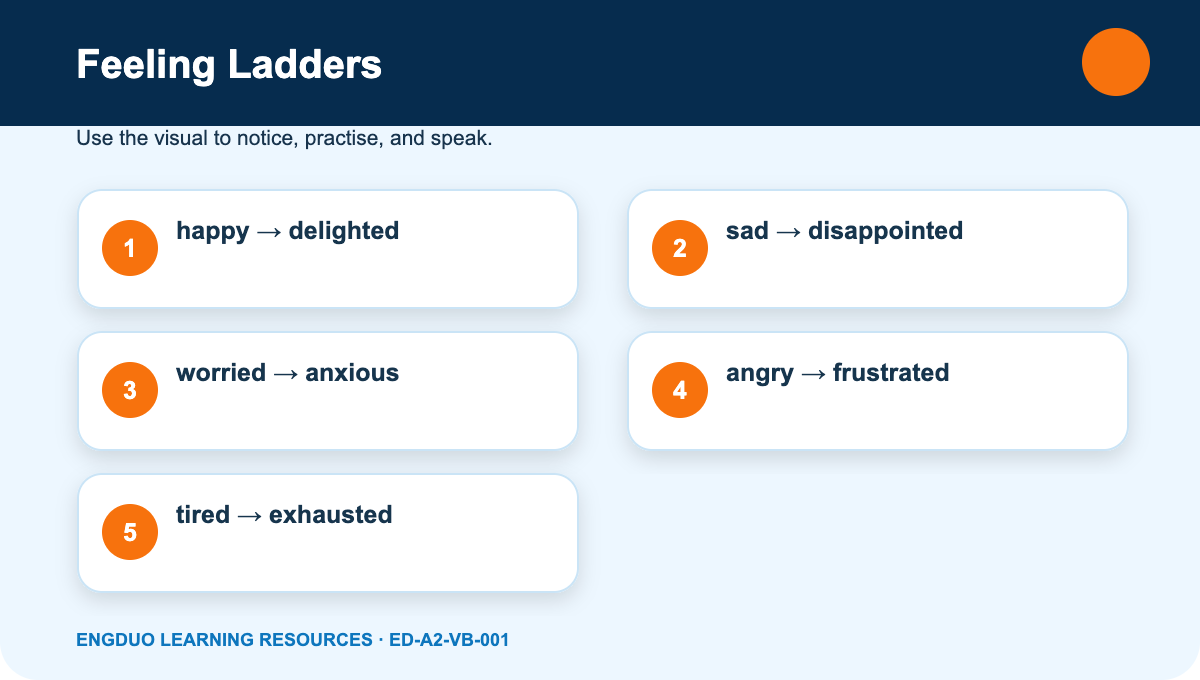
pleased → proud → delighted
Low energy
tired → exhausted
Uncertainty
concerned → worried → nervous
Problem
annoyed → frustrated → angry
Not as expected
disappointed · surprised
Problem ends
calm · relieved
2. Listen and infer the feeling
The speaker does not say the feeling word. Choose it from the situation.
1. proud or pleased
2. frustrated or annoyed
3. relieved
4. disappointed
Explain your evidence: I chose ______ because ______.
3. Connect feeling, cause, and reaction
Build a complete response instead of naming one adjective.
Feeling: I felt relieved.
Cause: I found my passport in my other bag.
Reaction: I checked all my documents again.
Connect: I felt relieved when I found my passport, so I checked all my documents again.
Retrieval checkpoint: Recall before you look
Close the feeling ladders. Recall six words from at least three feeling families and place each on a weak-to-strong scale. Reopen the visual only to check; then use two corrected words in original cause-and-reaction sentences.
4. Choose a precise word
Different answers can be reasonable. Explain the degree and context.
- You finish a difficult project and your manager thanks you.
- A delivery is late for the third time.
- You wait for an important medical result.
- A plan is cancelled, but you get a better alternative.
Response: I would feel ______ because ______. I would probably ______.
Compare: Why is annoyed or frustrated more suitable than simply angry?
Final practice: Choose and use the words
Complete the task without copying a model. The teacher observes the communication outcome before giving one focused correction and asking for a shorter retry.
Task: Respond to four situations with a precise feeling, a reason, and a likely reaction. Use at least four different feeling words.
Success: Your word matches the situation and intensity, and your reason makes the choice understandable.
VR · Vocabulary Range
1 Relies on a few general words or needs the answer list for most items.
2 Uses several suitable words with some repetition or support.
3 Uses a useful range of precise words independently in original communication.
FP · Functional Performance
1 Does not yet complete the main communication outcome.
2 Completes most of the outcome with prompts or one missing part.
3 Completes the full outcome independently and clearly enough for the listener to respond.
คำอธิบายภาษาไทย — เปิดเมื่อจำเป็นเท่านั้น
เลือกคำตาม “ประเภท” และ “ความเข้ม” ของอารมณ์ เช่น annoyed คือรำคาญหรือไม่พอใจ ส่วน frustrated มักเกิดเมื่อพยายามแล้วติดปัญหาหรือควบคุมสถานการณ์ไม่ได้ relieved ใช้เมื่อความกังวลหรือปัญหาลดลง ไม่ได้แปลเพียงว่ามีความสุข
Teacher guide · 30-minute delivery
- Confirm the learner outcome and connect it to one real use before opening every activity.
- Use the first visual or audio for meaning before explaining language.
- Select only the examples and phrases needed for this learner’s final task.
- Run the guided stage with reduced support rather than reading every instruction aloud.
- Complete Final Practice without interruption. Check meaning choice before form, then correct only the language that prevents clear use of the target words.
- Record VR, FP separately from 1–3, give one focused correction, and retry the weakest part.
Continue your learning path
Bored or Boring? Feelings and Causes
Connect feelings to causes
เชื่อมความรู้สึกกับสาเหตุ
Teaching references
- CEFR Companion Volume — Supports communication-first outcomes, observable performance, and progression through reception, production, and interaction.
Content and media rights
© 2026 Engduo Thailand. This lesson and its original instructional design, text, visuals, and prepared audio are for authorized Engduo use. Do not copy, download, republish, sell, scrape, or use any part in another course, website, dataset, product, or AI system without written permission, except where applicable law permits.