
Say what you do now and name one relevant area of experience.
← Back to Engduo Lessons
Interview Practice · A1 Core → A2 Direction
Tell Me About Yourself
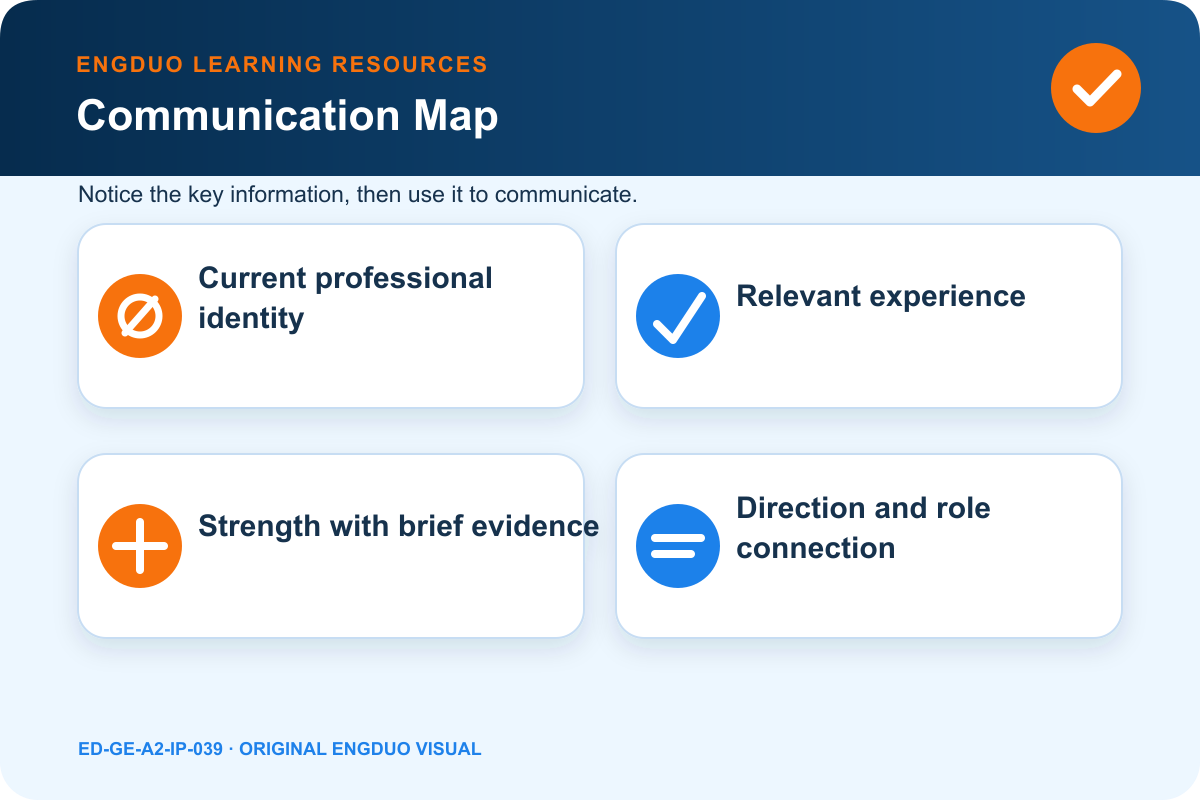
Build a relevant 60–90 second professional introduction from current identity, selected experience, one strength with evidence, and a clear connection to the target role.
Your goal
By the end of this lesson, you can give a relevant 60–90 second answer to Tell me about yourself and handle one follow-up question without reading a memorised script.
ดูคำอธิบายเป้าหมายภาษาไทย — เปิดเมื่อจำเป็น
นักเรียนจะเลือกข้อมูลที่เกี่ยวข้องกับงาน เปลี่ยนคำกล่าวอ้างเรื่องจุดแข็งให้มีตัวอย่างสั้น ๆ และเชื่อมประโยคสุดท้ายกับตำแหน่งที่สมัคร โดยไม่ต้องท่องประวัติทั้งหมด
Progress focusPROFCMFP
PROF · Professional CommunicationSelect role-relevant information and present it with an appropriate, confident, and truthful professional tone.
CM · Conversation ManagementDeliver a complete answer in a logical order and respond directly to a follow-up without returning to a memorised script.
FP · Functional PerformanceGive the interviewer enough evidence to understand your current profile, relevant value, and reason for pursuing the role.
Your progress path
Replace a general claim with one brief piece of evidence.
Select details for the role and handle a follow-up without a script.
30-minute lesson route
2 minTarget role
5 minListen & map
5 minSelect evidence
5 minBuild answer path
9 minMock rounds
4 minFeedback & retry
1. Understand what the interviewer needs
This question is not an invitation to tell your complete life story. Give a short professional map that helps the interviewer choose the next useful question.
How to run Stage 1
Name one target role and ask what evidence that employer would value. Keep the role visible; stop unrelated life-history details before building the answer.
2. Listen for four answer jobs
Identify the answer path
What is the speaker’s current role, experience, evidence, and direction?
Notice a tailored version
Which information appears selected for the target role?
How to run Stage 2
Play both models with the questions visible but no transcript. The learner identifies Now, Experience, Evidence, and Direction before replaying one uncertain part.
3. Select evidence for one target role
Selection rule: The best evidence can change when the target role changes. Relevance matters more than including everything.
How to run Stage 3
Ask for key words in all five boxes. Challenge each item with “Why is this relevant to the target role?” Remove details that do not help the interviewer decide.
4. Choose language for the answer path
Now
I’m currently …
Experience
My experience includes …
Evidence
One relevant strength is …
For example, …
Direction
I’m now looking to …
This role interests me because …
How to run Stage 4
The learner chooses one phrase for each job and personalises it. Do not allow a full written script; five key-word prompts are enough.
5. Improve three weak answers
Complete life story
Remove personal history that does not help the interviewer assess this role.
Claim without evidence
Add one brief example that shows the strength in action.
Generic motivation
Connect the final sentence to the role’s work or development opportunity.
Memorised delivery
Reduce the script to five key words and answer one follow-up naturally.
How to run Stage 5
Give one weak-answer problem at a time. Ask the learner to diagnose what the interviewer still cannot assess, then repair only that part.
6. Complete two mock interview rounds
Round 1: Give the answer with the five-part path visible.
Follow-up: Which experience prepared you most for this role? / Can you give another example of that strength?
Round 2: Change the target role or priority, select different evidence, and answer without a full script.
How to run Stage 6
Run Round 1 with the five-part path, ask one genuine follow-up, then change one role priority for Round 2 and hide the full sentences.
Final practice: Introduce yourself for this role
Give the answer from key words only. This checks professional relevance, interaction, and whether the interviewer receives a clear evidence-based profile.
Task: Deliver a 60–90 second answer with current identity, relevant experience, one strength with evidence, and a target-role connection. Answer one follow-up question.
Success: The interviewer can explain what you do, what relevant value you offer, and why the role is a logical next step.
PROF · Professional Communication
2 Relevant, concise, credible, and clearly tailored to the target role.
1 Mostly relevant after one prompt to remove a general detail or add evidence.
0 Unrelated history or unsupported claims prevent the interviewer from assessing fit.
CM · Conversation Management
2 Manages the answer and follow-up independently with a natural close.
1 Completes the answer and follow-up after one sequence or key-word prompt.
0 Needs the teacher to lead the sequence or supply the follow-up response.
FP · Functional Performance
2 The interviewer can identify the candidate’s profile, evidence, and target-role connection.
1 The profile is clear after one prompt for evidence or role connection.
0 The interviewer cannot yet identify the candidate’s relevant experience or value.
How to run Stage 7
Run a new 60–90 second answer from five key words and one unprepared follow-up. Score PROF, CM, and FP from 0–2, give one relevance cue and one delivery cue, then repeat the weakest 30-second part.
คำอธิบายภาษาไทย — เปิดเมื่อจำเป็นเท่านั้น
คำถามนี้ไม่ต้องเล่าชีวิตทั้งหมด ให้เลือกข้อมูลที่ช่วยให้ผู้สัมภาษณ์เข้าใจความเหมาะสมกับตำแหน่ง เริ่มจากสิ่งที่ทำปัจจุบัน เลือกประสบการณ์ที่เกี่ยวข้อง ยกตัวอย่างสั้น ๆ เพื่อสนับสนุนจุดแข็ง และเชื่อมกับงานที่สมัคร จากนั้นตอบคำถามต่อโดยไม่กลับไปอ่านสคริปต์
Teacher guide · 30-minute delivery
- Choose one realistic target role and identify two role priorities.
- Play the models and ask the learner to map now, experience, evidence, direction, and role link.
- Compare two possible examples and select the one most relevant to the role.
- Let the learner prepare five key words only.
- Run the first answer without interruption, then ask one evidence-based follow-up.
- Change one role priority for round two so the learner must adapt rather than repeat.
- Give feedback on one relevance point and one delivery or follow-up point, then retry.
- Record PROF, CM, and FP separately from 1–3.
Continue your learning path
Strengths with Evidence
Develop stronger proof for a common interview question.
A Challenge You Solved
Organise a short example around a problem, action, and result.
Teaching references
- CEFR Companion Volume — Supports prepared professional monologue, evidence-based description, interaction, and adaptation of content to audience and purpose.
Content and media rights
© 2026 Engduo Thailand. This lesson and its original instructional design, text, visuals, and prepared audio are for authorized Engduo use. Do not copy, download, republish, sell, scrape, or use any part in another course, website, dataset, product, or AI system without written permission, except where applicable law permits.