
What would success look like in the first ___?

Questions for the Interviewer
Ask the interviewer questions that reveal priorities, collaboration, and success measures instead of repeating information already provided.
Your goal
By the end of this lesson, you can ask thoughtful questions and respond to follow-ups.
Progress focus: PROFCMFP
Engduo Audio: Licensed voices prepared for this lesson. Audio never starts automatically. Use the transcript after the first listening attempt.
1. Notice the situation
Use the visual and model audio to identify the communication decision before studying the language.
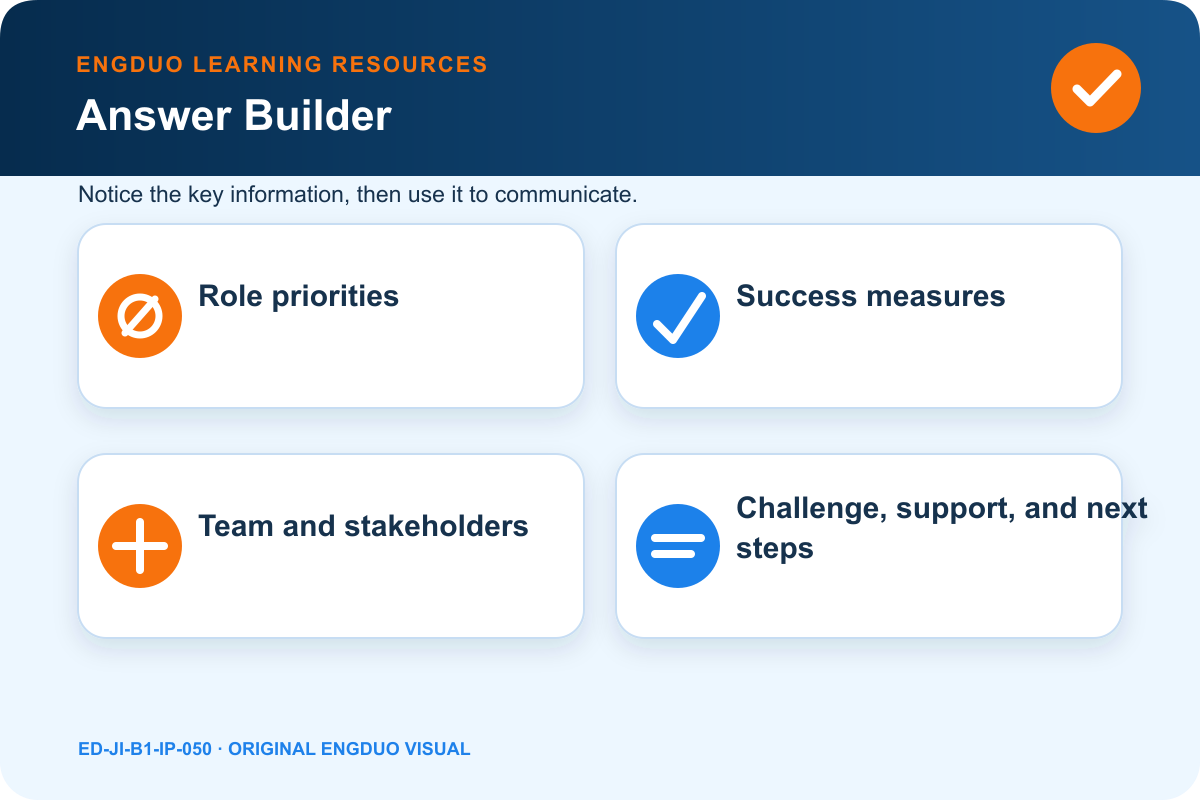
- role priorities
- success measures
- team and stakeholders
- challenge, support, and next steps
Engduo Audio • Australian English
Transcript — open after listening
What would success look like for the person in this role during the first three months?
Engduo Audio • Indian English
Transcript — open after listening
You mentioned a new support process. How would this role contribute to designing it?
How to run Stage 1
Confirm the observable outcome and connect it to one real learner need.
2. Build useful language
Select phrases for the meaning you need; do not memorise a full answer.
What are the team’s main priorities right now?
How does this role work with ___?
What is the biggest challenge for the person joining?
How is feedback usually shared?
Could you tell me more about ___?
How to run Stage 2
Use the visual and first audio for meaning before explaining language.
3. Rehearse with support
Practise the reasoning and communication choices that make the final task successful.
- Remove questions already answered in the job description.
- Prefer open questions that support a decision.
- Prepare a follow-up based on the interviewer’s answer.
How to run Stage 3
Select only the useful-language items needed for this learner.
4. Complete the communication task
Use information, evidence, or a partner response to reach a real outcome.
Choose three questions for a fictional interview and explain what decision each answer will help you make.
How to run Stage 4
Run the guided rehearsal without reading every instruction aloud.
5. Perform, receive feedback, and retry
Complete the task with keywords only, receive focused feedback, and repeat the weakest part.
Ask two questions, listen to each answer, and ask one relevant follow-up.
Retry: Repeat once with clearer evidence, structure, or listener support.
How to run Stage 5
Run the main task: Choose three questions for a fictional interview and explain what decision each answer will help you make.
Exit check
Complete this without reading a model: Ask one role-specific question and one follow-up that uses information from the answer.
Success looks like: Questions are relevant, not easily answered by the advert, and show genuine evaluation of the role.
Evidence: speaking · Repeat the weakest part once after focused teacher or self-feedback.
PROF · Professional Communication
2: Presents relevant professional evidence with an appropriate tone.
1: Demonstrates the skill after one focused prompt, correction or self-repair.
0: Cannot yet demonstrate the skill clearly enough to complete the stated outcome.
CM · Communication Management
2: Organises ideas, turns, clarification and response coherently.
1: Demonstrates the skill after one focused prompt, correction or self-repair.
0: Cannot yet demonstrate the skill clearly enough to complete the stated outcome.
FP · Functional Performance
2: Completes the real communication outcome independently.
1: Demonstrates the skill after one focused prompt, correction or self-repair.
0: Cannot yet demonstrate the skill clearly enough to complete the stated outcome.
Use these scores after the independent attempt. Record one recurring need in the Engduo app when lesson-result fields become available.
How to run Stage 6
Record focused feedback, repeat the weakest part, and complete the exit check.
คำอธิบายภาษาไทย — เปิดเมื่อจำเป็นเท่านั้น
คำถามที่ดีช่วยให้ผู้สมัครประเมินงานด้วย ไม่ใช่ถามเพื่อดูฉลาด ควรหลีกเลี่ยงสิ่งที่ประกาศงานตอบไว้แล้ว และถามต่อจากคำตอบจริง
Teacher guide
30-minute must-do route
- Confirm the observable outcome and connect it to one real learner need.
- Use the visual and first audio for meaning before explaining language.
- Select only the useful-language items needed for this learner.
- Run the guided rehearsal without reading every instruction aloud.
- Run the main task: Choose three questions for a fictional interview and explain what decision each answer will help you make.
- Record focused feedback, repeat the weakest part, and complete the exit check.
60-minute extension
- Adapt the second question after receiving an unexpected answer.
- Switch roles, evidence, or constraints so the learner transfers the skill rather than repeating an answer.
- Compare the first and second performance and record one specific improvement.
Make it easier
Choose two questions from four role-specific options.
Make it harder
Adapt the second question after receiving an unexpected answer.
Likely difficulty
The learner may ask only about benefits, read a long list, or miss a useful follow-up.
Correction priority
Prioritise relevance, open question form, and active listening.
Thai support rule
Keep the Thai panel closed unless examples, visuals, gestures, replay, and simpler English do not allow progress. Return to English after the key distinction is clear.
Progress record
Score PROF, CM, FP from 0–2 and record one recurring need from: question-quality, follow-up, role-evaluation.
Retry
Give one meaning-focused correction and one language-focused correction at most, then ask for a second attempt.
Continue your learning path
- Council of Europe — CEFR Companion Volume — Supports the communication-first level range, observable learner output, and interaction focus.
Content and media rights
© 2026 Engduo Thailand. Authorized Engduo use only. Copying, republishing, reselling, scraping, or reuse in another course, dataset, product, or AI system requires written permission except where applicable law permits.