
Hello. Can I have the ___, please?
At the Toy Shop
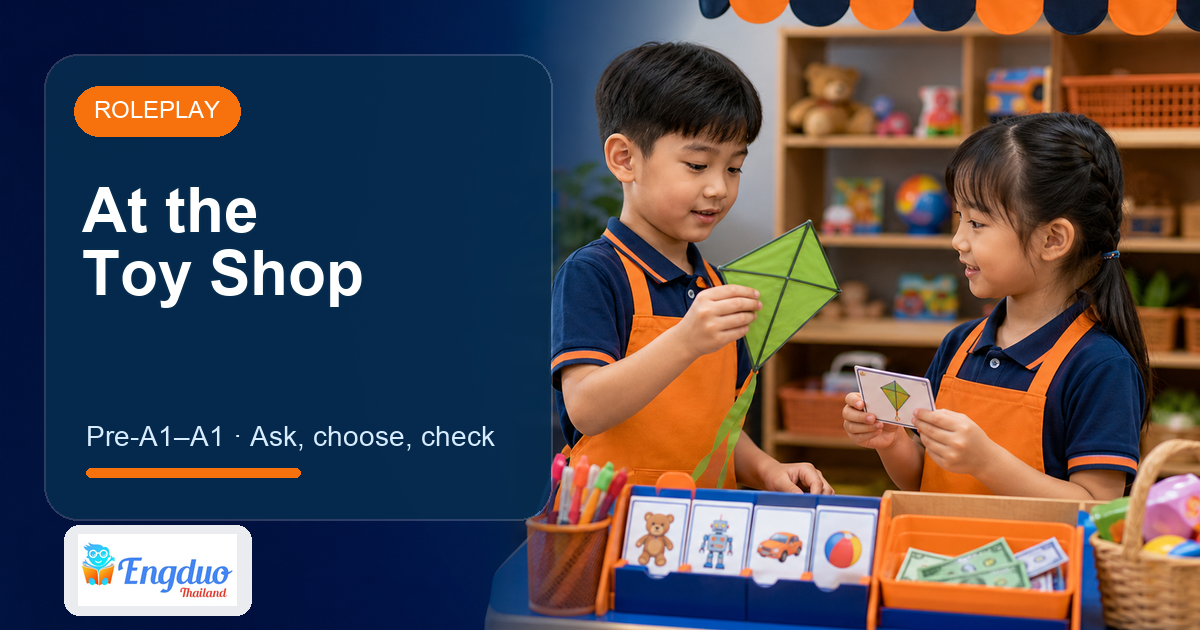
Use a toy-shop roleplay to ask for an item, choose a colour, check a price, and close the exchange politely.
Your goal
By the end of this lesson, you can ask for an item, color, and price.
Why this roleplay matters
Use English to reach a practical outcome with another person. Learn a complete exchange, practise both roles and then change the details so the final conversation is not a memorised script.
TF37 · Kids: School, Play & DiscoveryProgress Focus
Progress focus: CMLISTFP
Use the final independent attempt to apply the 0–2 scoring guide consistently.
30-minute lesson route
- Confirm the observable outcome in child-friendly language and offer a safe fictional option.
- Use the visual and first audio for meaning before explaining language.
- Choose only the language chunks this learner needs and model with gesture or pictures.
- Run one short supported rehearsal; keep correction light while meaning is developing.
- Run the main task: Customer and shopkeeper use different toy and price cards. Complete two purchases and check that the item, colour, and play-money total match.
- Record evidence, give one focused correction, repeat the weakest part, and celebrate the specific improvement.
Engduo Audio: Licensed voices prepared for this lesson. Audio never starts automatically. Use the transcript after the first listening attempt.
1. Understand the situation and roles
Identify who each person is, what each person needs and what successful communication must achieve.
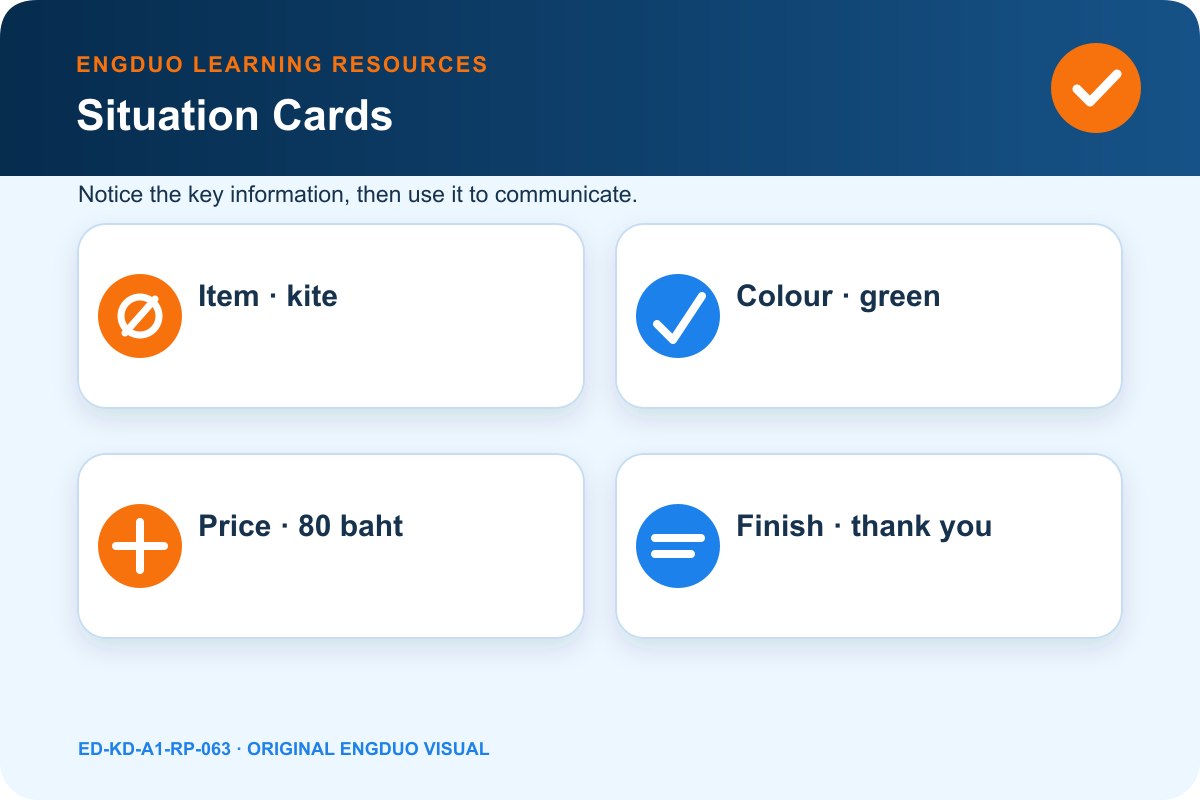
- item · kite
- colour · green
- price · 80 baht
- finish · thank you
Engduo Audio • Indian English
Transcript — open after listening
Hello. Can I have the kite, please? What colour would you like? I’d like the green one.
Engduo Audio • American English
Transcript — open after listening
How much is it? It’s eighty baht. Here you are. Thank you.
Teacher Help · Stage 1
Clarify the two roles and the shared outcome. Model the situation briefly, but do not perform the learner’s role for them.
2. Build the useful exchange
Choose the opening, request, response, clarification and closing phrases needed for one complete conversation.
What colour would you like?
I’d like the ___ one.
How much is it?
It’s ___ baht.
Here you are. Thank you.
Teacher Help · Stage 2
Select four to six useful chunks that form a complete exchange. Demonstrate how the turns connect; avoid reading the whole phrase bank aloud.
3. Rehearse one complete exchange
Practise the conversation once with visible support, then swap roles and change one detail.
- Point to the item before naming it.
- Listen for the colour and price.
- Use play money and fictional prices only.
Teacher Help · Stage 3
Run one supported exchange, then swap roles. Change one concrete detail so the learner must listen and adapt.
4. Complete the roleplay with a new detail
Use the role information to solve the situation. Listen and react instead of reading every line.
Customer and shopkeeper use different toy and price cards. Complete two purchases and check that the item, colour, and play-money total match.
Teacher Help · Stage 4
Give each role the information it needs. Let the conversation continue until the practical outcome is reached; correct only when communication stops.
5. Final practice: Roleplay independently
Complete a new round with keywords only, receive one focused correction and repeat the weakest turn.
Switch roles and complete a new purchase with no model dialogue.
Retry: Repeat once with clearer meaning, listening, pronunciation, or organisation.
Teacher Help · Stage 5
Remove the model and use keywords or role notes only. Give one communication correction and one language correction, then rerun the weakest turn.
Exit check
Complete this without reading a model: Ask for one item and colour, check the price, and finish the exchange politely.
Success looks like: Both partners agree on the correct item, colour, and fictional price.
Evidence: speaking · Repeat the weakest part once after one meaning-focused and one language-focused prompt at most.
CM · Communication Management
2: Organises ideas, turns, clarification and response coherently.
1: Demonstrates the skill after one focused prompt, correction or self-repair.
0: Cannot yet demonstrate the skill clearly enough to complete the stated outcome.
LIST · Listening Comprehension
2: Understands and uses the required spoken evidence accurately.
1: Demonstrates the skill after one focused prompt, correction or self-repair.
0: Cannot yet demonstrate the skill clearly enough to complete the stated outcome.
FP · Functional Performance
2: Completes the real communication outcome independently.
1: Demonstrates the skill after one focused prompt, correction or self-repair.
0: Cannot yet demonstrate the skill clearly enough to complete the stated outcome.
Use these scores after the independent attempt. Give one specific success note and choose one next practice focus.
Teacher Help · Stage 6
Score the stated Progress Focus from the independent round. Point to one successful interaction move and one next practice focus.
คำอธิบายภาษาไทย — เปิดเมื่อจำเป็นเท่านั้น
เป็นสถานการณ์สมมติ ใช้เงินเล่นและราคาในบัตร ไม่ชวนเด็กซื้อของจริง เป้าหมายคือถาม–ฟัง–ตรวจสอบข้อมูล
Teacher Guidance · How to conduct this class
30-minute must-do route
- Confirm the observable outcome in child-friendly language and offer a safe fictional option.
- Use the visual and first audio for meaning before explaining language.
- Choose only the language chunks this learner needs and model with gesture or pictures.
- Run one short supported rehearsal; keep correction light while meaning is developing.
- Run the main task: Customer and shopkeeper use different toy and price cards. Complete two purchases and check that the item, colour, and play-money total match.
- Record evidence, give one focused correction, repeat the weakest part, and celebrate the specific improvement.
60-minute extension
- Add a sold-out colour and require the customer to choose an alternative.
- Change the picture, role, information, or constraint so the learner transfers the skill rather than reciting.
- Compare the first and second attempt with one simple learner-friendly progress statement.
Make it easier
Use two toys, two colours, and prices under one hundred.
Make it harder
Add a sold-out colour and require the customer to choose an alternative.
Likely difficulty
The learner may name the item but miss the shopkeeper’s colour or price question.
Correction priority
Prioritise listening for the requested detail and a complete polite request.
Thai support rule
Keep the Thai panel closed unless pictures, gestures, replay, examples, and simpler English do not allow progress. Explain only the key distinction, then return to English.
Progress record
Use the 0–2 guide after the independent attempt and identify one recurring need for the next lesson.
Retry
Give one meaning-focused correction and one language-focused correction at most, then ask for a short second attempt. Use fictional alternatives, never require personal disclosure, do not publish learner work or recordings without the organisation’s appropriate consent process, and adapt movement or sensory demands.
- Council of Europe — CEFR Companion Volume — Supports observable communication outcomes, interaction, and progression.
- Cambridge English — Pre A1 Starters exam format — Supports familiar picture-based listening, spoken instructions, simple personal questions, and motivating young-learner tasks.
- Cambridge English — Activities for children — Supports level-aware child-friendly practice across listening, speaking, reading, and writing.
Content and media rights
© 2026 Engduo Thailand. Authorized Engduo use only. Copying, republishing, reselling, scraping, or reuse in another course, dataset, product, or AI system requires written permission except where applicable law permits.