
My name / nickname is ___.
My Mini Profile
Create a short, safe profile for yourself or an imaginary character, check sentence patterns, and present it to a partner.
Your goal
By the end of this lesson, you can complete and present a short personal profile.
Progress focus: WRLC
Engduo Audio: Licensed voices prepared for this lesson. Audio never starts automatically. Use the transcript after the first listening attempt.
1. Look, listen, and notice
Use the visual and model audio to understand the situation before explaining the language.
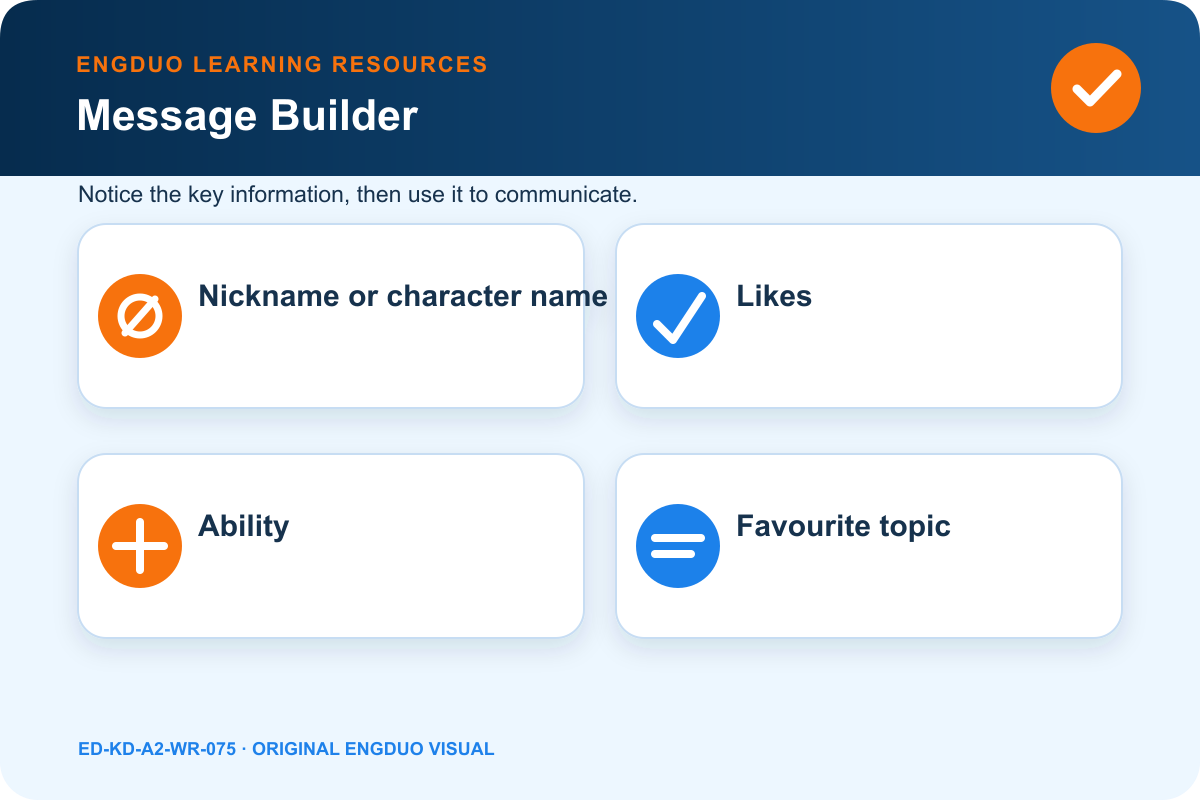
- nickname or character name
- likes
- ability
- favourite topic
Engduo Audio • Indian English
Transcript — open after listening
My nickname is Sky. I like puzzles. I can ride a bike. My favourite animal is a rabbit.
Engduo Audio • American English
Transcript — open after listening
My character is Momo. Momo likes music and can draw funny robots.
How to run Stage 1
Confirm the observable outcome in child-friendly language and offer a safe fictional option.
2. Build useful language
Choose a few useful chunks for the meaning you need; do not memorise a long script.
I am ___ years old. (optional)
I like ___.
I can ___.
My favourite ___ is ___.
Ask me about ___.
How to run Stage 2
Use the visual and first audio for meaning before explaining language.
3. Practise with support
Use pictures, movement, or short notes while the teacher checks meaning and participation.
- Choose real, limited details or an imaginary character.
- Do not include full name, school, address, phone, account, or exact location.
- Check capital letters, spacing, and full stops.
How to run Stage 3
Choose only the language chunks this learner needs and model with gesture or pictures.
4. Complete the challenge
Use English to solve, create, choose, or communicate—not just to repeat the model.
Complete a four-sentence mini profile for a safe classroom display, exchange it with a partner, and ask one question.
How to run Stage 4
Run one short supported rehearsal; keep correction light while meaning is developing.
5. Show what you can do
Complete the task with less support, receive one focused correction, and try the weakest part again.
Write a new profile from picture choices, read it aloud, and improve one sentence after feedback.
Retry: Repeat once with clearer meaning, listening, pronunciation, or organisation.
How to run Stage 5
Run the main task: Complete a four-sentence mini profile for a safe classroom display, exchange it with a partner, and ask one question.
Exit check
Complete this without reading a model: Write four clear profile sentences and answer one question without adding private information.
Success looks like: The profile is understandable, uses safe details, and contains basic sentence punctuation.
Evidence: writing · Repeat the weakest part once after one meaning-focused and one language-focused prompt at most.
WR · Writing Control
2: Produces reader-focused writing that completes the stated purpose.
1: Demonstrates the skill after one focused prompt, correction or self-repair.
0: Cannot yet demonstrate the skill clearly enough to complete the stated outcome.
LC · Language Control
2: Controls the target language well enough to keep meaning clear.
1: Demonstrates the skill after one focused prompt, correction or self-repair.
0: Cannot yet demonstrate the skill clearly enough to complete the stated outcome.
Use these scores after the independent attempt. Record one recurring need in the Engduo app when lesson-result fields become available.
How to run Stage 6
Record evidence, give one focused correction, repeat the weakest part, and celebrate the specific improvement.
คำอธิบายภาษาไทย — เปิดเมื่อจำเป็นเท่านั้น
ใช้ชื่อเล่นหรือตัวละครสมมติได้ ห้ามใส่นามสกุล โรงเรียน ที่อยู่ เบอร์โทร บัญชีออนไลน์ หรือสถานที่แบบเจาะจง อายุเป็นตัวเลือกไม่บังคับ
Teacher guide
30-minute must-do route
- Confirm the observable outcome in child-friendly language and offer a safe fictional option.
- Use the visual and first audio for meaning before explaining language.
- Choose only the language chunks this learner needs and model with gesture or pictures.
- Run one short supported rehearsal; keep correction light while meaning is developing.
- Run the main task: Complete a four-sentence mini profile for a safe classroom display, exchange it with a partner, and ask one question.
- Record evidence, give one focused correction, repeat the weakest part, and celebrate the specific improvement.
60-minute extension
- Add two linked sentences with and/but and present without reading every word.
- Change the picture, role, information, or constraint so the learner transfers the skill rather than reciting.
- Compare the first and second attempt with one simple learner-friendly progress statement.
Make it easier
Provide sentence starters and picture choices.
Make it harder
Add two linked sentences with and/but and present without reading every word.
Likely difficulty
The learner may copy labels without forming sentences or include identifying details.
Correction priority
Prioritise safe content, complete simple sentences, and readable punctuation.
Thai support rule
Keep the Thai panel closed unless pictures, gestures, replay, examples, and simpler English do not allow progress. Explain only the key distinction, then return to English.
Progress record
Score WR, LC from 0–2 and record one recurring need from: sentence-building, punctuation, privacy-awareness.
Retry
Give one meaning-focused correction and one language-focused correction at most, then ask for a short second attempt. Use fictional alternatives, never require personal disclosure, do not publish learner work or recordings without the organisation’s appropriate consent process, and adapt movement or sensory demands.
Continue your learning path
- Council of Europe — CEFR Companion Volume — Supports observable communication outcomes, interaction, and progression.
- Cambridge English — Pre A1 Starters exam format — Supports familiar picture-based listening, spoken instructions, simple personal questions, and motivating young-learner tasks.
- Cambridge English — A1 Movers Digital exam format — Supports descriptions, picture sequences, short stories, personal questions, and integrated listening, reading, writing, and speaking.
Content and media rights
© 2026 Engduo Thailand. Authorized Engduo use only. Copying, republishing, reselling, scraping, or reuse in another course, dataset, product, or AI system requires written permission except where applicable law permits.