
The writer intended to ___.

The Message That Sounded Rude
Analyse why a short message sounded rude by comparing intention, wording, punctuation, context, and reader interpretation, then revise it without changing the core request.
Your goal
By the end of this lesson, you can interpret tone and propose a clearer message.
Progress focus: READVR
Engduo Audio: Licensed voices prepared for this lesson. Audio never starts automatically. Use the transcript after the first listening attempt.
1. Read, listen, and notice
Use the visual and model audio to understand the situation, viewpoint, or communication problem before studying the language.
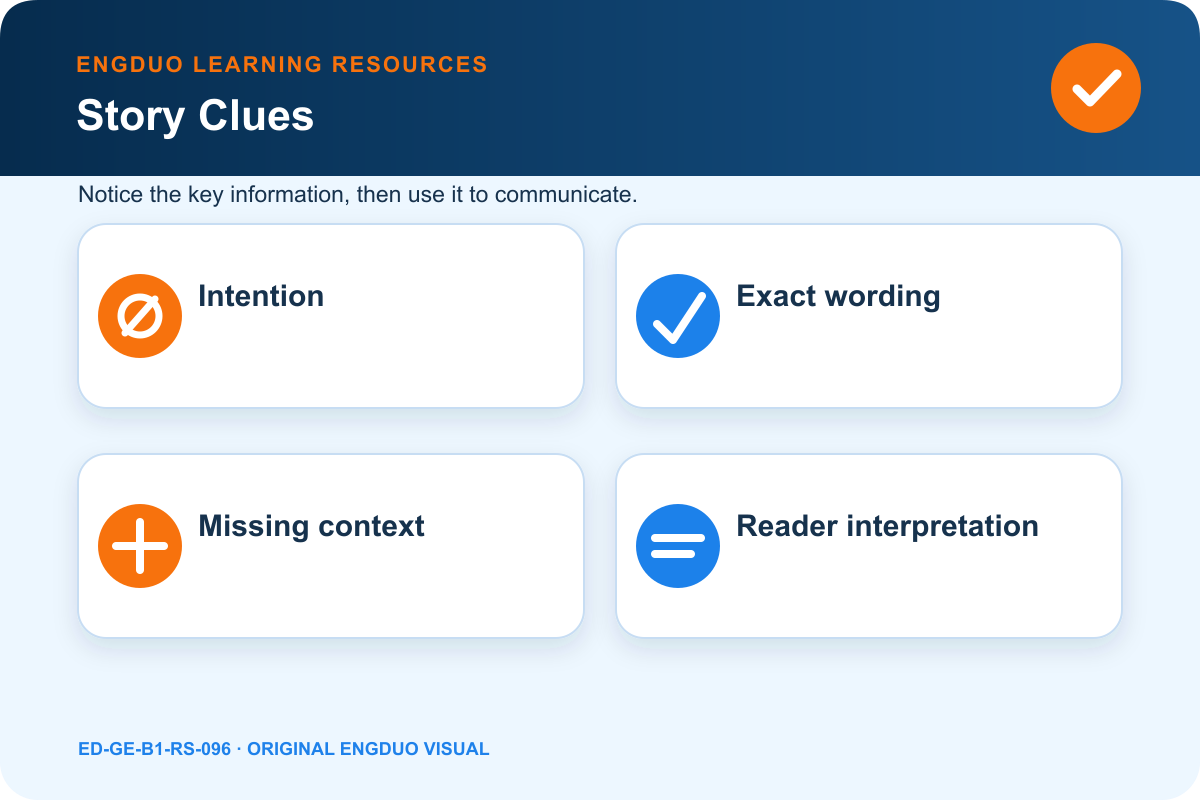
- intention
- exact wording
- missing context
- reader interpretation
The message that sounded rude
At 9:05, Arun wrote to Noor: “Send the file today.” He was preparing a report for a meeting and wanted to be brief because he was joining another call. Noor had not been told about the meeting. She read the short message after spending two hours correcting the same file and interpreted it as an order with no recognition of her work.
Noor replied, “I am busy.” Arun thought she was refusing an urgent request. Ten minutes later they spoke. Arun explained the deadline; Noor explained that she still needed the latest figures from him. They saw that neither first message included enough context or a clear next step.
Arun rewrote the request: “Hi Noor, could you send the updated file by four today? I need it for the final meeting check. I’ll send the figures by eleven. Thanks for fixing the earlier sections.” Noor confirmed the timing, and both agreed to include context when a short message could be interpreted in more than one way.
Engduo Audio • British English
Transcript — open after listening
The message said, Send the file today. The writer intended to be efficient, but the reader interpreted it as an order because there was no context or greeting.
Engduo Audio • American English
Transcript — open after listening
A clearer version is: Hi Noor, could you send the updated file by four today? I need it for the final check. Thanks.
How to run Stage 1
Confirm the observable outcome and connect it to one realistic learner need.
2. Build useful language
Choose the phrases that help you complete the task; do not memorise a full script.
The reader may interpret ___ as ___.
The phrase ___ sounds abrupt because ___.
A clearer version would be ___.
We could add context by saying ___.
The request remains the same, but the tone changes.
How to run Stage 2
Use the visual and first audio or text for meaning before explaining language.
3. Rehearse with support
Practise the decisions, evidence, listening, or language moves that make the final task successful.
- Quote the exact phrase that creates the tone problem.
- Avoid assuming emotion from punctuation alone.
- Revise only what improves clarity and relationship.
How to run Stage 3
Select only the useful-language items needed for this learner and this task.
4. Complete the communication task
Exchange information, solve a problem, create a text, or reach a decision with a real outcome.
Read an original message chain from two fictional colleagues. Reconstruct the misunderstanding, identify three tone triggers, and write a repair message.
How to run Stage 4
Run the supported rehearsal without reading every instruction aloud.
5. Perform, receive feedback, and retry
Complete the task with keywords only, receive focused feedback, and repeat the weakest part.
Explain the misunderstanding in one minute and revise two new messages for a friend and a service context.
Retry: Repeat once with clearer meaning, stronger evidence, more accurate listening, or less support.
How to run Stage 5
Run the main task: Read an original message chain from two fictional colleagues. Reconstruct the misunderstanding, identify three tone triggers, and write a repair message.
Exit check
Complete this without reading a model: Identify one tone risk from the text, explain a plausible interpretation, and produce a clearer revision.
Success looks like: The analysis distinguishes intention from interpretation and the revision keeps the request specific.
Evidence: reading · Repeat the weakest part once after one meaning-focused and one language-focused correction at most.
READ · Reading Comprehension
2: Finds and interprets the required written evidence accurately.
1: Demonstrates the skill after one focused prompt, correction or self-repair.
0: Cannot yet demonstrate the skill clearly enough to complete the stated outcome.
VR · Vocabulary Resource
2: Uses suitable target vocabulary naturally in an original message.
1: Demonstrates the skill after one focused prompt, correction or self-repair.
0: Cannot yet demonstrate the skill clearly enough to complete the stated outcome.
Use these scores after the independent attempt. Record one recurring need in the Engduo app when lesson-result fields become available.
How to run Stage 6
Record focused evidence, give one meaning-focused and one language-focused correction at most, repeat the weakest part, and complete the exit check.
คำอธิบายภาษาไทย — เปิดเมื่อจำเป็นเท่านั้น
อย่าตัดสินว่าเครื่องหมายหรือประโยคสั้นๆ rude เสมอ ต้องดูความสัมพันธ์ บริบท และข้อมูลที่หายไป แยก intention ของผู้เขียนจาก interpretation ของผู้อ่าน
Teacher guide
30-minute must-do route
- Confirm the observable outcome and connect it to one realistic learner need.
- Use the visual and first audio or text for meaning before explaining language.
- Select only the useful-language items needed for this learner and this task.
- Run the supported rehearsal without reading every instruction aloud.
- Run the main task: Read an original message chain from two fictional colleagues. Reconstruct the misunderstanding, identify three tone triggers, and write a repair message.
- Record focused evidence, give one meaning-focused and one language-focused correction at most, repeat the weakest part, and complete the exit check.
60-minute extension
- Adapt the same request for a close friend, a new colleague, and a customer-service channel.
- Change the role, information, listener, or constraint so the learner transfers the skill rather than repeating the same answer.
- Compare the first and second performance and record one specific improvement.
Make it easier
Highlight three possible tone triggers and choose between two revisions.
Make it harder
Adapt the same request for a close friend, a new colleague, and a customer-service channel.
Likely difficulty
The learner may label the writer as rude rather than analysing wording and context.
Correction priority
Prioritise text-based explanation, cautious interpretation, and functional revision.
Thai support rule
Keep the Thai panel closed unless examples, visuals, replay, reformulation, and simpler English do not allow progress. Explain only the key distinction, then return to English.
Progress record
Score READ, VR from 0–2 and record one recurring need from: pragmatic-reading, perspective-taking, revision.
Retry
Give one meaning-focused correction and one language-focused correction at most, then ask for a second attempt with fewer visible prompts.
Continue your learning path
- Council of Europe — CEFR Companion Volume — Supports B1 communication through connected speech, descriptions of experiences, opinions with reasons, travel situations, goal-oriented co-operation, written interaction, and action-oriented outcomes.
Content and media rights
© 2026 Engduo Thailand. Authorized Engduo use only. Copying, republishing, reselling, scraping, or reuse in another course, dataset, product, or AI system requires written permission except where applicable law permits.