
I’m writing about order / booking ___.
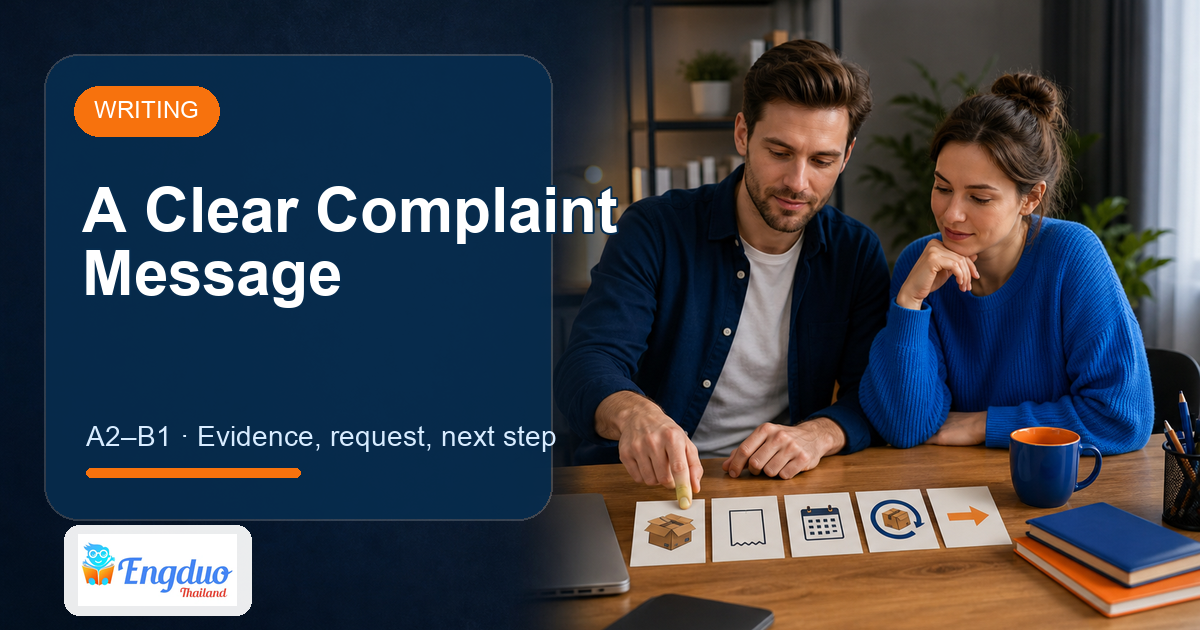
A Clear Complaint Message
Write a calm complaint message that documents the problem, gives necessary evidence, states the requested resolution, and makes the next step easy to act on.
Your goal
By the end of this lesson, you can describe a problem, evidence, and a reasonable request.
Progress focus: WRLC
Engduo Audio: Licensed voices prepared for this lesson. Audio never starts automatically. Use the transcript after the first listening attempt.
1. Look, listen, and notice
Use the visual and model audio to understand the situation, viewpoint, or communication problem before studying the language.
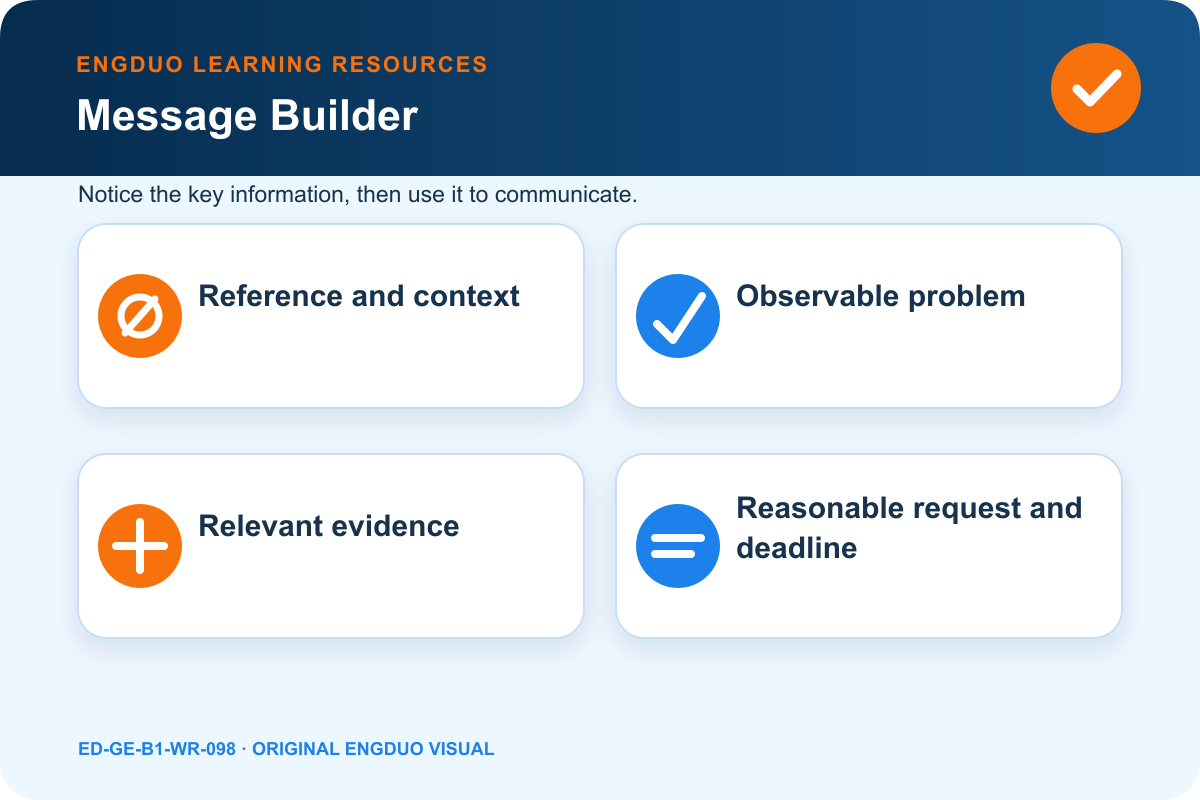
- reference and context
- observable problem
- relevant evidence
- reasonable request and deadline
Engduo Audio • Australian English
Transcript — open after listening
I’m writing about order K twenty-four. The confirmation shows a black medium jacket, but the parcel contained a blue large jacket.
Engduo Audio • Indian English
Transcript — open after listening
I would appreciate an exchange at no additional delivery cost. Please confirm the return steps within three business days.
How to run Stage 1
Confirm the observable outcome and connect it to one realistic learner need.
2. Build useful language
Choose the phrases that help you complete the task; do not memorise a full script.
The issue is ___.
According to ___.
I have attached / included ___.
I would appreciate ___.
Please confirm the next step by ___.
How to run Stage 2
Use the visual and first audio or text for meaning before explaining language.
3. Rehearse with support
Practise the decisions, evidence, listening, or language moves that make the final task successful.
- Separate facts from frustration.
- Include only evidence needed to verify the issue.
- Choose a proportionate resolution and a workable response time.
How to run Stage 3
Select only the useful-language items needed for this learner and this task.
4. Complete the communication task
Exchange information, solve a problem, create a text, or reach a decision with a real outcome.
Use one fictional case file to write a 130–170 word complaint about a wrong item, repeated service interruption, or incorrect reservation detail.
How to run Stage 4
Run the supported rehearsal without reading every instruction aloud.
5. Perform, receive feedback, and retry
Complete the task with keywords only, receive focused feedback, and repeat the weakest part.
Review the draft with a problem–evidence–request–next-step checklist, remove accusatory wording, and produce a final version.
Retry: Repeat once with clearer meaning, stronger evidence, more accurate listening, or less support.
How to run Stage 5
Run the main task: Use one fictional case file to write a 130–170 word complaint about a wrong item, repeated service interruption, or incorrect reservation detail.
Exit check
Complete this without reading a model: Write a complaint that identifies the case, explains the issue with evidence, requests a clear resolution, and asks for confirmation.
Success looks like: The recipient can verify the problem and knows exactly what response or action is requested.
Evidence: writing · Repeat the weakest part once after one meaning-focused and one language-focused correction at most.
WR · Writing Control
2: Produces reader-focused writing that completes the stated purpose.
1: Demonstrates the skill after one focused prompt, correction or self-repair.
0: Cannot yet demonstrate the skill clearly enough to complete the stated outcome.
LC · Language Control
2: Controls the target language well enough to keep meaning clear.
1: Demonstrates the skill after one focused prompt, correction or self-repair.
0: Cannot yet demonstrate the skill clearly enough to complete the stated outcome.
Use these scores after the independent attempt. Record one recurring need in the Engduo app when lesson-result fields become available.
How to run Stage 6
Record focused evidence, give one meaning-focused and one language-focused correction at most, repeat the weakest part, and complete the exit check.
คำอธิบายภาษาไทย — เปิดเมื่อจำเป็นเท่านั้น
complaint ที่ชัดเจนไม่ต้องใช้อารมณ์แรง ให้แยก fact, evidence, request และ next step ใช้เลขอ้างอิงสมมติและไม่ใส่ข้อมูลบัตรหรือข้อมูลจริง
Teacher guide
30-minute must-do route
- Confirm the observable outcome and connect it to one realistic learner need.
- Use the visual and first audio or text for meaning before explaining language.
- Select only the useful-language items needed for this learner and this task.
- Run the supported rehearsal without reading every instruction aloud.
- Run the main task: Use one fictional case file to write a 130–170 word complaint about a wrong item, repeated service interruption, or incorrect reservation detail.
- Record focused evidence, give one meaning-focused and one language-focused correction at most, repeat the weakest part, and complete the exit check.
60-minute extension
- Adapt the same complaint for email and a short in-app form with a strict word limit.
- Change the role, information, listener, or constraint so the learner transfers the skill rather than repeating the same answer.
- Compare the first and second performance and record one specific improvement.
Make it easier
Use a four-block message frame and one model case.
Make it harder
Adapt the same complaint for email and a short in-app form with a strict word limit.
Likely difficulty
The learner may write a long emotional account, omit the reference, or make several unclear demands.
Correction priority
Prioritise factual sequence, proportionate request, and actionable close.
Thai support rule
Keep the Thai panel closed unless examples, visuals, replay, reformulation, and simpler English do not allow progress. Explain only the key distinction, then return to English.
Progress record
Score WR, LC from 0–2 and record one recurring need from: formal-messages, evidence, requests.
Retry
Give one meaning-focused correction and one language-focused correction at most, then ask for a second attempt with fewer visible prompts.
Continue your learning path
- Council of Europe — CEFR Companion Volume — Supports B1 communication through connected speech, descriptions of experiences, opinions with reasons, travel situations, goal-oriented co-operation, written interaction, and action-oriented outcomes.
Content and media rights
© 2026 Engduo Thailand. Authorized Engduo use only. Copying, republishing, reselling, scraping, or reuse in another course, dataset, product, or AI system requires written permission except where applicable law permits.