
The text mainly aims to ___.
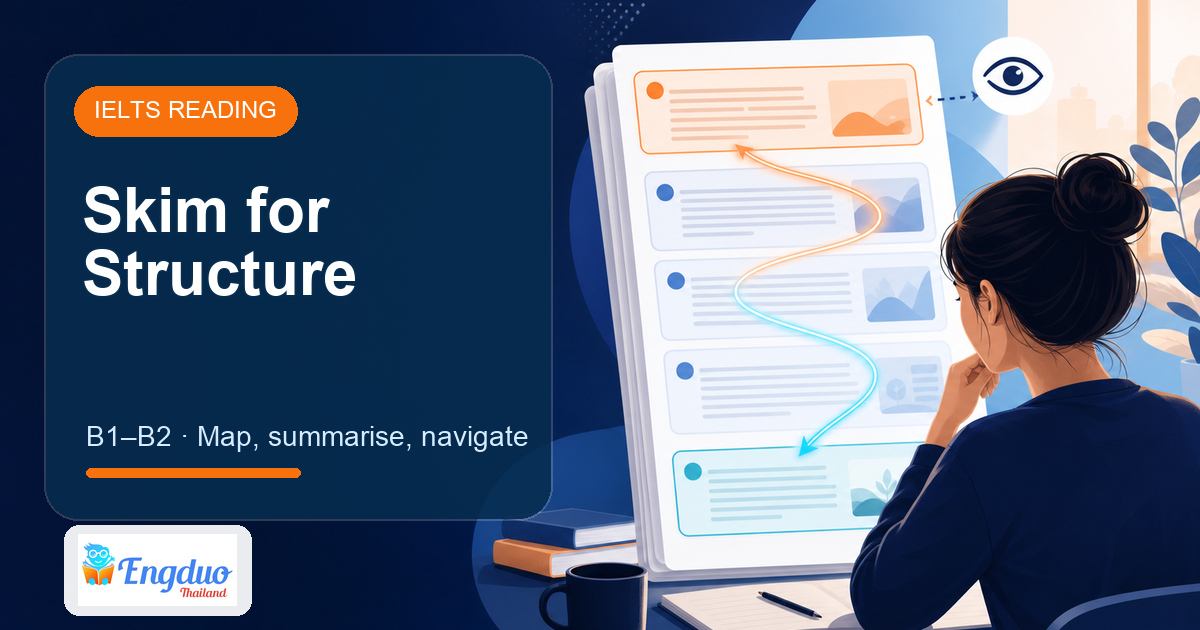
Skim for Text Structure
Read the title, opening, and paragraph signals to identify purpose and paragraph roles quickly before returning for detailed evidence.
Your goal
By the end of this lesson, you can identify purpose and paragraph roles quickly.
Progress focus: READVR
Engduo Audio: Licensed voices prepared for this lesson. Audio never starts automatically. Use the transcript after the first listening attempt.
1. Read, listen, and notice
Use the visual and model audio to understand the situation, viewpoint, or communication problem before studying the language.
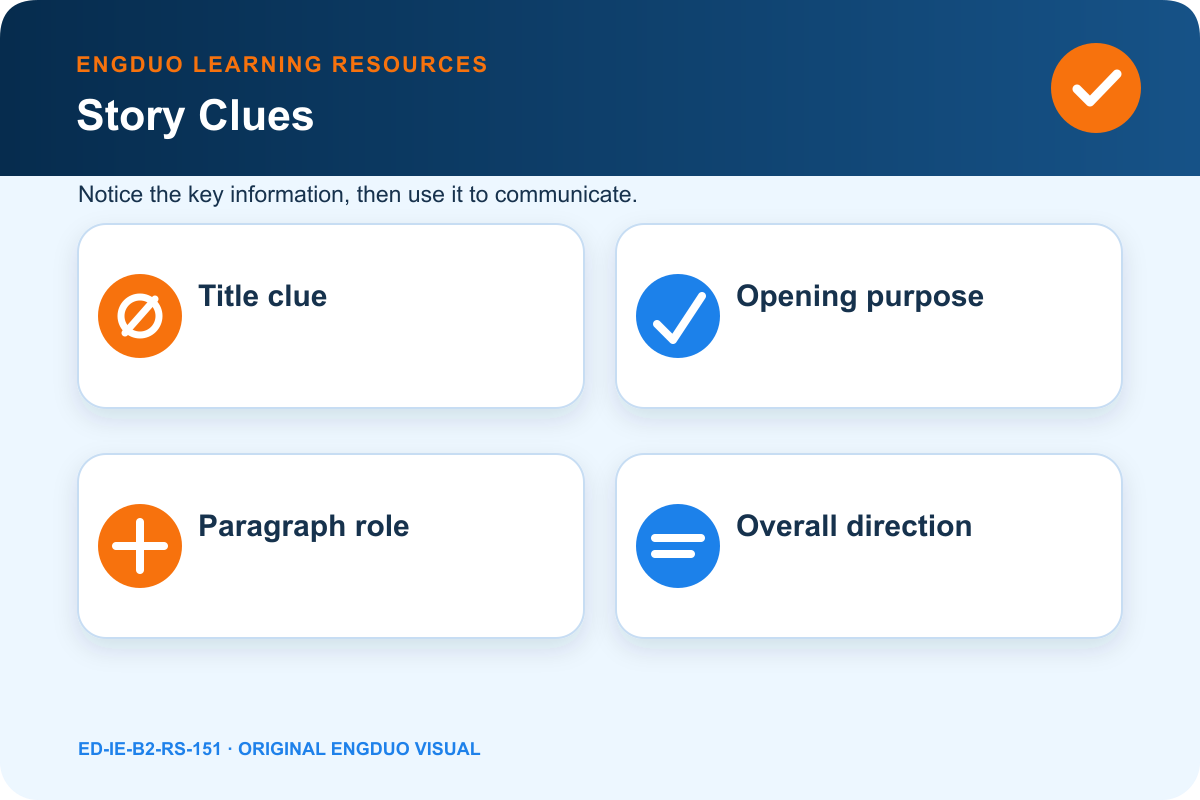
- title clue
- opening purpose
- paragraph role
- overall direction
More Than Books
A. In several towns, residents can now borrow drills, sewing machines, and gardening tools from a library. The idea began as a response to the high cost of items that many households use only a few times a year.
B. Members reserve an item, attend a short safety check when necessary, and return it after an agreed period. The model depends on clear maintenance records and trained volunteers.
C. Supporters say the service reduces waste and gives more people access to useful equipment. One coastal town also runs repair workshops so members can learn from each other.
D. However, the model is not equally simple everywhere. Storage, insurance, and specialist repairs can be expensive. Its long-term value may therefore depend on local demand and reliable funding.
Engduo Audio • Indian English
Transcript — open after listening
The text mainly aims to evaluate a new kind of community library. Paragraph A introduces the access problem, while Paragraph B explains the lending model.
Engduo Audio • British English
Transcript — open after listening
The final paragraph does not simply praise the idea. It evaluates cost, training, and which communities may benefit most.
How to run Stage 1
Confirm the observable outcome and connect it to one realistic learner need.
2. Build useful language
Choose the phrases that help you complete the task; do not memorise a full script.
Paragraph A introduces ___.
Paragraph B explains ___.
This paragraph contrasts ___.
The final paragraph evaluates ___.
The writer’s overall direction is ___.
How to run Stage 2
Use the visual and first audio or text for meaning before explaining language.
3. Rehearse with support
Practise the decisions, evidence, listening, or language moves that make the final task successful.
- Skim each paragraph for twenty seconds without stopping at unknown words.
- Assign roles such as problem, explanation, example, contrast, and evaluation.
- Predict where a detail question is most likely to be answered.
How to run Stage 3
Select only the useful-language items needed for this learner and this task.
4. Complete the communication task
Exchange information, solve a problem, create a text, or reach a decision with a real outcome.
Skim an original four-paragraph article about libraries lending tools as well as books. Build a paragraph-role map and justify the text’s purpose with two structural clues.
How to run Stage 4
Run the supported rehearsal without reading every instruction aloud.
5. Perform, receive feedback, and retry
Complete the task with keywords only, receive focused feedback, and repeat the weakest part.
Skim a new original text in three minutes, identify its purpose and five paragraph roles, then locate one detail using the structure map.
Retry: Repeat once with clearer meaning, stronger evidence, more accurate listening, or less support.
How to run Stage 5
Run the main task: Skim an original four-paragraph article about libraries lending tools as well as books. Build a paragraph-role map and justify the text’s purpose with two structural clues.
Exit check
Complete this without reading a model: State the purpose and the paragraph most likely to contain a limitation.
Success looks like: The learner identifies the writer’s direction without translating every sentence and uses structure to locate evidence.
Evidence: reading · Repeat the weakest part once after one meaning-focused and one language-focused correction at most.
READ · Reading Comprehension
2: Finds and interprets the required written evidence accurately.
1: Demonstrates the skill after one focused prompt, correction or self-repair.
0: Cannot yet demonstrate the skill clearly enough to complete the stated outcome.
VR · Vocabulary Resource
2: Uses suitable target vocabulary naturally in an original message.
1: Demonstrates the skill after one focused prompt, correction or self-repair.
0: Cannot yet demonstrate the skill clearly enough to complete the stated outcome.
Use these scores after the independent attempt. Record one recurring need in the Engduo app when lesson-result fields become available.
How to run Stage 6
Record focused evidence, give one meaning-focused and one language-focused correction at most, repeat the weakest part, and complete the exit check.
คำอธิบายภาษาไทย — เปิดเมื่อจำเป็นเท่านั้น
Skim เพื่อเห็นโครงสร้างก่อน ไม่ต้องแปลทุกคำ ดูชื่อเรื่อง ประโยคเปิด คำเชื่อม และหน้าที่ของแต่ละย่อหน้า
Teacher guide
30-minute must-do route
- Confirm the observable outcome and connect it to one realistic learner need.
- Use the visual and first audio or text for meaning before explaining language.
- Select only the useful-language items needed for this learner and this task.
- Run the supported rehearsal without reading every instruction aloud.
- Run the main task: Skim an original four-paragraph article about libraries lending tools as well as books. Build a paragraph-role map and justify the text’s purpose with two structural clues.
- Record focused evidence, give one meaning-focused and one language-focused correction at most, repeat the weakest part, and complete the exit check.
60-minute extension
- Use two paragraphs with the same topic but different roles and require a precise distinction.
- Change the role, information, listener, or constraint so the learner transfers the skill rather than repeating the same answer.
- Compare the first and second performance and record one specific improvement.
Make it easier
Provide five paragraph-role cards and highlight only opening sentences.
Make it harder
Use two paragraphs with the same topic but different roles and require a precise distinction.
Likely difficulty
The learner may read word by word and lose time before understanding the text’s overall purpose.
Correction priority
Prioritise purpose, paragraph role, and efficient return to evidence.
Thai support rule
Keep the Thai panel closed unless examples, visuals, replay, reformulation, and simpler English do not allow progress. Explain only the key distinction, then return to English.
Progress record
Score READ, VR from 0–2 and record one recurring need from: purpose, paragraph-role, reading-speed.
Retry
Give one meaning-focused correction and one language-focused correction at most, then ask for a second attempt with fewer visible prompts.
Continue your learning path
- Council of Europe — CEFR Companion Volume — Supports action-oriented language learning through age- and level-appropriate interaction, descriptions, goal-oriented co-operation, written interaction, and observable communication outcomes.
- IELTS — Academic test format in detail — Supports accurate lesson alignment to the official IELTS Listening, Reading, Writing, and Speaking task structure and skills.
- IELTS — Academic sample test questions — Supports accurate awareness of official IELTS question families while Engduo uses only original practice texts, visuals, recordings, prompts, and answer sets.
Content and media rights
© 2026 Engduo Thailand. Authorized Engduo use only. Copying, republishing, reselling, scraping, or reuse in another course, dataset, product, or AI system requires written permission except where applicable law permits.