
I would argue that ___.

Should a Tradition Change? A Concise Opinion
Write a concise opinion on whether a tradition should change by stating a qualified position, developing two reasons, addressing one counterpoint, and ending with a practical condition.
Your goal
By the end of this lesson, you can write a concise opinion that states a position, recognises value, evaluates harm or benefit, and proposes a balanced action..
Progress focus: WRLC
Engduo Audio: Licensed voices prepared for this lesson. Audio never starts automatically. Use the transcript after the first listening attempt.
1. Look, listen, and notice
Use the visual and model audio to understand the situation, viewpoint, or communication problem before studying the language.
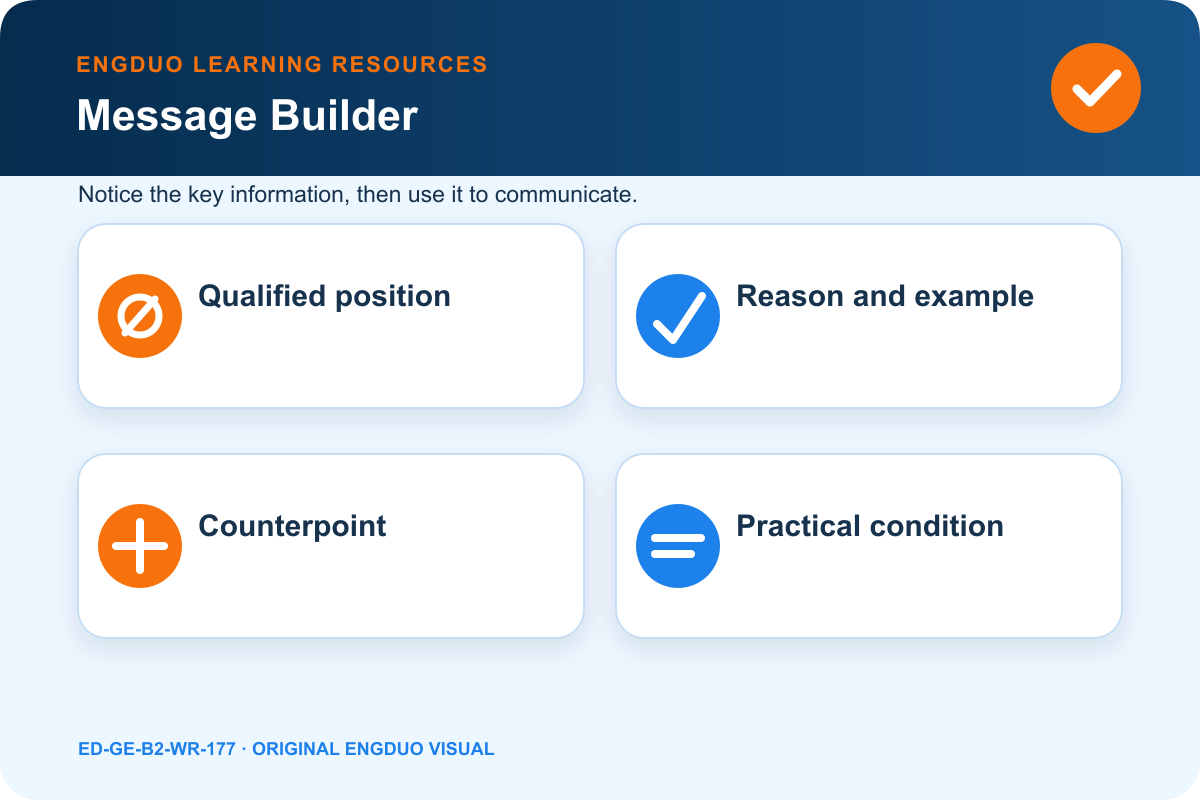
- qualified position
- reason and example
- counterpoint
- practical condition
Engduo Audio • American English
Transcript — open after listening
I would argue that the market should reduce amplified music after ten o’clock while continuing earlier live performances.
Engduo Audio • Australian English
Transcript — open after listening
Although some vendors may fear fewer visitors, a quieter final hour could protect residents without removing the tradition itself.
How to run Stage 1
Confirm the observable outcome and connect it to one realistic learner need.
2. Build useful language
Choose the phrases that help you complete the task; do not memorise a full script.
The strongest reason is ___.
A further consideration is ___.
Although critics may say ___, ___.
This does not mean ___.
The change should proceed only if ___.
How to run Stage 2
Use the visual and first audio or text for meaning before explaining language.
3. Rehearse with support
Practise the decisions, evidence, listening, or language moves that make the final task successful.
- Distinguish position from topic description.
- Combine although, despite, and however accurately.
- Remove repetition while preserving evidence.
How to run Stage 3
Select only the useful-language items needed for this learner and this task.
4. Complete the communication task
Exchange information, solve a problem, create a text, or reach a decision with a real outcome.
Plan a 180-word response about whether a fictional night market should reduce amplified music while preserving live performance.
How to run Stage 4
Run the supported rehearsal without reading every instruction aloud.
5. Perform, receive feedback, and retry
Complete the task with keywords only, receive focused feedback, and repeat the weakest part.
Write a 180–220 word opinion with a clear position, two developed reasons, one fair counterpoint, and one implementation condition; revise for cohesion and concision.
Retry: Repeat once with clearer meaning, stronger evidence, more accurate listening, or less support.
How to run Stage 5
Run the main task: Plan a 180-word response about whether a fictional night market should reduce amplified music while preserving live performance.
Exit check
Complete this without reading a model: Write a one-sentence position containing a qualification.
Success looks like: The reader can identify the position, support, counterpoint, and practical condition without unnecessary repetition.
Evidence: writing · Repeat the weakest part once after one meaning-focused and one language-focused correction at most.
WR · Writing Control
2: Produces reader-focused writing that completes the stated purpose.
1: Demonstrates the skill after one focused prompt, correction or self-repair.
0: Cannot yet demonstrate the skill clearly enough to complete the stated outcome.
LC · Language Control
2: Controls the target language well enough to keep meaning clear.
1: Demonstrates the skill after one focused prompt, correction or self-repair.
0: Cannot yet demonstrate the skill clearly enough to complete the stated outcome.
Use these scores after the independent attempt. Record one recurring need in the Engduo app when lesson-result fields become available.
How to run Stage 6
Record focused evidence, give one meaning-focused and one language-focused correction at most, repeat the weakest part, and complete the exit check.
คำอธิบายภาษาไทย — เปิดเมื่อจำเป็นเท่านั้น
เขียนความเห็นให้ชัดแต่ไม่สุดโต่ง มีเหตุผลที่พัฒนาแล้ว counterpoint ที่เป็นธรรม และเงื่อนไขนำไปใช้จริง ไม่เขียนวน
Teacher guide
30-minute must-do route
- Confirm the observable outcome and connect it to one realistic learner need.
- Use the visual and first audio or text for meaning before explaining language.
- Select only the useful-language items needed for this learner and this task.
- Run the supported rehearsal without reading every instruction aloud.
- Run the main task: Plan a 180-word response about whether a fictional night market should reduce amplified music while preserving live performance.
- Record focused evidence, give one meaning-focused and one language-focused correction at most, repeat the weakest part, and complete the exit check.
60-minute extension
- Revise the text for a council audience and reduce it by twenty percent without losing meaning.
- Change the role, information, listener, or constraint so the learner transfers the skill rather than repeating the same answer.
- Compare the first and second performance and record one specific improvement.
Make it easier
Use a four-part outline and one model connector per relationship.
Make it harder
Revise the text for a council audience and reduce it by twenty percent without losing meaning.
Likely difficulty
The learner may describe the topic, repeat the position, or use connectors without logical relationships.
Correction priority
Prioritise position, paragraph purpose, evidence, contrast, and concise reference.
Thai support rule
Keep the Thai panel closed unless examples, visuals, replay, reformulation, and simpler English do not allow progress. Explain only the key distinction, then return to English.
Progress record
Score WR, LC from 0–2 and record one recurring need from: qualified-position, contrast-connectors, cohesion.
Retry
Give one meaning-focused correction and one language-focused correction at most, then ask for a second attempt with fewer visible prompts.
Continue your learning path
- Council of Europe — CEFR Companion Volume — Supports action-oriented language learning through age- and level-appropriate interaction, descriptions, goal-oriented co-operation, written interaction, and observable communication outcomes.
- British Council LearnEnglish — Conditionals: zero, first and second — Supports the B1 first-conditional distinction between a realistic future condition and its probable result.
Content and media rights
© 2026 Engduo Thailand. Authorized Engduo use only. Copying, republishing, reselling, scraping, or reuse in another course, dataset, product, or AI system requires written permission except where applicable law permits.