Vocabulary Builder: Places Around Town
Review places around town
ทบทวนสถานที่รอบเมือง

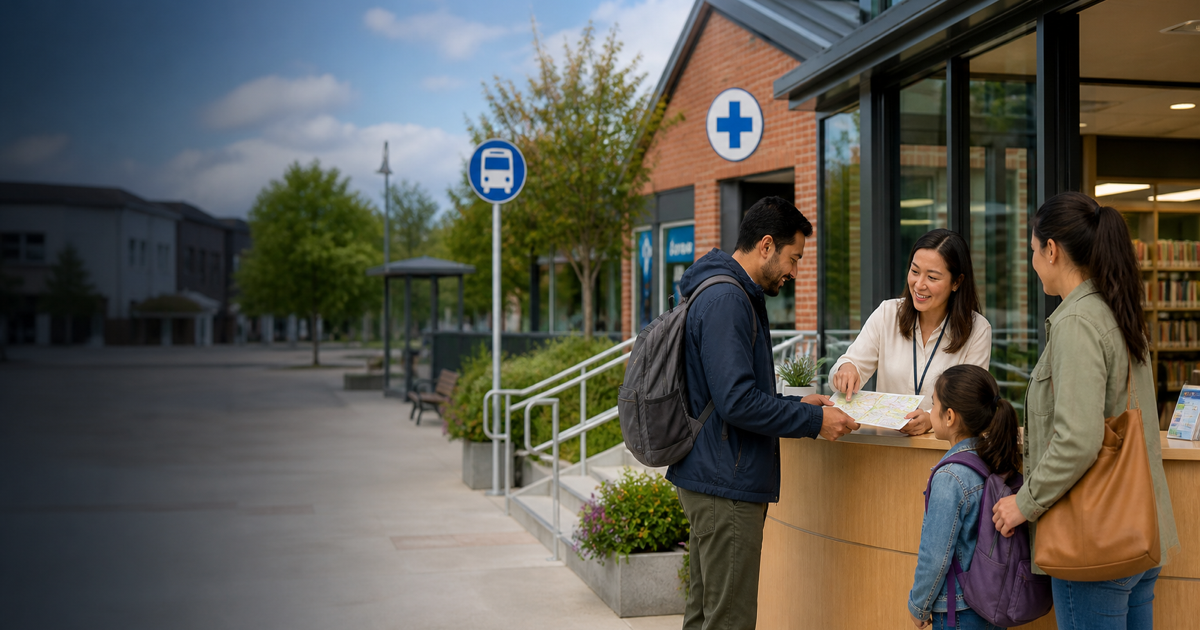
Build useful words for places, services and the people who help.
For learners: Learn the core words needed to find community services and ask the right person for help.
For teachers: Vocabulary is organised by place, person, service/action and description, then retrieved and combined in a visitor-help task.
สำหรับผู้เรียน: เรียนรู้คำหลักเพื่อค้นหาบริการในชุมชนและขอความช่วยเหลือจากคนที่เหมาะสม
สำหรับครู: จัดคำศัพท์เป็นสถานที่ คน บริการหรือการกระทำ และคำบรรยาย ก่อนดึงคำจากความจำและรวมใช้ในงานช่วยผู้มาเยือน
Name common community places, services and people, then say where to go and who can help with one familiar need.
เรียกชื่อสถานที่ บริการ และคนในชุมชนที่พบบ่อย แล้วบอกได้ว่าควรไปที่ไหนและใครช่วยความต้องการง่าย ๆ ได้
For the learner: These words help you find everyday public services and ask the right person for help.
For the teacher: The lesson separates places, people, services/actions and descriptions, then requires original use from every group before the final visitor task.
เหตุผลภาษาไทย: ผู้เรียนจัดคำศัพท์ตามหน้าที่ของคำ ฝึกใช้แต่ละหมวดในประโยค แล้วจึงรวมคำเพื่อแนะนำความช่วยเหลือในชุมชน
Teach a small working set by word function. Make the learner use every group in an original sentence before combining the groups in the final visitor-help task.
| Time | Teacher does | Student does | Evidence |
|---|---|---|---|
| 0–3 | Shows the cover and asks one simple need question. | Chooses a need and names any known place. | A relevant place or need. |
| 3–8 | Organises words by place, person, service and description. | Says a small working set and makes four short sentences. | Accurate word groups. |
| 8–12 | Plays two short service examples. | Identifies place, person, need and service. | Eight heard details. |
| 12–16 | Hides the table and prompts retrieval. | Recalls at least ten target items. | Independent recall. |
| 16–21 | Models one place-person-service chain. | Builds six original need-and-help sentences. | Meaningful vocabulary use. |
| 21–26 | Runs a visitor-help card task. | Recommends a place and helper, then swaps roles. | Connected mini-dialogue. |
| 26–30 | Changes one service detail and scores. | Performs and retries without a script. | VR/FP evidence. |
borrow a book · see a nurse · catch a bus · ask about a class · report a lost bag · relax outside
library · clinic · bus stop · community centre · police station · park
Accept one sensible connection. Do not explain every word yet; establish meaning with the cover and simple gestures.
| Word group | Target language | Use it in a sentence |
|---|---|---|
| Nouns · places | library, clinic, bus stop, community centre, police station, park | The clinic is near the park. |
| Nouns · people | librarian, nurse, bus driver, police officer, community worker, volunteer | A librarian helps people find books. |
| Nouns · services | books, health care, transport, information, safety, activities | The centre has activities for families. |
| Verbs · actions | borrow, visit, catch, ask, report, join | You can borrow a book here. |
| Adjectives · descriptions | open, closed, free, nearby, busy, safe | The library is open and free. |
Make the word job visible: nouns name places, people and services; verbs show actions; adjectives describe. Correct only the selected working set, then require immediate reuse.
Maya needs a quiet place to read and borrow a book. She goes to the library. The librarian shows her the children’s section. The library is open, free and not busy this morning.
Tom feels unwell and needs health care. He visits the clinic near the bus stop. A nurse asks about his problem and gives him information. The clinic is busy, but it is open.
Play each track once for meaning and once for checking. Keep the transcript closed until the learner has attempted need, place, person and service.
Give the word group, a place gesture or a first sound before giving an answer. Hide the support again after recall.
I need to ___.
I can go to the ___.
It is ___ and ___.
A ___ can help me.
I can ___ there.
The place has ___.
Require original content. Give one word-choice correction and one sentence-pattern correction at most, then ask for the corrected sentence again.
A: I want a free family activity. · B: I lost my bag. · C: I need a bus downtown. · D: My child feels unwell.
Allow a keyword list during planning but no full script. Prompt with the missing word group, not a complete sentence.
A visitor needs information about a free weekend activity and later needs to catch a bus home.
Score the first unsupported performance, then score the focused retry separately.
Target: 3/4 overall with FP = 2 and no zero.
Score the unsupported advice before feedback. Give one vocabulary and one sentence correction at most, then rerun only the weak section.
เริ่มจากสถานที่และความต้องการใกล้ตัว แยกคำเป็นสถานที่ คน บริการหรือการกระทำ และคำบรรยาย ให้ผู้เรียนแต่งประโยคจากแต่ละหมวดก่อน แล้วค่อยรวมเป็นคำแนะนำแก่ผู้มาเยือน
Review places around town
ทบทวนสถานที่รอบเมือง
Hear a place and purpose
ฟังเพื่อหาสถานที่และจุดประสงค์
Choose a community idea together
เลือกแนวคิดชุมชนร่วมกัน
Choose an innovation for the community
เลือกนวัตกรรมสำหรับชุมชน