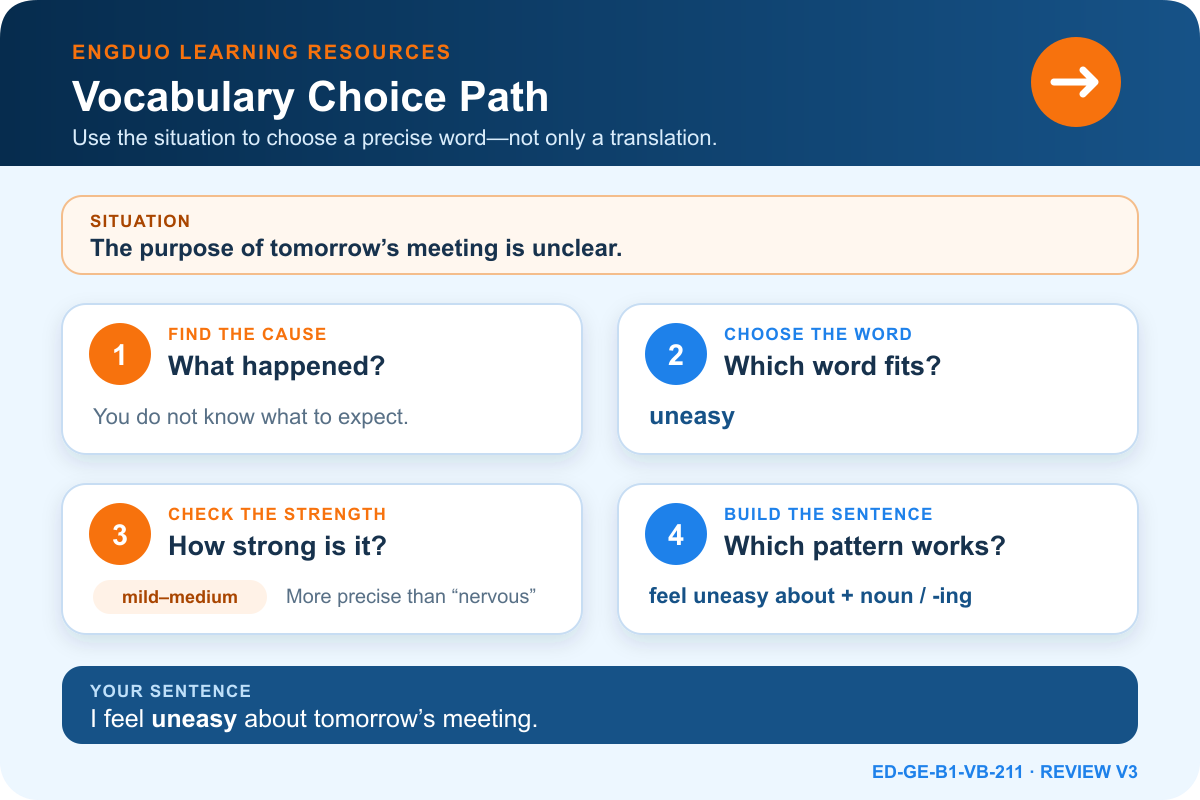
uneasy
Slightly worried or uncomfortable because something is uncertain or does not feel right.
feel uneasy about + noun / -ing
I felt uneasy about changing the plan without telling the team.

Vocabulary Builder · B1
Move beyond “happy”, “sad”, and “nervous” by choosing a word that matches the cause and strength of the feeling.
For learners: Help learners choose feeling words that match cause and intensity, then use them accurately in personal communication.
For teachers: The lesson contrasts meaning, strength, and sentence pattern, adds retrieval and listening checks, then ends with an independent personal story and retry.
สำหรับผู้เรียน: ช่วยให้ผู้เรียนเลือกคำบอกความรู้สึกให้ตรงกับสาเหตุและระดับอารมณ์ แล้วใช้ได้แม่นยำในการสื่อสารส่วนตัว
สำหรับครู: บทเรียนเปรียบเทียบความหมาย ระดับ และรูปแบบประโยค เพิ่มการเรียกคืนคำและการฟังตรวจสอบ แล้วจบด้วยเรื่องส่วนตัวแบบอิสระและการลองใหม่
By the end of this lesson, you can choose a precise feeling word and describe its cause, intensity, and change in your own sentences.
เมื่อจบบทเรียน นักเรียนจะเลือกคำบอกความรู้สึกที่ตรงกับสถานการณ์และระดับความรู้สึก พร้อมอธิบายสาเหตุและการเปลี่ยนแปลงด้วยประโยคของตัวเองได้
Choosing a feeling word by cause, intensity, and sentence pattern prevents vague or misleading descriptions. The result is more precise personal storytelling and more appropriate responses to other people.
Follow this choice path: What caused the feeling? Which word fits that cause? How strong was it? Which sentence pattern does the word normally use?
Notice all eight words, then choose two or three to use actively in your speaking task. Each card separates strength from function; the situation, tone, and supporting detail can make a feeling stronger or weaker.
Slightly worried or uncomfortable because something is uncertain or does not feel right.
feel uneasy about + noun / -ing
I felt uneasy about changing the plan without telling the team.
Unable to relax because you expect pressure, difficulty, or conflict.
feel tense before / during + event
Everyone felt tense before the client joined the call.
Relaxed and happier because a worry, danger, or difficult situation has ended.
feel relieved when / that …
I felt relieved when I heard that the deadline had moved.
Less worried because someone gave you useful information, support, or confirmation.
feel reassured by + person / information
The manager’s explanation made me feel reassured.
Slow or uncertain about speaking, acting, or making a decision.
feel hesitant about + noun / -ing
I felt hesitant about accepting the new responsibility.
Annoyed because a problem, delay, or repeated failure prevents progress.
feel frustrated with / by + noun
I was frustrated by the repeated changes.
Unhappy because the result was worse than you expected or hoped.
feel disappointed with / by / that …
We were disappointed that the event was cancelled.
Feeling that there is too much to manage, understand, or deal with.
feel overwhelmed by + amount / situation
She felt overwhelmed by the number of urgent tasks.
| Broad word | More precise choice | Use it when … |
|---|---|---|
| nervous | uneasy / tense | Uneasy focuses on uncertainty; tense focuses on pressure and difficulty relaxing. |
| upset | frustrated / disappointed | Frustrated follows blocked progress; disappointed follows an unmet expectation. |
| happy | relieved / reassured | Relieved follows the end of a worry; reassured follows information or support that reduces worry. |
-ed describes how a person feels: “I felt reassured.”
-ing describes the thing that causes the feeling: “The explanation was reassuring.”
I felt uneasy before the meeting because the purpose wasn’t clear. I was relieved when the manager explained that it was only a progress check.
A strong sentence does more than name the feeling. Add its cause, strength, or change.
Choose and use a precise feeling word without a model. Your teacher can then give one focused correction before you try again.
Task: Describe how you feel about one current plan without using happy, sad, good, bad, or nervous. Add a cause and one detail that shows the intensity.
Success: The chosen word matches the situation, its strength, and its normal sentence pattern.
1 Word does not yet match the cause or pattern.
2 Word fits with a prompt or visible choices.
3 Word fits the cause, strength, and pattern independently.
1 Names a feeling, but the situation or intended meaning is not yet clear.
2 Describes the situation and feeling, but needs a prompt to add the cause or change.
3 Clearly describes the situation, cause, and feeling or change using a target word.
อย่าจำเพียงคำแปลภาษาไทย ให้เลือกคำจาก “สาเหตุ” และ “ระดับความรู้สึก” เช่น uneasy เน้นความไม่แน่ใจหรือรู้สึกว่ามีบางอย่างไม่ถูกต้อง ส่วน tense เน้นความกดดันจนผ่อนคลายไม่ได้ relieved ใช้เมื่อความกังวลสิ้นสุดลง และ reassured ใช้เมื่อข้อมูลหรือการยืนยันช่วยให้กังวลน้อยลง
Use precise feelings in an empathetic response
ใช้คำบอกความรู้สึกในการตอบอย่างเข้าใจ
© 2026 Engduo Thailand. This lesson and its original instructional design, text, visuals, and prepared audio are for authorized Engduo use. Do not copy, download, republish, sell, scrape, or use any part in another course, website, dataset, product, or AI system without written permission, except where applicable law permits.