
She strongly supports ___.

Different Views on Tradition
Recognise how speakers express support, reservation, concern, and qualified agreement when discussing whether a tradition should change.
Your goal
By the end of this lesson, you can track three speakers’ positions on a tradition, identify common ground, and summarise the unresolved issue..
Why this listening matters
Train the learner to understand the situation, collect useful spoken evidence and respond without depending on a transcript. The transcript stays closed until after the first listening attempt.
TF26 · Culture, Traditions & HistoryProgress Focus
Progress focus: LISTCM
Use the final independent attempt to apply the 0–2 scoring guide consistently.
30-minute lesson route
- Confirm the observable outcome and connect it to one realistic learner need.
- Use the visual and first audio or text for meaning before explaining language.
- Select only the useful-language items needed for this learner and this task.
- Run the supported rehearsal without reading every instruction aloud.
- Run the main task: Listen to an original discussion about moving a river festival away from its traditional date. Map three viewpoints and the common ground.
- Record focused evidence, give one meaning-focused and one language-focused correction at most, repeat the weakest part, and complete the exit check.
Engduo Audio: Licensed voices prepared for this lesson. Audio never starts automatically. Use the transcript after the first listening attempt.
1. Listen for the situation
Look at the visual, keep the transcript closed and listen once for the speaker, situation and main purpose.
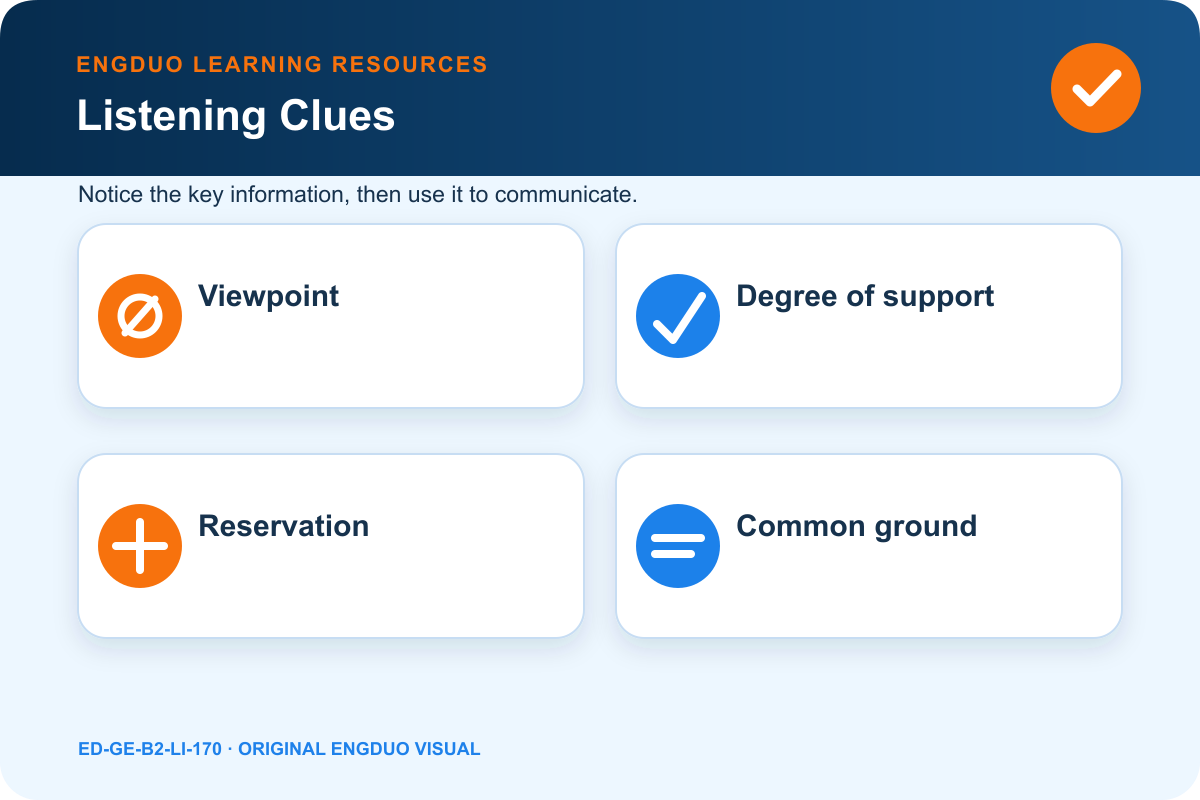
- viewpoint
- degree of support
- reservation
- common ground
Engduo Audio • Australian English
Transcript — open after listening
Mali strongly supports keeping the original date because it connects the festival to the harvest. Arun accepts that link but questions whether the current weather risk can be ignored.
Engduo Audio • Indian English
Transcript — open after listening
Nok is more cautious than the others. She supports a change only if community elders help choose the new date.
Teacher Help · Stage 1
Keep the transcript closed. Set one gist question, play the audio once without pausing and accept a short answer before discussing details.
2. Build a listening map
Identify the meaning categories or signal phrases that will help you recognise the important information.
He accepts ___ but questions ___.
Her main reservation is ___.
They partly agree that ___.
The tone becomes more cautious when ___.
Their shared position is ___.
Teacher Help · Stage 2
Preview only the categories or signal words needed for the task. Do not explain every line or reveal the answers.
3. Listen again and collect evidence
Replay only as needed. Record the exact details that support each answer, then compare before opening the transcript.
- Match stance phrases to strong, qualified, and cautious positions.
- Listen for stress and intonation that signal contrast.
- Summarise two positions without making them sound identical.
Teacher Help · Stage 3
Play again at natural speed. Ask what exact word, number, reason or change supports each answer; replay only an uncertain section.
4. Complete the listening task
Use the spoken evidence to choose, organise, clarify or respond to the real communication need in this lesson.
Listen to an original discussion about moving a river festival away from its traditional date. Map three viewpoints and the common ground.
Teacher Help · Stage 4
Require the learner to use the collected evidence to complete the lesson outcome. Prompt for clarification only when meaning breaks down.
5. Final practice: Listen and respond independently
Complete a fresh or less-supported listening attempt, give the required response and retry the weakest detail after one focused prompt.
Listen once to a new discussion, report each speaker’s position and degree of certainty, identify two reservations, and summarise one shared conclusion.
Retry: Repeat once with clearer meaning, stronger evidence, more accurate listening, or less support.
Teacher Help · Stage 5
Use a fresh item or remove visible support. Observe without interrupting, give one listening-focused correction and ask for a short retry.
Exit check
Complete this without reading a model: Contrast two speakers in one accurate sentence using whereas.
Success looks like: The summary preserves both the content and strength of each speaker’s stance.
Evidence: listening · Repeat the weakest part once after one meaning-focused and one language-focused correction at most.
LIST · Listening Comprehension
2: Understands and uses the required spoken evidence accurately.
1: Demonstrates the skill after one focused prompt, correction or self-repair.
0: Cannot yet demonstrate the skill clearly enough to complete the stated outcome.
CM · Communication Management
2: Organises ideas, turns, clarification and response coherently.
1: Demonstrates the skill after one focused prompt, correction or self-repair.
0: Cannot yet demonstrate the skill clearly enough to complete the stated outcome.
Use these scores after the independent attempt. Give one specific success note and choose one next practice focus.
Teacher Help · Stage 6
Score the stated Progress Focus from the independent attempt. Name one successful listening behaviour and one precise next practice focus.
คำอธิบายภาษาไทย — เปิดเมื่อจำเป็นเท่านั้น
จับทั้งเนื้อหาและระดับท่าที เช่น strongly supports, partly agrees, has reservations อย่าสรุปทุกคนเป็นเห็นด้วยหรือไม่เห็นด้วยเหมือนกัน
Teacher Guidance · How to conduct this class
30-minute must-do route
- Confirm the observable outcome and connect it to one realistic learner need.
- Use the visual and first audio or text for meaning before explaining language.
- Select only the useful-language items needed for this learner and this task.
- Run the supported rehearsal without reading every instruction aloud.
- Run the main task: Listen to an original discussion about moving a river festival away from its traditional date. Map three viewpoints and the common ground.
- Record focused evidence, give one meaning-focused and one language-focused correction at most, repeat the weakest part, and complete the exit check.
60-minute extension
- Infer a change in stance after one speaker receives new information.
- Change the role, information, listener, or constraint so the learner transfers the skill rather than repeating the same answer.
- Compare the first and second performance and record one specific improvement.
Make it easier
Choose each stance from a strength scale while listening.
Make it harder
Infer a change in stance after one speaker receives new information.
Likely difficulty
The learner may hear topic words but miss qualification and degree of agreement.
Correction priority
Prioritise stance markers, contrastive stress, reservation, and faithful summary.
Thai support rule
Keep the Thai panel closed unless examples, visuals, replay, reformulation, and simpler English do not allow progress. Explain only the key distinction, then return to English.
Progress record
Use the 0–2 guide after the independent attempt and identify one recurring need for the next lesson.
Retry
Give one meaning-focused correction and one language-focused correction at most, then ask for a second attempt with fewer visible prompts.
- Council of Europe — CEFR Companion Volume — Supports action-oriented language learning through age- and level-appropriate interaction, descriptions, goal-oriented co-operation, written interaction, and observable communication outcomes.
- British Council TeachingEnglish — English sentence stress — Supports listening for prominent meaning words and using sentence stress to communicate contrast and meaning.
Content and media rights
© 2026 Engduo Thailand. Authorized Engduo use only. Copying, republishing, reselling, scraping, or reuse in another course, dataset, product, or AI system requires written permission except where applicable law permits.