
Select useful words and connect them to a situation.

Vocabulary Builder · B1–B2
Everyday Collocations and Phrasal Verbs
Build more natural speech by learning words in useful combinations, checking particle meaning and separability, and transferring each phrase to a new situation.
Your goal
By the end of this lesson, you can use high-value everyday collocations and phrasal verbs accurately in original spoken situations.
Why these words matter
Use this vocabulary to move from naming the topic to explaining, comparing, choosing, or solving a real communication need. Learn the words in useful chunks, then use them in your own message.
TF30 · Language Systems & Word SkillsTF30 · Language Systems & Word SkillsProgress focusVRFP
VR · Vocabulary RangeChoose suitable target words or chunks and use them naturally in an original message.
FP · Functional PerformanceComplete the lesson’s real communication outcome with less support.
Lesson structure · Progress path and 30-minute route
Listen, notice and make short personal examples.
Use the vocabulary to complete a real communication task.
3 minSet the goal
7 minBuild words
5 minListen & notice
6 minSupported use
5 minCommunicate
4 minFinal & retry
Teacher Lesson Plan · Read before class
Teacher Guidance · How to conduct this class
30-minute must-do route
- Confirm the observable outcome and connect it to one realistic learner need.
- Use the visual and first audio or text for meaning before explaining language.
- Select only the useful-language items needed for this learner and this task.
- Run the supported rehearsal without reading every instruction aloud.
- Run the main task: Solve a fictional busy-week problem using a schedule, unfinished tasks, and one disagreement. Use target chunks to describe priorities and actions.
- Record focused evidence, give one meaning-focused and one language-focused correction at most, repeat the weakest part, and complete the exit check.
60-minute extension
- Retell the update with different subjects, tenses, and object positions while keeping every chunk natural.
- Change the role, information, listener, or constraint so the learner transfers the skill rather than repeating the same answer.
- Compare the first and second performance and record one specific improvement.
Make it easier
Use six chunk families and complete short context gaps before speaking.
Make it harder
Retell the update with different subjects, tenses, and object positions while keeping every chunk natural.
Likely difficulty
The learner may translate particles literally, mix make and do, or repeat memorised examples without transfer.
Correction priority
Correct collocation and object placement first, then pronunciation and register.
Thai support rule
Keep the Thai panel closed unless examples, visuals, replay, reformulation, and simpler English do not allow progress. Explain only the key distinction, then return to English.
Progress record
Score VR, FP from 0–2 and record one recurring need from: natural-chunks, transfer, object-placement.
Retry
Give one meaning-focused correction and one language-focused correction at most, then ask for a second attempt with fewer visible prompts.
Engduo Audio: Licensed voices prepared for this lesson. Audio never starts automatically. Use the transcript after the first listening attempt.
1. Build the useful words and chunks
Study the target language as useful words and chunks. Choose the items needed for this lesson goal and make one short personal example.
make progress / make a decision
take responsibility / take a break
deal with / figure out
put off / carry on
run out of / catch up on
bring up / sort out
How to run Stage 1
Model one word or chunk in a complete sentence. Ask the learner to choose only the items needed for today, explain the meaning and make a true example. Do not turn the whole language bank into reading practice.
2. Listen and connect the words to a situation
Look at the visual and listen before opening the transcript. Identify the situation and the words or clues that carry the meaning.
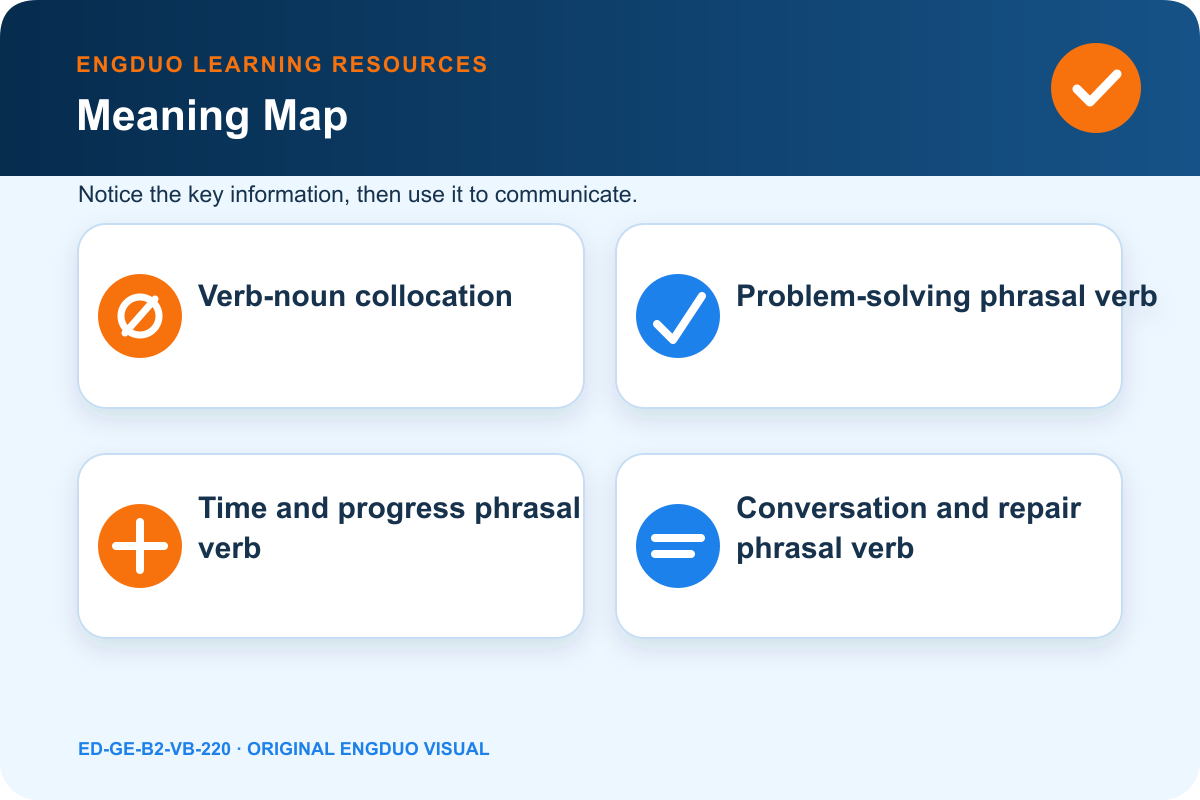
- verb-noun collocation
- problem-solving phrasal verb
- time and progress phrasal verb
- conversation and repair phrasal verb
Engduo Audio • British English
Transcript — open after listening
We ran out of time on Tuesday, so we put off the review and carried on with the urgent work.
Engduo Audio • American English
Transcript — open after listening
I brought up the scheduling problem, and the team helped me sort it out. We made a decision and took responsibility for the delay.
How to run Stage 2
Use the visual before the transcript. Play each recording once, ask which word or clue carried the meaning, then replay once to confirm. The learner should explain the clue instead of guessing.
3. Use the vocabulary with support
Complete the supported task. Use the frame only while it helps, then make short, true examples instead of reading a list aloud.
- Build collocation families instead of memorising isolated verbs.
- Choose literal or idiomatic meanings from original contexts.
- Check whether an object can separate the verb and particle, then create a new example.
How to run Stage 3
Demonstrate one supported example, then give the learner thinking time. Keep the frame visible only while it is needed and ask for a personal or situation-specific example.
4. Use the vocabulary to communicate
Exchange information, explain a choice, compare options, or solve the real communication need in this lesson.
Solve a fictional busy-week problem using a schedule, unfinished tasks, and one disagreement. Use target chunks to describe priorities and actions.
How to run Stage 4
Take the partner role and run the communication task without correcting every sentence. Ask one natural follow-up, switch roles when useful, and save the main correction until the round ends.
Final practice: Use the vocabulary independently
Complete the final task with keywords only. Receive one focused correction, then repeat the weakest part with less support.
Give a two-minute spoken update using at least ten target collocations or phrasal verbs and answer two follow-up questions in new contexts.
Retry: Repeat once with clearer meaning, stronger evidence, more accurate listening, or less support.
How to run Stage 5
Remove full-sentence models. Let the learner complete the independent task first, score VR and FP from the evidence, give one focused correction, and ask for one shorter retry.
Exit check
Complete this without reading a model: Use one collocation and one phrasal verb in two true or realistic original sentences.
Success looks like: Target chunks are accurate, natural in context, and transferred beyond the model examples.
Evidence: speaking · Repeat the weakest part once after one meaning-focused and one language-focused correction at most.
Teacher scoring guide
Score the independent final attempt—not the supported practice.
VR · Vocabulary Range
0 · Not yet Relies mainly on teacher-supplied words or cannot yet choose vocabulary that fits the meaning.
1 · With support Uses some suitable target words after one prompt, model, or focused correction.
2 · Independent Chooses and uses a useful range of target words naturally in an original message.
FP · Functional Performance
0 · Not yet Cannot yet complete the stated communication outcome clearly enough for the listener.
1 · With support Completes the outcome after one clear prompt, repair, or supplied frame.
2 · Independent Completes the real communication outcome clearly without a model or supplied key sentence.
How to run the Exit check
Record focused evidence, give one meaning-focused and one language-focused correction at most, repeat the weakest part, and complete the exit check.
คำอธิบายภาษาไทย — เปิดเมื่อจำเป็นเท่านั้น
เรียนเป็นกลุ่มคำ ไม่แปลทีละคำ และตรวจว่า phrasal verb แยกกรรมได้หรือไม่ จากนั้นต้องแต่งประโยคใหม่ของตัวเอง
Continue your learning path
- Council of Europe — CEFR Companion Volume — Supports action-oriented language learning through age- and level-appropriate interaction, descriptions, goal-oriented co-operation, written interaction, and observable communication outcomes.
- British Council LearnEnglish — B1–B2 vocabulary — Supports topic-based intermediate vocabulary learning that develops meaning, pronunciation, spelling, recall, and confident communication.
Content and media rights
© 2026 Engduo Thailand. Authorized Engduo use only. Copying, republishing, reselling, scraping, or reuse in another course, dataset, product, or AI system requires written permission except where applicable law permits.