
The event aims to ___.
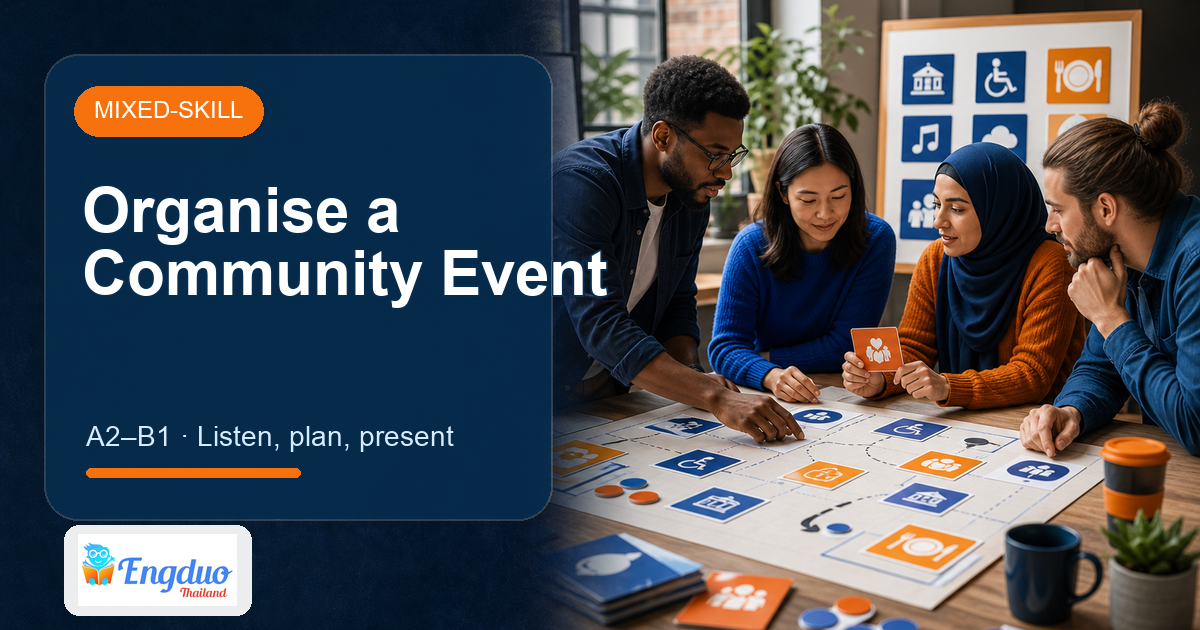
Organise a Community Event
Combine listening, reading, discussion, planning, and presentation to organise an inclusive fictional community event within real constraints.
Your goal
By the end of this lesson, you can interpret needs, discuss options, and publish a final plan.
Why this mixed-skill lesson matters
Combine listening, speaking, reading or writing to complete one meaningful outcome. Each activity supplies evidence or language for the final task rather than testing isolated skills.
TF08 · Town, Directions & CommunityProgress Focus
Progress focus: FPCMLIST
Use the final independent attempt to apply the 0–2 scoring guide consistently.
30-minute lesson route
- Confirm the observable outcome and connect it to one realistic learner need.
- Use the visual and first audio or text for meaning before explaining language.
- Select only the useful-language items needed for this learner and this task.
- Run the supported rehearsal without reading every instruction aloud.
- Run the main task: Plan a fictional three-hour community event from a venue notice, four character messages, an activity menu, a thirty-point play budget, and two disruption cards.
- Record focused evidence, give one meaning-focused and one language-focused correction at most, repeat the weakest part, and complete the exit check.
Engduo Audio: Licensed voices prepared for this lesson. Audio never starts automatically. Use the transcript after the first listening attempt.
1. Understand the challenge
Use the visual and input to identify the situation, the information available and the final outcome.
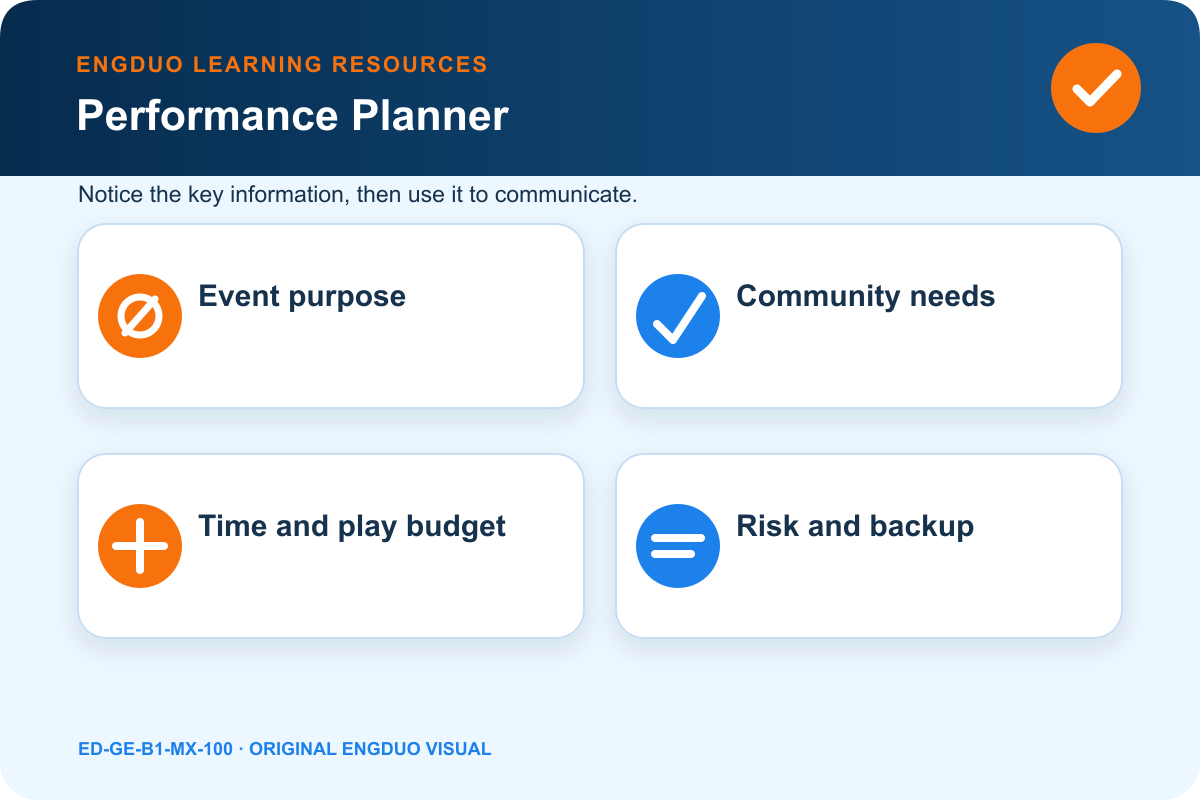
- event purpose
- community needs
- time and play budget
- risk and backup
Engduo Audio • British English
Transcript — open after listening
The event aims to help neighbours meet each other. According to the notice, the hall is available from one until four.
Engduo Audio • American English
Transcript — open after listening
We chose two short activities and a quiet drop-in table because the messages show different energy and access needs. If the outdoor area closes, our backup is the second room.
Teacher Help · Stage 1
Explain the final outcome first. Use the visual or input to show what information the learner must collect, not every answer.
2. Build the language and strategy
Choose the language, evidence and task strategy needed to complete the challenge successfully.
According to the notice, ___.
One group needs ___.
Our priority is ___.
We chose ___ because ___.
If ___ happens, our backup plan is ___.
Teacher Help · Stage 2
Choose only the language and strategy that unlock the task. Connect each item to where the learner will use it later.
3. Practise the parts with support
Practise the most difficult listening, speaking, reading or writing step before combining the skills.
- Extract constraints from the notice and voice messages.
- Rank needs before choosing activities.
- Use a planning grid to test time, accessibility, and play-budget fit.
Teacher Help · Stage 3
Isolate the hardest sub-skill and rehearse it briefly. Keep the support visible, then reduce it before the main challenge.
4. Complete the integrated task
Use information from more than one skill to solve, create, decide, present or communicate a real outcome.
Plan a fictional three-hour community event from a venue notice, four character messages, an activity menu, a thirty-point play budget, and two disruption cards.
Teacher Help · Stage 4
Run the full challenge and require evidence from the earlier input. Let the learner organise the response before correcting form.
5. Final practice: Combine the skills independently
Complete the final outcome with less support, receive focused feedback and repeat the weakest part.
Present the plan for three minutes, answer four stakeholder questions, receive focused feedback, and revise one weak decision.
Retry: Repeat once with clearer meaning, stronger evidence, more accurate listening, or less support.
Teacher Help · Stage 5
Remove unnecessary support. Observe the whole performance, give one outcome correction and one language correction, then retry the weakest part.
Exit check
Complete this without reading a model: Produce and defend a complete event plan that meets the purpose, responds to three stated needs, fits the constraints, and includes a backup.
Success looks like: The final plan is internally consistent, evidence-based, understandable to stakeholders, and improved after feedback.
Evidence: mixed · Repeat the weakest part once after one meaning-focused and one language-focused correction at most.
FP · Functional Performance
2: Completes the real communication outcome independently.
1: Demonstrates the skill after one focused prompt, correction or self-repair.
0: Cannot yet demonstrate the skill clearly enough to complete the stated outcome.
CM · Communication Management
2: Organises ideas, turns, clarification and response coherently.
1: Demonstrates the skill after one focused prompt, correction or self-repair.
0: Cannot yet demonstrate the skill clearly enough to complete the stated outcome.
LIST · Listening Comprehension
2: Understands and uses the required spoken evidence accurately.
1: Demonstrates the skill after one focused prompt, correction or self-repair.
0: Cannot yet demonstrate the skill clearly enough to complete the stated outcome.
Use these scores after the independent attempt. Give one specific success note and choose one next practice focus.
Teacher Help · Stage 6
Score the stated Progress Focus from the final performance. Name the strongest combined-skill behaviour and one next practice focus.
คำอธิบายภาษาไทย — เปิดเมื่อจำเป็นเท่านั้น
ข้อมูลและงบเป็นสถานการณ์สมมติทั้งหมด ให้ดึง constraint จากเอกสารและเสียงก่อนเลือกกิจกรรม จุดสำคัญคืออธิบายเหตุผลและปรับแผนเมื่อมีข้อมูลใหม่
Teacher Guidance · How to conduct this class
30-minute must-do route
- Confirm the observable outcome and connect it to one realistic learner need.
- Use the visual and first audio or text for meaning before explaining language.
- Select only the useful-language items needed for this learner and this task.
- Run the supported rehearsal without reading every instruction aloud.
- Run the main task: Plan a fictional three-hour community event from a venue notice, four character messages, an activity menu, a thirty-point play budget, and two disruption cards.
- Record focused evidence, give one meaning-focused and one language-focused correction at most, repeat the weakest part, and complete the exit check.
60-minute extension
- Add a late venue restriction and require a revised schedule without losing the event purpose.
- Change the role, information, listener, or constraint so the learner transfers the skill rather than repeating the same answer.
- Compare the first and second performance and record one specific improvement.
Make it easier
Use two stakeholder cards, a twenty-point budget, and one fixed venue.
Make it harder
Add a late venue restriction and require a revised schedule without losing the event purpose.
Likely difficulty
The learner may choose appealing activities before checking purpose, timing, participation needs, or budget.
Correction priority
Prioritise evidence-to-decision links, clear organisation, and responsive revision.
Thai support rule
Keep the Thai panel closed unless examples, visuals, replay, reformulation, and simpler English do not allow progress. Explain only the key distinction, then return to English.
Progress record
Use the 0–2 guide after the independent attempt and identify one recurring need for the next lesson.
Retry
Give one meaning-focused correction and one language-focused correction at most, then ask for a second attempt with fewer visible prompts.
- Council of Europe — CEFR Companion Volume — Supports B1 communication through connected speech, descriptions of experiences, opinions with reasons, travel situations, goal-oriented co-operation, written interaction, and action-oriented outcomes.
Content and media rights
© 2026 Engduo Thailand. Authorized Engduo use only. Copying, republishing, reselling, scraping, or reuse in another course, dataset, product, or AI system requires written permission except where applicable law permits.