
This is a ___ intended to ___.
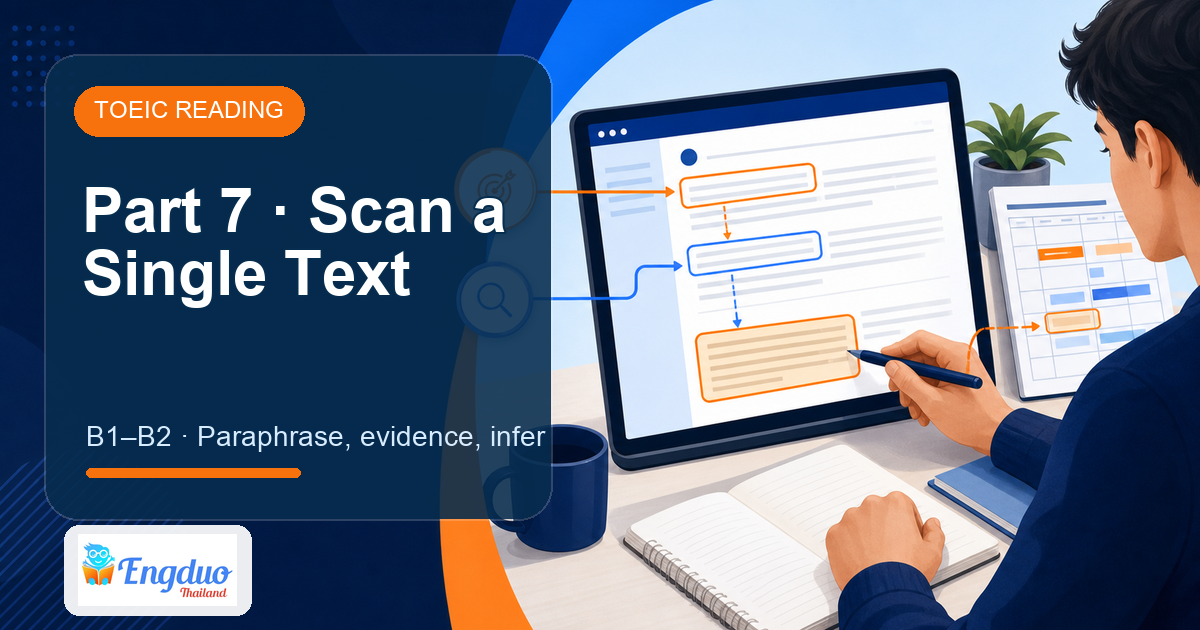
Part 7: Scan a Single Text
Scan one original workplace text efficiently by identifying genre, purpose, target information, paraphrase, and exact evidence while rejecting nearby distractors.
Your goal
By the end of this lesson, you can locate evidence and distinguish nearby distractors.
Progress focus: STRATLISTREAD
Engduo Audio: Licensed voices prepared for this lesson. Audio never starts automatically. Use the transcript after the first listening attempt.
1. Look, listen, and notice
Use the visual and model audio to understand the situation, viewpoint, or communication problem before studying the language.
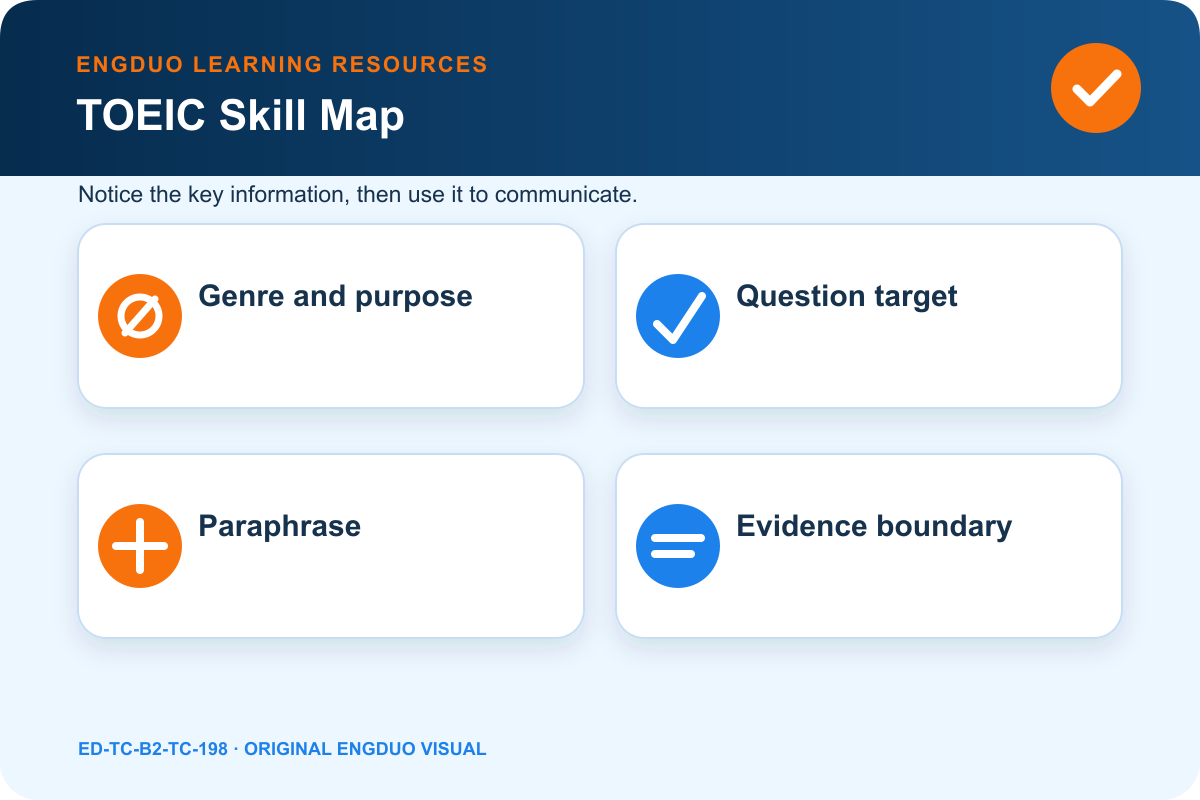
- genre and purpose
- question target
- paraphrase
- evidence boundary
Engduo Audio • Australian English
Transcript — open after listening
The maintenance team will inspect the third-floor meeting rooms on Wednesday. Staff should remove personal equipment by Tuesday evening.
Engduo Audio • Indian English
Transcript — open after listening
Members who renew before 15 September will keep their current rate for another year. New workshop fees are listed separately.
How to run Stage 1
Confirm the observable outcome and connect it to one realistic learner need.
2. Build useful language
Choose the phrases that help you complete the task; do not memorise a full script.
The question asks for ___.
The text paraphrases it as ___.
The exact evidence is ___.
The nearby detail refers to ___.
The writer implies ___ because ___.
How to run Stage 2
Use the visual and first audio or text for meaning before explaining language.
3. Rehearse with support
Practise the decisions, evidence, listening, or language moves that make the final task successful.
- Preview questions and predict answer type.
- Scan for names, dates, actions, and paraphrased ideas.
- Mark why a nearby detail does not answer the question.
How to run Stage 3
Select only the useful-language items needed for this learner and this task.
4. Complete the communication task
Exchange information, solve a problem, create a text, or reach a decision with a real outcome.
Read an original email, schedule, and policy notice. Locate evidence for purpose, detail, vocabulary-in-context, and inference questions.
How to run Stage 4
Run the supported rehearsal without reading every instruction aloud.
5. Perform, receive feedback, and retry
Complete the task with keywords only, receive focused feedback, and repeat the weakest part.
Complete a timed original single-text set, cite the evidence line for every answer, and explain two distractors that are true but irrelevant.
Retry: Repeat once with clearer meaning, stronger evidence, more accurate listening, or less support.
How to run Stage 5
Run the main task: Read an original email, schedule, and policy notice. Locate evidence for purpose, detail, vocabulary-in-context, and inference questions.
Exit check
Complete this without reading a model: Answer one inference question and state the evidence boundary.
Success looks like: The learner finds and interprets relevant evidence without confusing adjacent true information with the answer.
Evidence: mixed · Repeat the weakest part once after one meaning-focused and one language-focused correction at most.
STRAT · Task Strategy
2: Uses an efficient task strategy and supports decisions with evidence.
1: Demonstrates the skill after one focused prompt, correction or self-repair.
0: Cannot yet demonstrate the skill clearly enough to complete the stated outcome.
LIST · Listening Comprehension
2: Understands and uses the required spoken evidence accurately.
1: Demonstrates the skill after one focused prompt, correction or self-repair.
0: Cannot yet demonstrate the skill clearly enough to complete the stated outcome.
READ · Reading Comprehension
2: Finds and interprets the required written evidence accurately.
1: Demonstrates the skill after one focused prompt, correction or self-repair.
0: Cannot yet demonstrate the skill clearly enough to complete the stated outcome.
Use these scores after the independent attempt. Record one recurring need in the Engduo app when lesson-result fields become available.
How to run Stage 6
Record focused evidence, give one meaning-focused and one language-focused correction at most, repeat the weakest part, and complete the exit check.
คำอธิบายภาษาไทย — เปิดเมื่อจำเป็นเท่านั้น
ดู genre และ purpose ก่อน ทำนายชนิดคำตอบ แล้วหา paraphrase พร้อมขีดขอบเขตหลักฐานให้ตรงคำถาม
Teacher guide
30-minute must-do route
- Confirm the observable outcome and connect it to one realistic learner need.
- Use the visual and first audio or text for meaning before explaining language.
- Select only the useful-language items needed for this learner and this task.
- Run the supported rehearsal without reading every instruction aloud.
- Run the main task: Read an original email, schedule, and policy notice. Locate evidence for purpose, detail, vocabulary-in-context, and inference questions.
- Record focused evidence, give one meaning-focused and one language-focused correction at most, repeat the weakest part, and complete the exit check.
60-minute extension
- Use a longer text with two similar dates and an implied reason.
- Change the role, information, listener, or constraint so the learner transfers the skill rather than repeating the same answer.
- Compare the first and second performance and record one specific improvement.
Make it easier
Highlight question keywords and match them to paraphrases in an untimed text.
Make it harder
Use a longer text with two similar dates and an implied reason.
Likely difficulty
The learner may read every word slowly or choose a nearby true detail that answers a different question.
Correction priority
Prioritise target prediction, paraphrase, evidence boundary, and distractor diagnosis.
Thai support rule
Keep the Thai panel closed unless examples, visuals, replay, reformulation, and simpler English do not allow progress. Explain only the key distinction, then return to English.
Progress record
Score STRAT, LIST, READ from 0–2 and record one recurring need from: scanning, paraphrase, evidence-boundary.
Retry
Give one meaning-focused correction and one language-focused correction at most, then ask for a second attempt with fewer visible prompts.
Continue your learning path
- Council of Europe — CEFR Companion Volume — Supports action-oriented language learning through age- and level-appropriate interaction, descriptions, goal-oriented co-operation, written interaction, and observable communication outcomes.
- ETS — About the TOEIC Listening and Reading Test — Supports accurate alignment to the current Listening Parts 1–4 and Reading Parts 5–7 while Engduo uses only original practice content.
- ETS — TOEIC Test Preparation Materials — Supports awareness of official preparation resources and sample-test families without copying protected questions, recordings, images, or answer sets.
Content and media rights
© 2026 Engduo Thailand. Authorized Engduo use only. Copying, republishing, reselling, scraping, or reuse in another course, dataset, product, or AI system requires written permission except where applicable law permits.