
I’m really into ___ because ___.

Preferences Beyond Like and Dislike
Move beyond like and dislike by showing how strong a preference is, what it depends on, and whether you are open to another choice.
Why this lesson matters · เหตุผลที่เรียนบทนี้
For learners: Move beyond like and dislike by expressing strength of preference, conditions, reluctance, and openness to alternatives.
For teachers: Learners map preference language by strength, retrieve expressions from scenarios, justify choices, and complete a 30-minute independent discussion with a retry.
สำหรับผู้เรียน: พัฒนาเกินคำว่า like และ dislike ด้วยการบอกระดับความชอบ เงื่อนไข ความลังเล และการเปิดรับตัวเลือกอื่น
สำหรับครู: ผู้เรียนจัดภาษาความชอบตามระดับ เรียกคืนสำนวนจากสถานการณ์ ให้เหตุผลในการเลือก และทำกิจกรรมสนทนาแบบอิสระภายใน 30 นาทีพร้อมลองใหม่
Your goal
By the end of this lesson, you can express degrees of preference, enthusiasm, reluctance, and indifference with reasons and conditions.
Why these words matter
Preference language shows degree, condition, openness, and reluctance. It helps learners negotiate a shared choice without sounding vague, absolute, or unnecessarily negative.
30-minute lesson route
- 3 min: goal, situation, and prediction
- 5 min: notice meaning and evidence in the model
- 5 min: select and retrieve the useful language
- 9 min: rehearse and complete the communication task
- 5 min: independent performance, focused feedback, and retry
- 3 min: exit check and next step
Progress focus: VRFP
Engduo Audio: Licensed voices prepared for this lesson. Audio never starts automatically. Use the transcript after the first listening attempt.
1. Look, listen, and notice
Use the visual and model audio to understand the situation, viewpoint, or communication problem before studying the language.
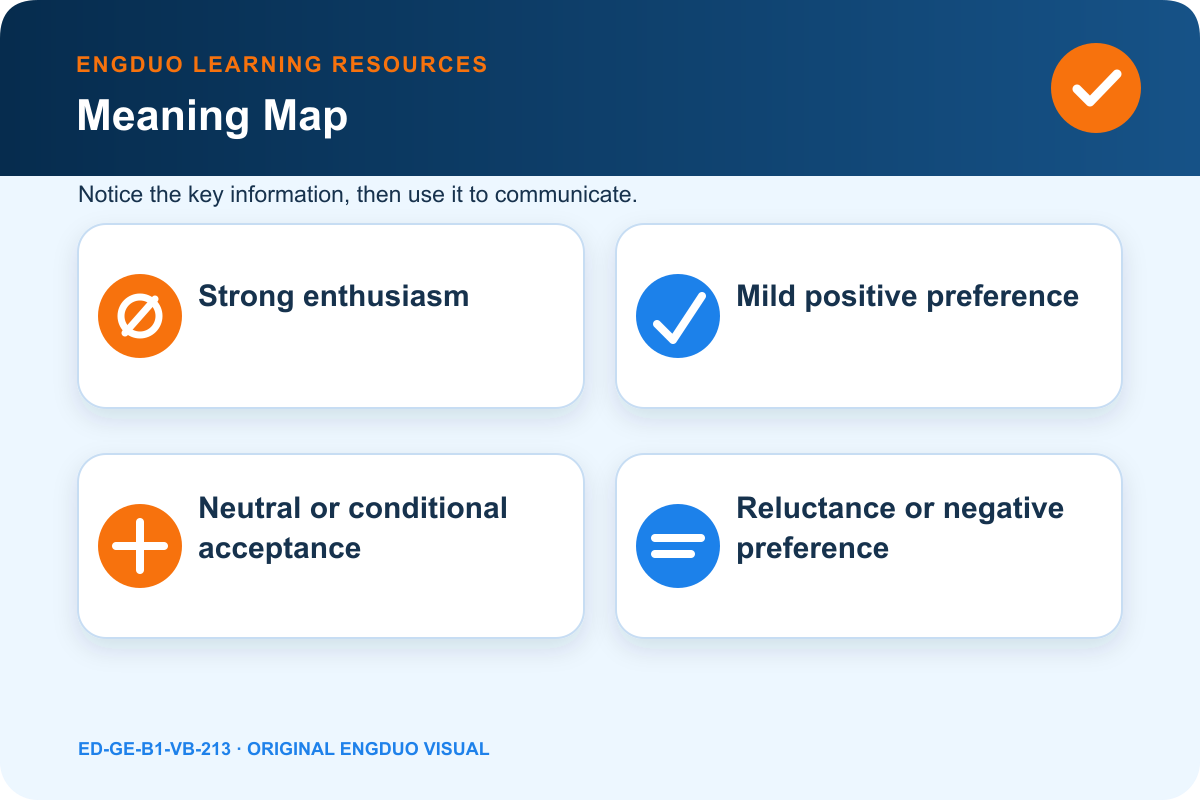
- strong enthusiasm
- mild positive preference
- neutral or conditional acceptance
- reluctance or negative preference
Engduo Audio • American English
Transcript — open after listening
I’m really into outdoor markets, but I don’t mind visiting a museum as long as it isn’t crowded.
Engduo Audio • Australian English
Transcript — open after listening
I’d rather go somewhere nearby than spend two hours travelling, although I’m open to a longer trip if we leave early.
How to run Stage 1
Confirm the observable outcome and connect it to one realistic learner need.
2. Build useful language
Choose the phrases that help you complete the task; do not memorise a full script.
I’m quite keen on ___.
I don’t mind ___ as long as ___.
I’d rather ___ than ___.
I’m not particularly fond of ___.
I’m open to ___ if ___.
How to run Stage 2
Use the visual and first audio or text for meaning before explaining language.
3. Rehearse with support
Practise the decisions, evidence, listening, or language moves that make the final task successful.
- Order expressions by strength and openness.
- Turn binary like-dislike answers into qualified preferences.
- Use rather, prefer, and would prefer with accurate structures.
How to run Stage 3
Select only the useful-language items needed for this learner and this task.
4. Complete the communication task
Exchange information, solve a problem, create a text, or reach a decision with a real outcome.
Agree on one weekend activity for three people with different budgets, energy levels, and interests.
How to run Stage 4
Run the supported rehearsal without reading every instruction aloud.
5. Perform, receive feedback, and retry
Complete the task with keywords only, receive focused feedback, and repeat the weakest part.
Negotiate for two minutes using at least six preference expressions, two conditions, and one genuine compromise.
Retry: Repeat once with clearer meaning, stronger evidence, more accurate listening, or less support.
How to run Stage 5
Run the main task: Agree on one weekend activity for three people with different budgets, energy levels, and interests.
Exit check
Complete this without reading a model: Compare two activities using one strong preference and one condition.
Success looks like: The learner communicates strength and flexibility clearly enough to reach a shared decision.
Evidence: speaking · Repeat the weakest part once after one meaning-focused and one language-focused correction at most.
VR · Vocabulary Resource
2: Uses suitable target vocabulary naturally in an original message.
1: Demonstrates the skill after one focused prompt, correction or self-repair.
0: Cannot yet demonstrate the skill clearly enough to complete the stated outcome.
FP · Functional Performance
2: Completes the real communication outcome independently.
1: Demonstrates the skill after one focused prompt, correction or self-repair.
0: Cannot yet demonstrate the skill clearly enough to complete the stated outcome.
Use these scores after the independent attempt. Record one recurring need in the Engduo app when lesson-result fields become available.
How to run Stage 6
Record focused evidence, give one meaning-focused and one language-focused correction at most, repeat the weakest part, and complete the exit check.
คำอธิบายภาษาไทย — เปิดเมื่อจำเป็นเท่านั้น
เลือกสำนวนให้ตรงระดับความชอบ และเติมเงื่อนไขหรือเหตุผลเพื่อให้คู่สนทนาเข้าใจ ไม่ใช่ตอบแค่ like หรือ don’t like
Teacher guide
30-minute must-do route
- Confirm the observable outcome and connect it to one realistic learner need.
- Use the visual and first audio or text for meaning before explaining language.
- Select only the useful-language items needed for this learner and this task.
- Run the supported rehearsal without reading every instruction aloud.
- Run the main task: Agree on one weekend activity for three people with different budgets, energy levels, and interests.
- Record focused evidence, give one meaning-focused and one language-focused correction at most, repeat the weakest part, and complete the exit check.
60-minute extension
- Change one constraint halfway through and renegotiate without repeating the same expressions.
- Change the role, information, listener, or constraint so the learner transfers the skill rather than repeating the same answer.
- Compare the first and second performance and record one specific improvement.
Make it easier
Use a preference scale and three activity cards.
Make it harder
Change one constraint halfway through and renegotiate without repeating the same expressions.
Likely difficulty
The learner may confuse prefer doing with would rather do or sound too absolute during negotiation.
Correction priority
Prioritise strength, openness, and the verb pattern after preference expressions.
Thai support rule
Keep the Thai panel closed unless examples, visuals, replay, reformulation, and simpler English do not allow progress. Explain only the key distinction, then return to English.
Progress record
Score VR, FP from 0–2 and record one recurring need from: preference-range, reasons, compromise.
Retry
Give one meaning-focused correction and one language-focused correction at most, then ask for a second attempt with fewer visible prompts.
Continue your learning path
Continue your learning path
Opinions from Mild to Strong
Compare preference and opinion language
เปรียบเทียบภาษาความชอบและความคิดเห็น
- Council of Europe — CEFR Companion Volume — Supports action-oriented language learning through age- and level-appropriate interaction, descriptions, goal-oriented co-operation, written interaction, and observable communication outcomes.
- British Council LearnEnglish — B1–B2 vocabulary — Supports topic-based intermediate vocabulary learning that develops meaning, pronunciation, spelling, recall, and confident communication.
Content and media rights
© 2026 Engduo Thailand. Authorized Engduo use only. Copying, republishing, reselling, scraping, or reuse in another course, dataset, product, or AI system requires written permission except where applicable law permits.