
My answer is relevant because ___.
Speaking Mock and Retry
Complete an original three-part speaking cycle, collect evidence under the four official assessment areas, and improve one high-impact feature on a second attempt.
Your goal
By the end of this lesson, you can complete an original three-part mock and apply feedback.
Why this mixed-skill lesson matters
Combine listening, speaking, reading or writing to complete one meaningful outcome. Each activity supplies evidence or language for the final task rather than testing isolated skills.
TF34 · IELTS Skills & Academic CommunicationProgress Focus
Progress focus: FPCMLIST
Use the final independent attempt to apply the 0–2 scoring guide consistently.
30-minute lesson route
- Confirm the observable outcome and connect it to one realistic learner need.
- Use the visual and first audio or text for meaning before explaining language.
- Select only the useful-language items needed for this learner and this task.
- Run the supported rehearsal without reading every instruction aloud.
- Run the main task: Complete an original mock on learning new skills: familiar questions, a long turn about a useful skill, and a broader discussion about who should fund adult learning.
- Record focused evidence, give one meaning-focused and one language-focused correction at most, repeat the weakest part, and complete the exit check.
Engduo Audio: Licensed voices prepared for this lesson. Audio never starts automatically. Use the transcript after the first listening attempt.
1. Understand the challenge
Use the visual and input to identify the situation, the information available and the final outcome.
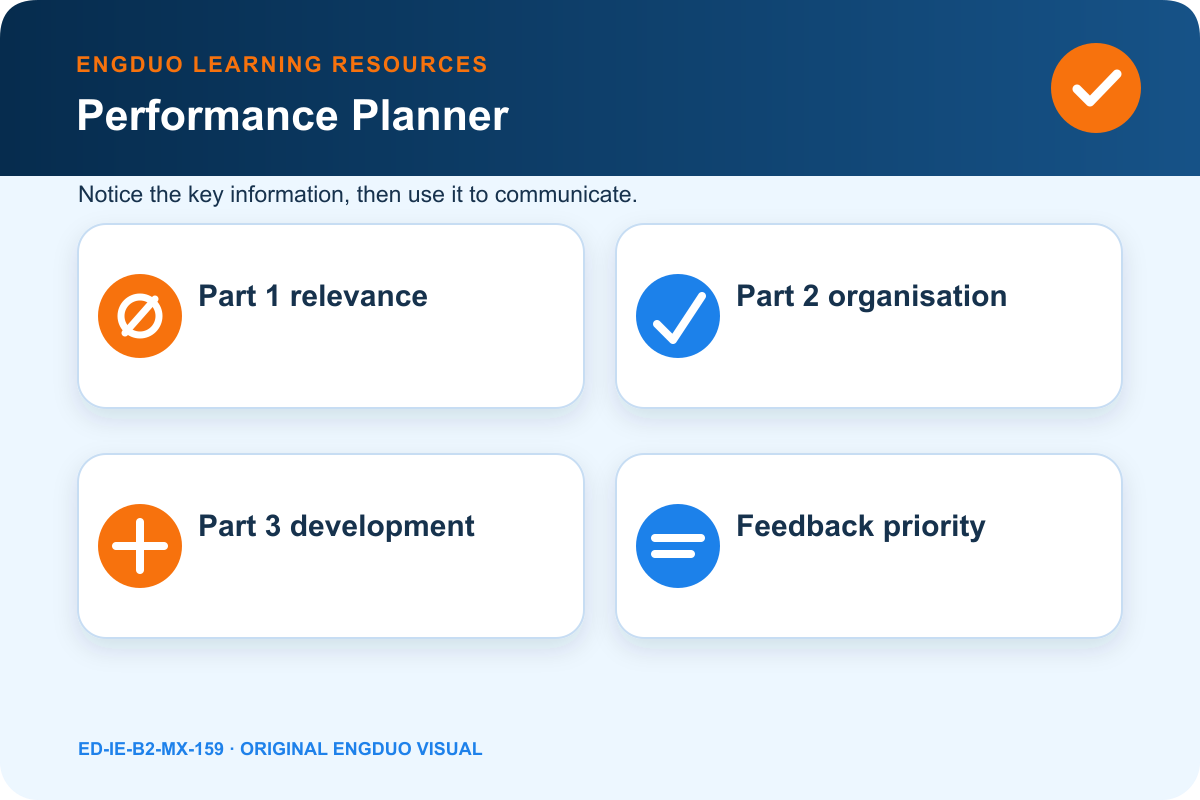
- Part 1 relevance
- Part 2 organisation
- Part 3 development
- feedback priority
Engduo Audio • Indian English
Transcript — open after listening
My Part 2 answer had a clear sequence, but I repeated useful several times. On the retry, I will use practical, transferable, and relevant more precisely.
Engduo Audio • British English
Transcript — open after listening
The listener lost meaning when I rushed the contrast. I will divide it into two thought groups and stress the two options.
Teacher Help · Stage 1
Explain the final outcome first. Use the visual or input to show what information the learner must collect, not every answer.
2. Build the language and strategy
Choose the language, evidence and task strategy needed to complete the challenge successfully.
I developed the topic by ___.
The word I needed was ___.
The grammar choice helped me ___.
The listener lost meaning when ___.
On the retry, I will ___.
Teacher Help · Stage 2
Choose only the language and strategy that unlock the task. Connect each item to where the learner will use it later.
3. Practise the parts with support
Practise the most difficult listening, speaking, reading or writing step before combining the skills.
- Warm up with two direct Part 1 answers.
- Prepare one long turn from five keywords.
- Build a Part 3 claim–reason–example–qualification chain.
Teacher Help · Stage 3
Isolate the hardest sub-skill and rehearse it briefly. Keep the support visible, then reduce it before the main challenge.
4. Complete the integrated task
Use information from more than one skill to solve, create, decide, present or communicate a real outcome.
Complete an original mock on learning new skills: familiar questions, a long turn about a useful skill, and a broader discussion about who should fund adult learning.
Teacher Help · Stage 4
Run the full challenge and require evidence from the earlier input. Let the learner organise the response before correcting form.
5. Final practice: Combine the skills independently
Complete the final outcome with less support, receive focused feedback and repeat the weakest part.
Complete all three parts, review evidence for fluency/coherence, vocabulary, grammar, and pronunciation, then repeat one selected segment with a measurable improvement.
Retry: Repeat once with clearer meaning, stronger evidence, more accurate listening, or less support.
Teacher Help · Stage 5
Remove unnecessary support. Observe the whole performance, give one outcome correction and one language correction, then retry the weakest part.
Exit check
Complete this without reading a model: Name one strong transferred feature and one priority for the next lesson.
Success looks like: The retry shows a specific improvement while the learner keeps the answer relevant, natural, and independently produced.
Evidence: mixed · Repeat the weakest part once after one meaning-focused and one language-focused correction at most.
FP · Functional Performance
2: Completes the real communication outcome independently.
1: Demonstrates the skill after one focused prompt, correction or self-repair.
0: Cannot yet demonstrate the skill clearly enough to complete the stated outcome.
CM · Communication Management
2: Organises ideas, turns, clarification and response coherently.
1: Demonstrates the skill after one focused prompt, correction or self-repair.
0: Cannot yet demonstrate the skill clearly enough to complete the stated outcome.
LIST · Listening Comprehension
2: Understands and uses the required spoken evidence accurately.
1: Demonstrates the skill after one focused prompt, correction or self-repair.
0: Cannot yet demonstrate the skill clearly enough to complete the stated outcome.
Use these scores after the independent attempt. Give one specific success note and choose one next practice focus.
Teacher Help · Stage 6
Score the stated Progress Focus from the final performance. Name the strongest combined-skill behaviour and one next practice focus.
คำอธิบายภาษาไทย — เปิดเมื่อจำเป็นเท่านั้น
ใช้เกณฑ์ 4 ด้านเพื่อหา evidence ไม่ทำนายคะแนน Band เลือกแก้จุดที่มีผลสูงหนึ่งอย่างแล้วพูดซ้ำช่วงนั้นให้ดีขึ้น
Teacher Guidance · How to conduct this class
30-minute must-do route
- Confirm the observable outcome and connect it to one realistic learner need.
- Use the visual and first audio or text for meaning before explaining language.
- Select only the useful-language items needed for this learner and this task.
- Run the supported rehearsal without reading every instruction aloud.
- Run the main task: Complete an original mock on learning new skills: familiar questions, a long turn about a useful skill, and a broader discussion about who should fund adult learning.
- Record focused evidence, give one meaning-focused and one language-focused correction at most, repeat the weakest part, and complete the exit check.
60-minute extension
- Repeat the same Part 3 idea with stronger qualification and more flexible vocabulary.
- Change the role, information, listener, or constraint so the learner transfers the skill rather than repeating the same answer.
- Compare the first and second performance and record one specific improvement.
Make it easier
Use shorter timings and one feedback question per part.
Make it harder
Repeat the same Part 3 idea with stronger qualification and more flexible vocabulary.
Likely difficulty
The learner may ask for a score from one short performance or try to correct every error at once.
Correction priority
Prioritise the highest-impact meaning or listener-effort issue and a focused retry.
Thai support rule
Keep the Thai panel closed unless examples, visuals, replay, reformulation, and simpler English do not allow progress. Explain only the key distinction, then return to English.
Progress record
Use the 0–2 guide after the independent attempt and identify one recurring need for the next lesson.
Retry
Give one meaning-focused correction and one language-focused correction at most, then ask for a second attempt with fewer visible prompts.
- Council of Europe — CEFR Companion Volume — Supports action-oriented language learning through age- and level-appropriate interaction, descriptions, goal-oriented co-operation, written interaction, and observable communication outcomes.
- IELTS — Academic Speaking test format — Supports the three-part Speaking sequence and the official assessment areas of fluency and coherence, lexical resource, grammatical range and accuracy, and pronunciation.
Content and media rights
© 2026 Engduo Thailand. Authorized Engduo use only. Copying, republishing, reselling, scraping, or reuse in another course, dataset, product, or AI system requires written permission except where applicable law permits.