
Compared with the past, ___.

Speaking Part 3: Compare Ideas
Move from personal experience to a broader discussion by comparing groups, time periods, or policies and supporting a qualified position with a reason and example.
Your goal
By the end of this lesson, you can compare perspectives and support a position.
Progress focus: PROFCMFP
Engduo Audio: Licensed voices prepared for this lesson. Audio never starts automatically. Use the transcript after the first listening attempt.
1. Look, listen, and notice
Use the visual and model audio to understand the situation, viewpoint, or communication problem before studying the language.
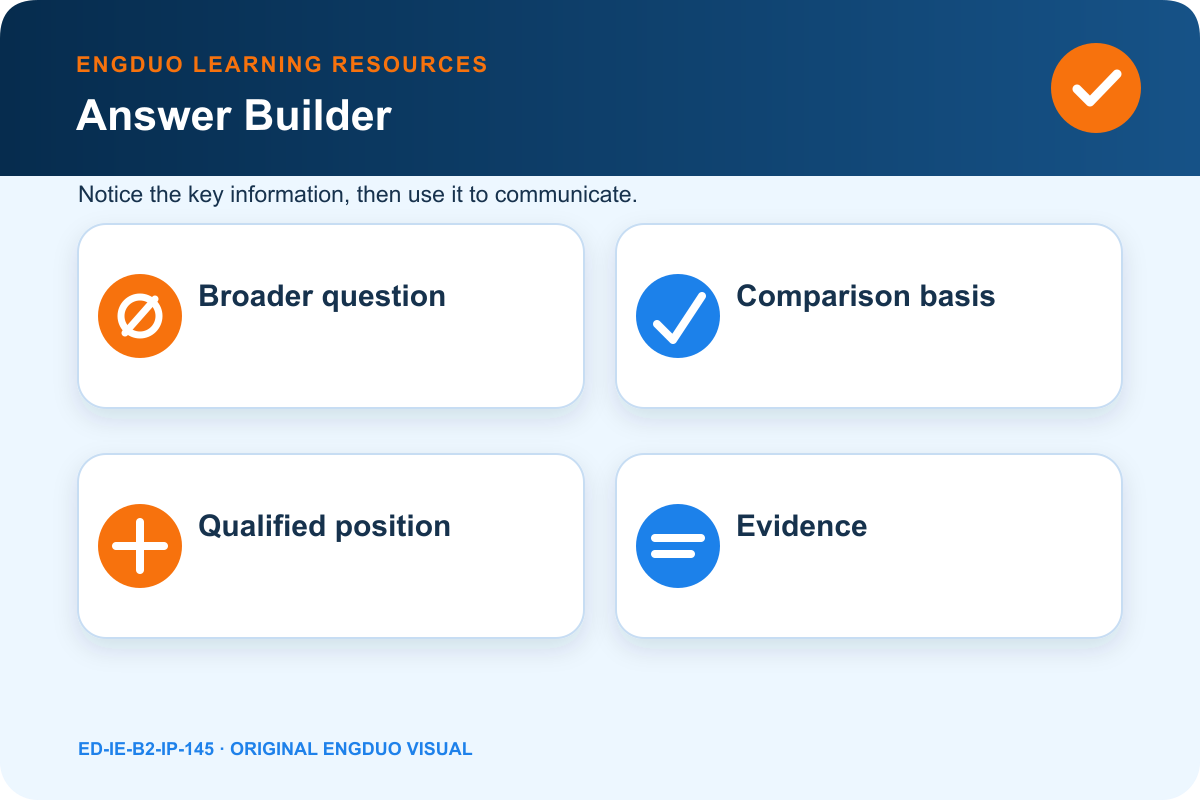
- broader question
- comparison basis
- qualified position
- evidence
Engduo Audio • American English
Transcript — open after listening
Compared with the past, reliable internet is far more important for public services. However, access is still uneven in some communities.
Engduo Audio • Australian English
Transcript — open after listening
For older residents, the most practical investment may be better local transport because it improves access to several services at once.
How to run Stage 1
Confirm the observable outcome and connect it to one realistic learner need.
2. Build useful language
Choose the phrases that help you complete the task; do not memorise a full script.
One important difference is ___.
The most practical option may be ___.
That is generally true, although ___.
From a community perspective, ___.
A clear example would be ___.
How to run Stage 2
Use the visual and first audio or text for meaning before explaining language.
3. Rehearse with support
Practise the decisions, evidence, listening, or language moves that make the final task successful.
- Change a personal Part 2 idea into a social Part 3 question.
- Use two comparatives, one superlative, and one qualifying clause accurately.
- Separate a claim, reason, example, and limitation.
How to run Stage 3
Select only the useful-language items needed for this learner and this task.
4. Complete the communication task
Exchange information, solve a problem, create a text, or reach a decision with a real outcome.
Discuss an original issue: whether cities should prioritise public transport, parks, or digital services. Compare present and past needs, then recommend the most useful priority for two different groups.
How to run Stage 4
Run the supported rehearsal without reading every instruction aloud.
5. Perform, receive feedback, and retry
Complete the task with keywords only, receive focused feedback, and repeat the weakest part.
Answer four unseen Part 3-style questions using precise comparison, a clear position, evidence, and one qualification; defend one answer after a challenge question.
Retry: Repeat once with clearer meaning, stronger evidence, more accurate listening, or less support.
How to run Stage 5
Run the main task: Discuss an original issue: whether cities should prioritise public transport, parks, or digital services. Compare present and past needs, then recommend the most useful priority for two different groups.
Exit check
Complete this without reading a model: Give one comparative claim and one carefully justified superlative recommendation.
Success looks like: The response compares a clear basis, supports the position, and avoids presenting every claim as universally true.
Evidence: speaking · Repeat the weakest part once after one meaning-focused and one language-focused correction at most.
PROF · Professional Communication
2: Presents relevant professional evidence with an appropriate tone.
1: Demonstrates the skill after one focused prompt, correction or self-repair.
0: Cannot yet demonstrate the skill clearly enough to complete the stated outcome.
CM · Communication Management
2: Organises ideas, turns, clarification and response coherently.
1: Demonstrates the skill after one focused prompt, correction or self-repair.
0: Cannot yet demonstrate the skill clearly enough to complete the stated outcome.
FP · Functional Performance
2: Completes the real communication outcome independently.
1: Demonstrates the skill after one focused prompt, correction or self-repair.
0: Cannot yet demonstrate the skill clearly enough to complete the stated outcome.
Use these scores after the independent attempt. Record one recurring need in the Engduo app when lesson-result fields become available.
How to run Stage 6
Record focused evidence, give one meaning-focused and one language-focused correction at most, repeat the weakest part, and complete the exit check.
คำอธิบายภาษาไทย — เปิดเมื่อจำเป็นเท่านั้น
Part 3 ต้องขยายจากเรื่องส่วนตัวไปสู่ภาพกว้าง ใช้ comparison/superlative พร้อมเหตุผล ตัวอย่าง และข้อจำกัด ไม่ตอบแบบสุดโต่ง
Teacher guide
30-minute must-do route
- Confirm the observable outcome and connect it to one realistic learner need.
- Use the visual and first audio or text for meaning before explaining language.
- Select only the useful-language items needed for this learner and this task.
- Run the supported rehearsal without reading every instruction aloud.
- Run the main task: Discuss an original issue: whether cities should prioritise public transport, parks, or digital services. Compare present and past needs, then recommend the most useful priority for two different groups.
- Record focused evidence, give one meaning-focused and one language-focused correction at most, repeat the weakest part, and complete the exit check.
60-minute extension
- Compare short- and long-term effects and revise the recommendation for a different stakeholder.
- Change the role, information, listener, or constraint so the learner transfers the skill rather than repeating the same answer.
- Compare the first and second performance and record one specific improvement.
Make it easier
Use claim–reason–example–limitation cards with a familiar community topic.
Make it harder
Compare short- and long-term effects and revise the recommendation for a different stakeholder.
Likely difficulty
The learner may give only a personal story, use vague better/best language, or make an unsupported universal claim.
Correction priority
Prioritise comparison basis, logical support, and qualified rather than absolute language.
Thai support rule
Keep the Thai panel closed unless examples, visuals, replay, reformulation, and simpler English do not allow progress. Explain only the key distinction, then return to English.
Progress record
Score PROF, CM, FP from 0–2 and record one recurring need from: abstract-discussion, comparatives-superlatives, qualified-position.
Retry
Give one meaning-focused correction and one language-focused correction at most, then ask for a second attempt with fewer visible prompts.
Continue your learning path
- Council of Europe — CEFR Companion Volume — Supports action-oriented language learning through age- and level-appropriate interaction, descriptions, goal-oriented co-operation, written interaction, and observable communication outcomes.
- IELTS — Academic Speaking test format — Supports the three-part Speaking sequence and the official assessment areas of fluency and coherence, lexical resource, grammatical range and accuracy, and pronunciation.
- British Council LearnEnglish — Modifying comparatives — Supports communicating precise differences with modifiers such as much, slightly, almost, and exactly.
Content and media rights
© 2026 Engduo Thailand. Authorized Engduo use only. Copying, republishing, reselling, scraping, or reuse in another course, dataset, product, or AI system requires written permission except where applicable law permits.