
I selected ___ because ___.

Timed Mini-Cycle and Error Log
Complete a balanced original Engduo mini-cycle, analyse every error by cause, retry a parallel skill, and choose a measurable learning route. This Engduo practice result is not an official score estimate.
Your goal
By the end of this lesson, you can complete an original mixed set and choose the next study priority.
Progress focus: STRATLISTREAD
Engduo Audio: Licensed voices prepared for this lesson. Audio never starts automatically. Use the transcript after the first listening attempt.
1. Look, listen, and notice
Use the visual and model audio to understand the situation, viewpoint, or communication problem before studying the language.
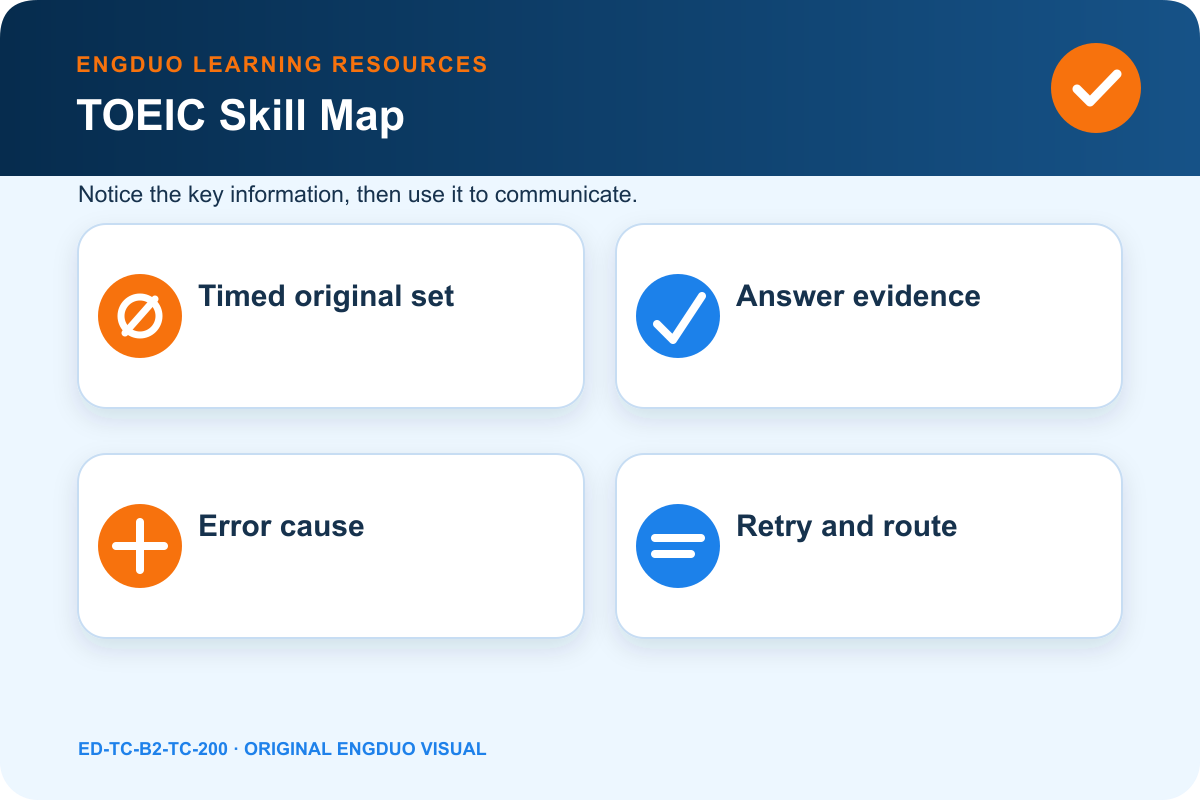
- timed original set
- answer evidence
- error cause
- retry and route
Engduo Audio • British English
Transcript — open after listening
I selected the familiar phrase before checking the sentence role. My error was grammatical, not simply careless, so I need more word-form contrast practice.
Engduo Audio • American English
Transcript — open after listening
On the retry, I previewed the question target and marked the evidence boundary. My next two-week priority is completing three short evidence-first reading sets.
How to run Stage 1
Confirm the observable outcome and connect it to one realistic learner need.
2. Build useful language
Choose the phrases that help you complete the task; do not memorise a full script.
The exact evidence was ___.
My error was caused by ___.
The language pattern I need is ___.
On the retry, I changed ___.
My next two-week priority is ___.
How to run Stage 2
Use the visual and first audio or text for meaning before explaining language.
3. Rehearse with support
Practise the decisions, evidence, listening, or language moves that make the final task successful.
- Set a realistic time plan for listening and reading tasks.
- Use error codes for language, attention, evidence, and pace.
- Distinguish a one-off mistake from a recurring development need.
How to run Stage 3
Select only the useful-language items needed for this learner and this task.
4. Complete the communication task
Exchange information, solve a problem, create a text, or reach a decision with a real outcome.
Complete a twenty-item original Engduo cycle across Parts 1–7, then audit all answers and retry four parallel items linked to the most frequent error.
How to run Stage 4
Run the supported rehearsal without reading every instruction aloud.
5. Perform, receive feedback, and retry
Complete the task with keywords only, receive focused feedback, and repeat the weakest part.
Report accuracy by skill family, explain three error causes with evidence, demonstrate improvement on a parallel retry, and set one listening and one reading action for two weeks.
Retry: Repeat once with clearer meaning, stronger evidence, more accurate listening, or less support.
How to run Stage 5
Run the main task: Complete a twenty-item original Engduo cycle across Parts 1–7, then audit all answers and retry four parallel items linked to the most frequent error.
Exit check
Complete this without reading a model: State one recurring need, one successful strategy, and the next measurable action.
Success looks like: The learner uses performance evidence to choose a focused route and understands that the result is not an official score estimate or guarantee.
Evidence: mixed · Repeat the weakest part once after one meaning-focused and one language-focused correction at most.
STRAT · Task Strategy
2: Uses an efficient task strategy and supports decisions with evidence.
1: Demonstrates the skill after one focused prompt, correction or self-repair.
0: Cannot yet demonstrate the skill clearly enough to complete the stated outcome.
LIST · Listening Comprehension
2: Understands and uses the required spoken evidence accurately.
1: Demonstrates the skill after one focused prompt, correction or self-repair.
0: Cannot yet demonstrate the skill clearly enough to complete the stated outcome.
READ · Reading Comprehension
2: Finds and interprets the required written evidence accurately.
1: Demonstrates the skill after one focused prompt, correction or self-repair.
0: Cannot yet demonstrate the skill clearly enough to complete the stated outcome.
Use these scores after the independent attempt. Record one recurring need in the Engduo app when lesson-result fields become available.
How to run Stage 6
Record focused evidence, give one meaning-focused and one language-focused correction at most, repeat the weakest part, and complete the exit check.
คำอธิบายภาษาไทย — เปิดเมื่อจำเป็นเท่านั้น
เป้าหมายคือรู้ว่าผิดเพราะภาษา สมาธิ หลักฐาน หรือเวลา แล้วลองใหม่และกำหนดแผนสองสัปดาห์ ไม่แปลงเป็นคะแนนจริง
Teacher guide
30-minute must-do route
- Confirm the observable outcome and connect it to one realistic learner need.
- Use the visual and first audio or text for meaning before explaining language.
- Select only the useful-language items needed for this learner and this task.
- Run the supported rehearsal without reading every instruction aloud.
- Run the main task: Complete a twenty-item original Engduo cycle across Parts 1–7, then audit all answers and retry four parallel items linked to the most frequent error.
- Record focused evidence, give one meaning-focused and one language-focused correction at most, repeat the weakest part, and complete the exit check.
60-minute extension
- Repeat a parallel cycle after two weeks and compare error distributions, not only totals.
- Change the role, information, listener, or constraint so the learner transfers the skill rather than repeating the same answer.
- Compare the first and second performance and record one specific improvement.
Make it easier
Complete the cycle in two blocks and use a fixed four-code error log.
Make it harder
Repeat a parallel cycle after two weeks and compare error distributions, not only totals.
Likely difficulty
The learner may count only correct answers, label every error careless, or choose a broad plan such as practise more.
Correction priority
Prioritise evidence-based error causes, parallel retry, measurable actions, and responsible score language.
Thai support rule
Keep the Thai panel closed unless examples, visuals, replay, reformulation, and simpler English do not allow progress. Explain only the key distinction, then return to English.
Progress record
Score STRAT, LIST, READ from 0–2 and record one recurring need from: time-management, error-log, learning-route.
Retry
Give one meaning-focused correction and one language-focused correction at most, then ask for a second attempt with fewer visible prompts.
- Council of Europe — CEFR Companion Volume — Supports action-oriented language learning through age- and level-appropriate interaction, descriptions, goal-oriented co-operation, written interaction, and observable communication outcomes.
- ETS — About the TOEIC Listening and Reading Test — Supports accurate alignment to the current Listening Parts 1–4 and Reading Parts 5–7 while Engduo uses only original practice content.
- ETS — TOEIC Test Preparation Materials — Supports awareness of official preparation resources and sample-test families without copying protected questions, recordings, images, or answer sets.
- ETS — TOEIC Listening and Reading Test Examinee Handbook — Supports accurate orientation to test procedures and format; no official questions or branded test materials are reproduced.
Content and media rights
© 2026 Engduo Thailand. Authorized Engduo use only. Copying, republishing, reselling, scraping, or reuse in another course, dataset, product, or AI system requires written permission except where applicable law permits.