IDEA · Evidence & imagination
0 The talk remains a list of objects or copied prompts.
1 One interpretation develops with support.
2 Evidence, alternatives, and one careful judgement develop clearly.

Topic FamilyTF01 · Identity & Personal Information
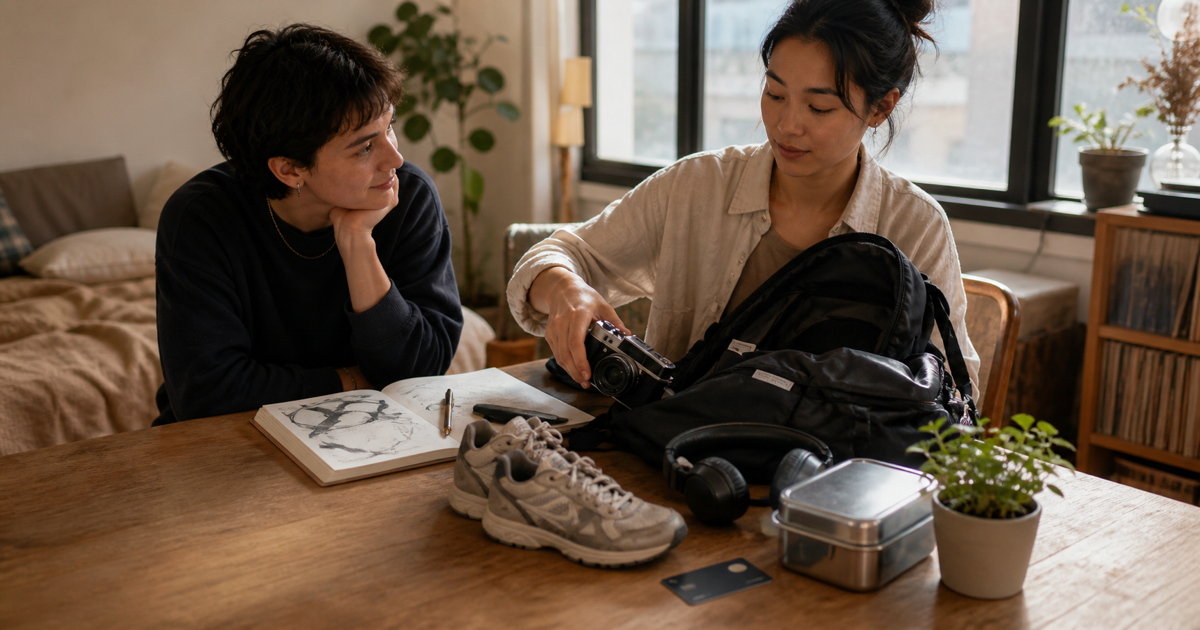
Use one picture to notice clues, question first impressions, explore identity language, and create a conversation that can move beyond names and basic facts.
For learners: Move beyond basic personal facts: use visual clues carefully, question first impressions, and discuss what may shape a person without forcing private disclosure.
For teachers: The visual-first sequence separates observation from inference, opens two plausible stories, offers optional identity language, challenges assumptions, and ends with a learner-led transfer task. No listening audio or model answer is used.
สำหรับผู้เรียน: ต่อยอดจากข้อมูลส่วนตัวพื้นฐานไปสู่การสังเกตและพูดเรื่องตัวตนอย่างมีเหตุผล ตั้งคำถามกับความประทับใจแรก และเลือกใช้ตัวอย่างจริงหรือสมมติโดยไม่ต้องเปิดเผยเรื่องส่วนตัว
สำหรับครู: ลำดับเริ่มจากภาพและแยกสิ่งที่เห็นออกจากการคาดเดา เปิดให้สร้างได้มากกว่าหนึ่งเรื่อง เลือกคำศัพท์ตามความคิดของผู้เรียน ตั้งคำถามกับอคติ และจบด้วยการพูดอย่างอิสระ ไม่มีเสียงฟังหรือคำตอบตัวอย่างบังคับ
By the end of this lesson, you can use visible clues carefully, separate observation from assumption, choose useful identity language, and sustain a three-minute discussion about what shapes a person.
ใช้สิ่งของและรายละเอียดในภาพเป็นจุดเริ่มต้นในการพูดเรื่องตัวตน แยกสิ่งที่มองเห็นจริงออกจากการคาดเดา เลือกคำศัพท์หรือ phrasal verbs ที่ช่วยสื่อความคิด และสนทนาอย่างอิสระโดยไม่เปิดเผยข้อมูลส่วนตัวที่ไม่ต้องการบอก
The picture leads; the learner chooses the direction. Vocabulary, phrasal verbs, sentence starters, and questions are optional resources—not boxes to complete. Do not add listening audio, a model answer, or a required personal disclosure.
| Stage | Teacher move | Evidence |
|---|---|---|
| 1 | Ask for visible details before any interpretation. | Observation separated from inference |
| 2 | Invite two different possible stories and ask what supports each one. | Multiple plausible interpretations |
| 3 | Let the learner select only language that supports an emerging idea. | Useful language choices |
| 4 | Challenge one assumption without telling the learner the correct answer. | Fair, reasoned judgement |
| 5 | Follow the learner’s last idea instead of completing every prompt. | Learner-led exchange |
| 6 | Score IDEA/LANG/TALK 0–2, give one target, then retry only that part. | Independent talk + improvement |
Useful distinction: I can see… · This might mean… · I cannot know whether…
4 min. Ask for at least three visible details before interpretation. Accept a new topic if it grows naturally from the image. Never require the learner to share sensitive personal information.
Optional sentence starters: One possibility is… · Another explanation could be… · The strongest clue is… · We may be assuming that…
5 min. Ask for two plausible interpretations, not the correct biography. Follow up with “Which clue supports that?” and “What else could be true?”
You do not need to use every item. Select the language that makes your interpretation more precise.
Language note: A phrasal verb combines a verb with a particle to create a meaning that may differ from the verb alone.
5 min. Ask the learner to choose three words and one or two phrasal verbs. They may reject or replace any item. Meaningful choice matters more than using the full list.
Useful thinking language: It depends on… · The evidence suggests…, but it does not prove… · We should be careful not to assume… · What matters more may be…
5 min. Choose one question only if it creates depth. Ask for a reason and an example. Keep the discussion respectful and allow fictional examples instead of personal disclosure.
Start anywhere: hobbies, belongings, privacy, first impressions, changing interests, or the difference between how people see us and how we see ourselves.
Freedom rule: You may leave the picture and use a real, general, or fictional example once the conversation has a clear direction.
5 min. Facilitate rather than lead. Ask questions generated by the learner’s last idea. Do not return to unused prompts simply because they appear on the page.
Task: Choose a real or fictional person. Select three objects that could represent them. Explain what each object may reveal, identify one possible misleading assumption, respond to two genuine follow-up questions, and add one unprepared final thought.
Success: The discussion sounds like your thinking—not a completed worksheet or memorised model.
0 The talk remains a list of objects or copied prompts.
1 One interpretation develops with support.
2 Evidence, alternatives, and one careful judgement develop clearly.
0 General words repeatedly block the intended meaning.
1 Selected new language helps after prompts or correction.
2 Words and expressions are chosen naturally to make ideas precise.
0 The teacher manages most of the discussion.
1 The learner continues with visible prompts or one reminder.
2 The learner develops, responds, questions, and extends independently.
Result: 0–2 Rebuild · 3–4 Developing · 5–6 Pilot evidence.
Feedback + retry: Keep the first score. Choose one target—stronger evidence, more precise language, or more independent interaction—and retry only the weakest part.
6 min. Record IDEA/LANG/TALK from 0–2 before feedback. Give one precise target and run a short focused retry without restarting the entire discussion.
Free Talk ใช้ภาพเป็นแรงกระตุ้นและไม่มีคำตอบเดียว ผู้เรียนแยกสิ่งที่เห็นจริงออกจากการคาดเดา เลือกคำศัพท์ที่ช่วยสื่อความคิด ตั้งคำถามกับความประทับใจแรก และเชื่อมไปสู่การสนทนาเรื่องตัวตนได้อย่างอิสระ โดยใช้ตัวอย่างสมมติแทนข้อมูลส่วนตัวได้เสมอ
Build a useful personal-detail word bank first.
สร้างคลังคำเกี่ยวกับข้อมูลส่วนตัวก่อน
Listen for identity details and ask a connected question.
ฟังข้อมูลตัวตนและถามคำถามต่อยอด
Use selected identity details in a fuller introduction.
นำข้อมูลตัวตนไปใช้ในการแนะนำตัวที่สมบูรณ์ขึ้น
Explain your background, interests, and recent changes.
อธิบายภูมิหลัง ความสนใจ และการเปลี่ยนแปลงล่าสุด
CEFR Companion Volume — used for interaction, turn-taking, and observable communication outcomes.
© 2026 Engduo Thailand. This lesson and its original instructional design, text, visuals, and prepared media are for authorized Engduo use. Do not copy, republish, sell, scrape, or use any part in another course, website, dataset, product, or AI system without written permission, except where applicable law permits.