IDEA · Ideas and thinking · 0–2
0 The talk remains a list or copied prompts.
1 One interpretation or judgement develops with support.
2 Original ideas, reasons, possibilities or consequences develop clearly.

Topic FamilyTF37 · Kids: School, Play & Discovery
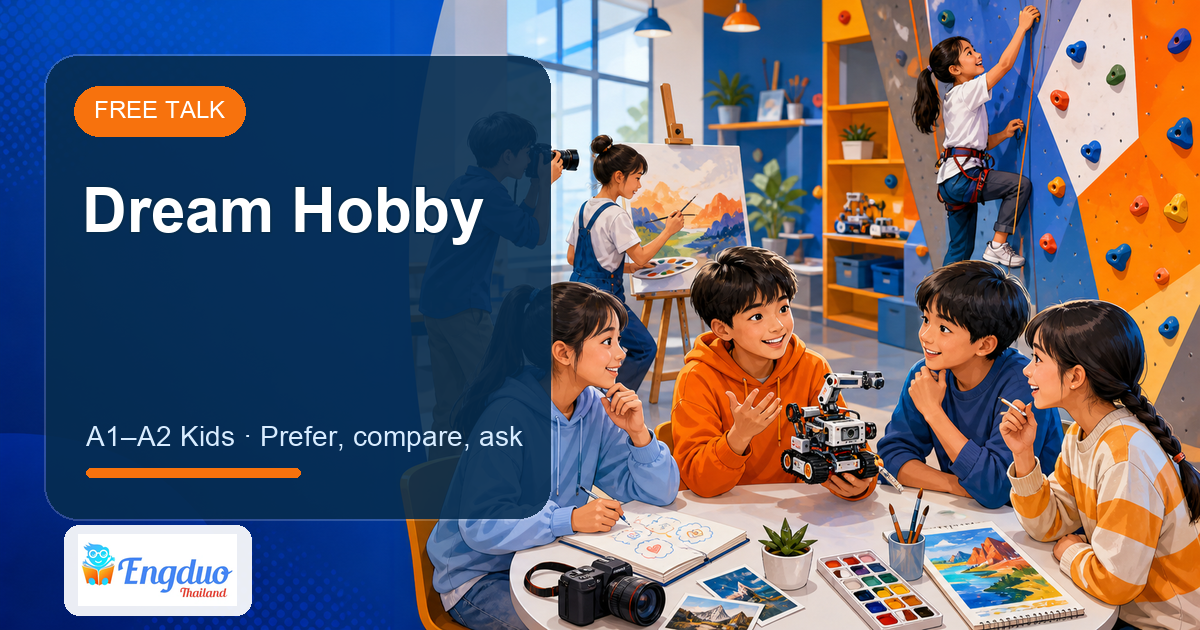
Use one picture to imagine a hobby, explain likes and dislikes, and explore what would make the hobby worth trying.
For learners: Use a hobby visual to explain likes and dislikes, imagine possibilities, ask follow-up questions and sustain free talk.
For teachers: The visual leads. Learners observe, select optional language, imagine beyond the frame, challenge assumptions and sustain an unscripted discussion. No listening audio or model answer.
สำหรับผู้เรียน: ใช้ภาพงานอดิเรกเพื่ออธิบายสิ่งที่ชอบและไม่ชอบ จินตนาการ ถามต่อ และสนทนาอย่างอิสระ
สำหรับครู: ภาพเป็นแกนหลัก ผู้เรียนสังเกต เลือกภาษาที่ต้องการ จินตนาการ คิดต่าง และสนทนาโดยไม่มีบทตายตัว ไม่มีเสียงฟังหรือคำตอบตัวอย่าง
By the end of this lesson, you can describe a dream hobby, explain two likes or dislikes, use selected topic language, ask two follow-up questions, and sustain a two-minute conversation.
บรรยายงานอดิเรกในฝัน อธิบายสิ่งที่ชอบหรือไม่ชอบ เลือกใช้คำศัพท์ที่ช่วยสื่อความคิด ถามคำถามต่อยอดสองข้อ และสนทนาต่อประมาณสองนาที
The picture and learner ideas lead. Vocabulary, phrasal verbs and questions are optional resources—not boxes to complete. Do not add listening audio, a model answer or a choice-card funnel.
| Stage | Teacher move | Evidence |
|---|---|---|
| 1 | Ask for visible details before interpretation. | Observation + first inference |
| 2 | Let the learner select only language that supports the emerging idea. | Meaningful language choices |
| 3 | Accept different stories when they connect to evidence. | Coherent possibility |
| 4 | Challenge one assumption or ask about a trade-off. | Reasoned judgement |
| 5 | Follow the learner’s last idea instead of completing every prompt. | Learner-led exchange |
| 6 | Score IDEA/LANG/TALK 0–2, give one target and retry the weakest part. | Independent talk + improvement |
Choose your own direction: You may follow another idea if it grows naturally from the picture.
4 min. Ask for at least three visible details before interpretation. Keep “I can see…” separate from “I think…” or “I imagine…”.
You do not need every item. Select only the language that makes your own meaning clearer.
Language note: Choose one or two useful phrases. You may replace them with language that better fits your idea.
5 min. Ask the learner to choose three topic words and one or two phrasal verbs. Meaningful choice matters more than using the full list.
Optional starters: They may have… · Perhaps… · One possible reason is… · The picture suggests…, but it does not prove…
5 min. Ask for one coherent possibility, not the correct story. Follow up with: “Which visual detail gave you that idea?”
Useful thinking language: It depends on… · The advantage is…, but… · We may be assuming that… · A fair response would be…
5 min. Use one question only if it creates depth. Ask for a reason, an example and one possible consequence.
Choose a hobby from the picture or invent your own. Compare it with one hobby you already know and follow your partner’s questions.
Freedom rule: Leave the picture and connect the idea to real life once the conversation has a clear direction.
5 min. Facilitate rather than lead. Build the next question from the learner’s last idea and do not return to unused prompts just because they are visible.
Task: Present one dream hobby, explain two attractions and one possible difficulty, ask two follow-up questions, and add one new idea after your partner responds.
Success: The discussion sounds like the learner’s thinking—not a completed worksheet or memorised model.
0 The talk remains a list or copied prompts.
1 One interpretation or judgement develops with support.
2 Original ideas, reasons, possibilities or consequences develop clearly.
0 General language repeatedly blocks the intended meaning.
1 Selected new language helps after a prompt or correction.
2 Vocabulary and expressions are chosen naturally to make ideas precise.
0 The teacher manages most of the exchange.
1 The learner continues with visible prompts or one reminder.
2 The learner develops, responds, questions and extends independently.
Target: Aim for at least 5/6 with TALK = 2.
Feedback + improved retry: Keep the first score. Choose one target—deeper idea, more precise language or more independent interaction—and retry only the weakest part.
6 min. Observe the first performance without interruption. Score IDEA/LANG/TALK 0–2, give one precise target and run a short focused retry without restarting the whole discussion.
Free Talk ใช้ภาพเป็นแรงกระตุ้น ไม่ได้กำหนดคำตอบเดียวหรือบังคับให้ตอบครบทุกคำถาม เลือกคำศัพท์ที่ช่วยความคิด จินตนาการสิ่งที่ภาพไม่ได้บอก ตั้งข้อสังเกตหรือมุมมองของตัวเอง และปล่อยให้บทสนทนาดำเนินไปตามความหมายที่เกิดขึ้นจริง
Build vocabulary for hobbies, equipment and preferences.
สร้างคำศัพท์งานอดิเรก อุปกรณ์ และความชอบ
Listen and respond to preferences in another skill.
ฝึกฟังและตอบสนองความชอบในอีกทักษะ
Use hobby language in a longer guided conversation.
ใช้ภาษางานอดิเรกในการสนทนาแบบมีแนวทางที่ยาวขึ้น
Review personal interests in an integrated performance.
ทบทวนความสนใจส่วนตัวในงานบูรณาการ
CEFR Companion Volume — interaction, turn-taking and observable communication outcomes.
© 2026 Engduo Thailand. This lesson and its instructional design, text and existing Engduo lesson visual are for authorised Engduo use.