
Ask one question before choosing the advice.

Give Advice with Should
Understand a simple problem, give useful advice with a reason, and adapt the advice when the situation changes.
Should and shouldn’t for practical advice
Use should or shouldn’t + base verb to recommend a helpful action, then explain why it fits the problem.
Your goal
By the end of this lesson, you can ask about a problem, give two should or shouldn’t suggestions with reasons, and change one suggestion after learning new information.
คำอธิบายเป้าหมายภาษาไทย — เปิดเมื่อจำเป็น
บทนี้ฝึกถามปัญหา ให้คำแนะนำด้วย should/shouldn’t พร้อมเหตุผล และปรับคำแนะนำเมื่อได้รับข้อมูลใหม่
Progress focus LCFP
LC · Language Control
Control the target pattern so the intended time and meaning remain clear.
Control the target pattern so the intended time and meaning remain clear.
FP · Functional Performance
Complete the lesson’s real communication outcome without teacher-supplied sentences.
Complete the lesson’s real communication outcome without teacher-supplied sentences.
Your grammar path
Keep the main verb unchanged after should or shouldn’t.
Give a reason, check the response, and adapt when needed.
30-minute lesson route
3 minProblem clues
5 minShould + base verb
5 minAdvice + reason
6 minGuided advice
7 minAdvice clinic
4 minFeedback & retry
Match the advice to the real problem
Good advice is specific, possible, and helpful for this person.
Health
rest · drink water · ask an adult
rest · drink water · ask an adult
Study
make a plan · practise · take a break
make a plan · practise · take a break
Friendship
listen · explain · apologise
listen · explain · apologise
How to run Stage 1
3 min: Identify the problem and collect two useful action verbs.
Use should or shouldn’t + base verb
Listen for the advice and the reason.
Engduo Audio: Listen for meaning first. Audio never starts automatically.
Listen for the problem, advice, and reason.
Listen for the new information and how the advice changes.
You should to rest.
You should rest.
You should rest.
How to run Stage 2
5 min: Play both models and establish should/shouldn’t + base verb.
Add a reason and a check question
| Advice | Reason | Check |
|---|---|---|
| You should make a short plan. | It will help you start. | Could you try that today? |
| You shouldn’t stay up late. | You need energy tomorrow. | What time can you sleep? |
How to run Stage 3
5 min: Add reasons and one check question to simple advice.
Build two possible suggestions
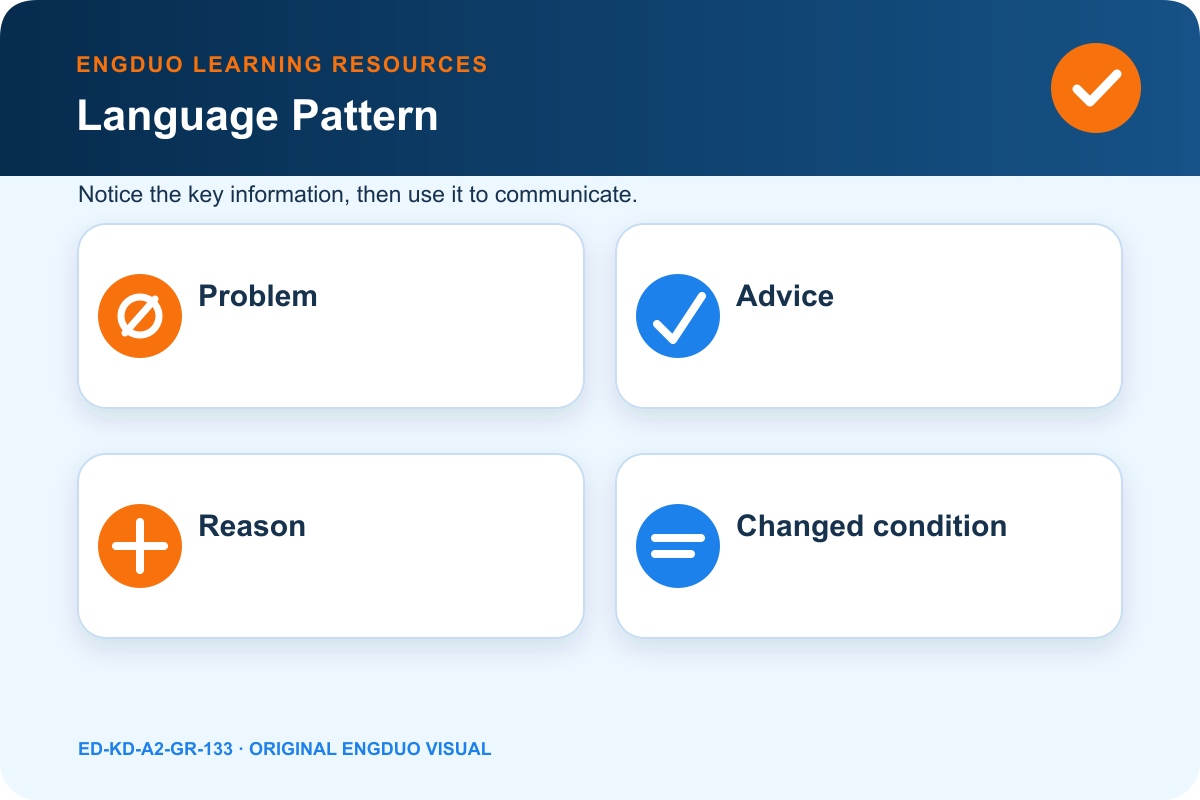
- Ask: What happened? / How do you feel?
- Advise: You should / shouldn’t ______.
- Explain: This may help because ______.
- Offer another option: You could also ______.
How to run Stage 4
6 min: Build two suggestions for two short problem cards.
Run an advice clinic
Choose a school, health, or friendship problem. Ask one question, give two suggestions, and change one after receiving a new detail.
Required: one question, one should, one shouldn’t, two reasons, one alternative, and one adapted suggestion.
How to run Stage 5
7 min: Run the advice clinic with one new-information twist.
Final practice: Give and adapt helpful advice
Task: Listen to one problem, ask a question, give two suggestions with reasons, then change one suggestion when the speaker adds new information.
Success: Should and shouldn’t are followed by base verbs, the advice matches the problem, and the learner adapts it without teacher-supplied sentences.
LC · Language Control
0 Frequent form problems obscure the intended time or meaning.
1 Meaning remains clear with some prompting or self-correction.
2 Controls should/shouldn’t + base verb across advice, reasons, and follow-up turns.
FP · Functional Performance
0 Does not yet complete the communication outcome.
1 Completes most of the outcome with visible prompts.
2 Understands the problem, gives useful advice, and adapts one suggestion independently.
How to run Stage 6
4 min: Score LC and FP, correct one form or relevance problem, and retry the adapted advice.
คำอธิบายภาษาไทย — เปิดเมื่อจำเป็นเท่านั้น
หลัง should หรือ shouldn’t ใช้กริยารูปปกติ เช่น You should rest. คำแนะนำที่ดีควรมีเหตุผลและปรับได้เมื่อรู้ข้อมูลเพิ่ม
Continue your learning path
Teaching references
CEFR Companion Volume — used for communication outcomes and observable progress.
Content and media rights
© 2026 Engduo Thailand. This lesson and its original instructional design, text, visuals, and prepared media are for authorized Engduo use. Do not copy, download, republish, sell, scrape, or use any part in another course, website, dataset, product, or AI system without written permission, except where applicable law permits.