
Record the real action and result before evaluating the alternative.
Past Modals for Criticism, Regret, and Missed Options
Use should have, could have, and needn’t have to evaluate past decisions, distinguish mistakes from unused options, and improve the next plan.
Past modals for criticism and regret
UseEvaluate a better past action, a missed possibility, or an action completed unnecessarily.
Core formshould/shouldn’t have + participle · could have + participle · needn’t have + participle
Meaning contrastbetter action · missed option · unnecessary completed action
RememberNeedn’t have done means the action happened but was unnecessary; didn’t need to do does not necessarily mean the action happened.
ชื่อไวยากรณ์ภาษาไทย — เปิดเมื่อจำเป็น
should have ใช้พูดถึงสิ่งที่ควรทำแต่ไม่ได้ทำ could have คือทางเลือกที่มีแต่ไม่ได้ใช้ และ needn’t have คือทำไปแล้วแต่จริงๆไม่จำเป็น ต่างจาก didn’t need to ที่เพียงบอกว่าไม่จำเป็นและอาจไม่ได้ทำ
Your goal
By the end of this lesson, you can evaluate four past decisions, distinguish criticism from missed possibility and unnecessary action, soften feedback, and agree on two future safeguards.
คำอธิบายเป้าหมายภาษาไทย — เปิดเมื่อจำเป็น
บทนี้ฝึกประเมินการตัดสินใจที่ผ่านมาให้ความหมายตรงว่าเป็นสิ่งที่ควรทำ ทางเลือกที่พลาด หรือสิ่งที่ทำเกินจำเป็น พร้อมให้ข้อเสนอแนะโดยไม่กล่าวโทษและปรับแผนครั้งต่อไป
Progress focus LCFP
LC · Language Control
Control the target pattern so the intended meaning remains clear.
Control the target pattern so the intended meaning remains clear.
FP · Functional Performance
Complete the lesson’s real communication outcome without teacher-supplied sentences.
Complete the lesson’s real communication outcome without teacher-supplied sentences.
Your grammar path
Use should have, could have, or needn’t have according to mistake, option, or unnecessary action.
Explain impact, soften personal criticism, and agree on a safeguard.
30-minute lesson route
3 minDecision-review baseline
5 minBetter action and missed option
5 minUnnecessary action contrast
6 minListen and classify
7 minLessons-learned meeting
4 minFeedback and retry
Record action, result, and available alternatives
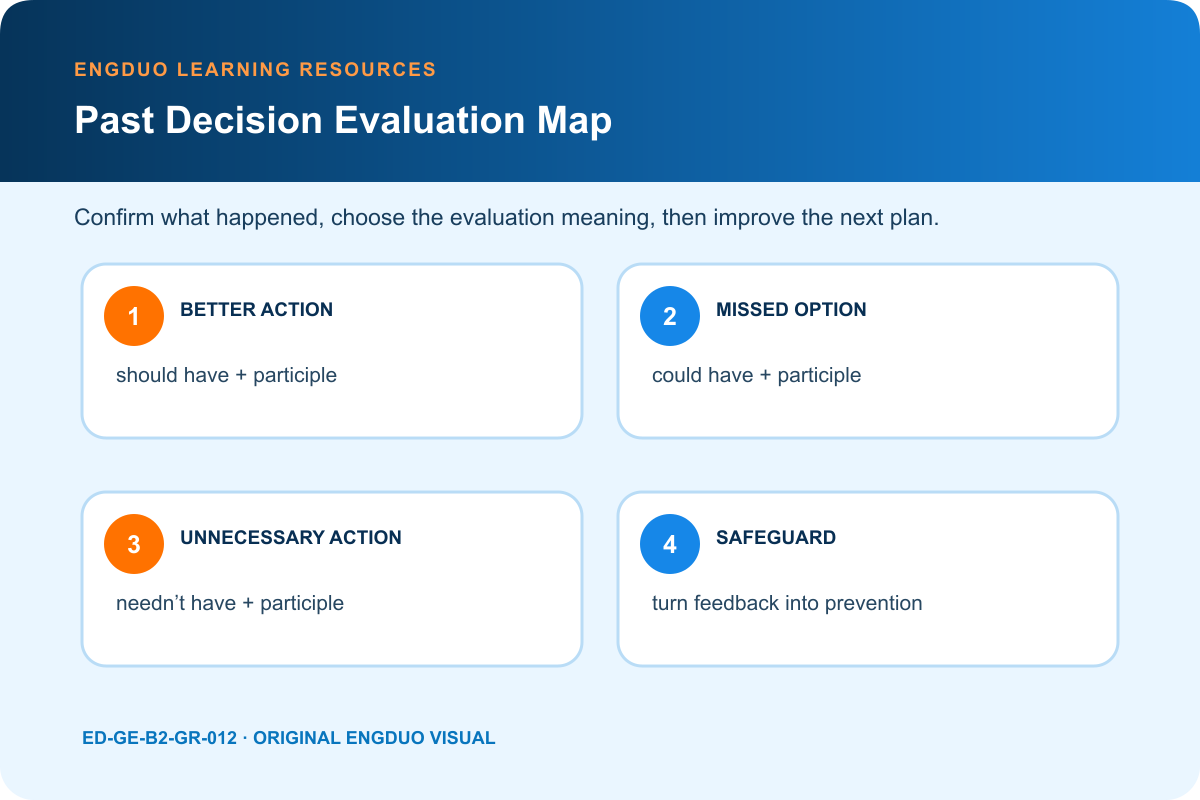
Use four decisions. Confirm what happened and what effect it had before choosing a past modal.
How to run Stage 1
3 min: Establish four real actions, results, and alternatives.
Use should have and could have
Use should have for a better expected action and could have for an available but unused possibility. Add impact rather than blame.
How to run Stage 2
5 min: Build should-have criticism and could-have missed options.
Contrast needn’t have with didn’t need to
Engduo Audio: Listen for meaning first. Audio never starts automatically.
Classify the better action, missed option, unnecessary completed work, and safeguard.
Identify criticism, alternative, unnecessary action, and prevention.
Make clear whether the action happened. Practise needn’t have printed versus didn’t need to print.
How to run Stage 3
5 min: Contrast needn’t have with didn’t need to.
Recover meaning and safeguard
Listen to both reviews. Label each statement as better action, missed option, unnecessary work, or prevention.
How to run Stage 4
6 min: Play both reviews and classify evaluation meanings.
Run a lessons-learned meeting
Evaluate four decisions with two should-have forms, one could-have option, one needn’t-have action, softened feedback, and two agreed safeguards.
How to run Stage 5
7 min: Run the lessons-learned meeting and agree safeguards.
Final practice: Review a past decision without turning feedback into blame
Task: Complete a two-minute retrospective using two should-have evaluations, one could-have option, one needn’t-have action, their impacts, and two safeguards.
Success: Each past modal carries the intended evaluation, feedback remains constructive, and the safeguards address the reviewed causes.
LC · Language Control
0 Frequent form problems obscure the intended meaning.
1 Meaning remains clear with some prompting or self-correction.
2 Controls past-modal participles and distinguishes better action, missed option, and unnecessary completed action.
FP · Functional Performance
0 Does not yet complete the communication outcome.
1 Completes most of the outcome with visible prompts.
2 Delivers constructive retrospective feedback and agrees on safeguards independently.
How to run Stage 6
4 min: Score LC and FP, repair one meaning or participle issue, and retry the feedback.
คำอธิบายภาษาไทย — เปิดเมื่อจำเป็นเท่านั้น
เริ่มจากสิ่งที่เกิดจริงก่อน แล้วเลือก should have สำหรับสิ่งที่ควรทำ could have สำหรับทางเลือกที่มี และ needn’t have สำหรับสิ่งที่ทำแล้วแต่ไม่จำเป็น จากนั้นพูดผลกระทบและวิธีป้องกันแทนการตำหนิบุคคล
Continue your learning path
Teaching references
CEFR Companion Volume — used for communication outcomes and observable progress.
Content and media rights
© 2026 Engduo Thailand. This lesson and its original instructional design, text, visuals, and prepared media are for authorized Engduo use. Do not copy, download, republish, sell, scrape, or use any part in another course, website, dataset, product, or AI system without written permission, except where applicable law permits.