
State the strongest fair version of the claim, identify what is valid, and specify whether the disagreement concerns facts, scope, evidence, inference, priority, or action.
Diplomatic Disagreement and Concession
Represent another position fairly, concede its strongest valid point, and challenge its scope, evidence, inference, or recommendation without weakening your own conclusion.
Concessive grammar and calibrated counter-positioning
UseAcknowledge truth or force in another claim, limit the concession precisely, and transition to a counterclaim through clause, adverbial, modal, or comparative structures.
Core formalthough/while + clause · granted/admittedly + proposition · may well…but
Counter-positioningthat said · even so · be that as it may · not so much X as Y · I would not go so far as to…
RememberA genuine concession preserves the other person’s valid point; do not use an acknowledgement formula as a preface to misrepresenting or dismissing it, and make the exact boundary of disagreement explicit.
ชื่อไวยากรณ์ภาษาไทย — เปิดเมื่อจำเป็น
การ concede ที่ดีต้องยอมรับส่วนที่อีกฝ่ายพูดถูกจริง แล้วระบุให้ชัดว่าไม่เห็นด้วยตรง scope, evidence, inference หรือ recommendation ใด ไม่ใช่พูดประโยคสุภาพก่อนแล้วปฏิเสธทั้งหมด
Your goal
By the end of this lesson, you can separate four disagreement targets, formulate six genuine concessions, repair five dismissive or misleading responses, and deliver a fair counter-position that advances a decision.
คำอธิบายเป้าหมายภาษาไทย — เปิดเมื่อจำเป็น
บทนี้ฝึกยอมรับข้อที่อีกฝ่ายมีเหตุผล แล้วโต้แย้งเฉพาะขอบเขต หลักฐาน การอนุมาน หรือข้อเสนอที่ต่างกันอย่างชัดและสุภาพ
Progress focus LCFP
LC · Language Control
Control the target pattern so the intended meaning remains clear.
Control the target pattern so the intended meaning remains clear.
FP · Functional Performance
Complete the lesson’s real communication outcome without teacher-supplied sentences.
Complete the lesson’s real communication outcome without teacher-supplied sentences.
Your grammar path
Use while, although, granted, admittedly, may well, even so, that said, or calibrated distancing with accurate scope and connective force.
Support the counter-position, invite a test or condition, and summarise the remaining common ground and next action.
30-minute lesson route
3 minDisagreement-boundary baseline
5 minClause and stance concession patterns
5 minCounterclaim scope and diplomatic distance
6 minListen and evaluate fairness
7 minDecision-advancing disagreement
4 minFairness logic and action audit
Disagree with a proposition, not a person
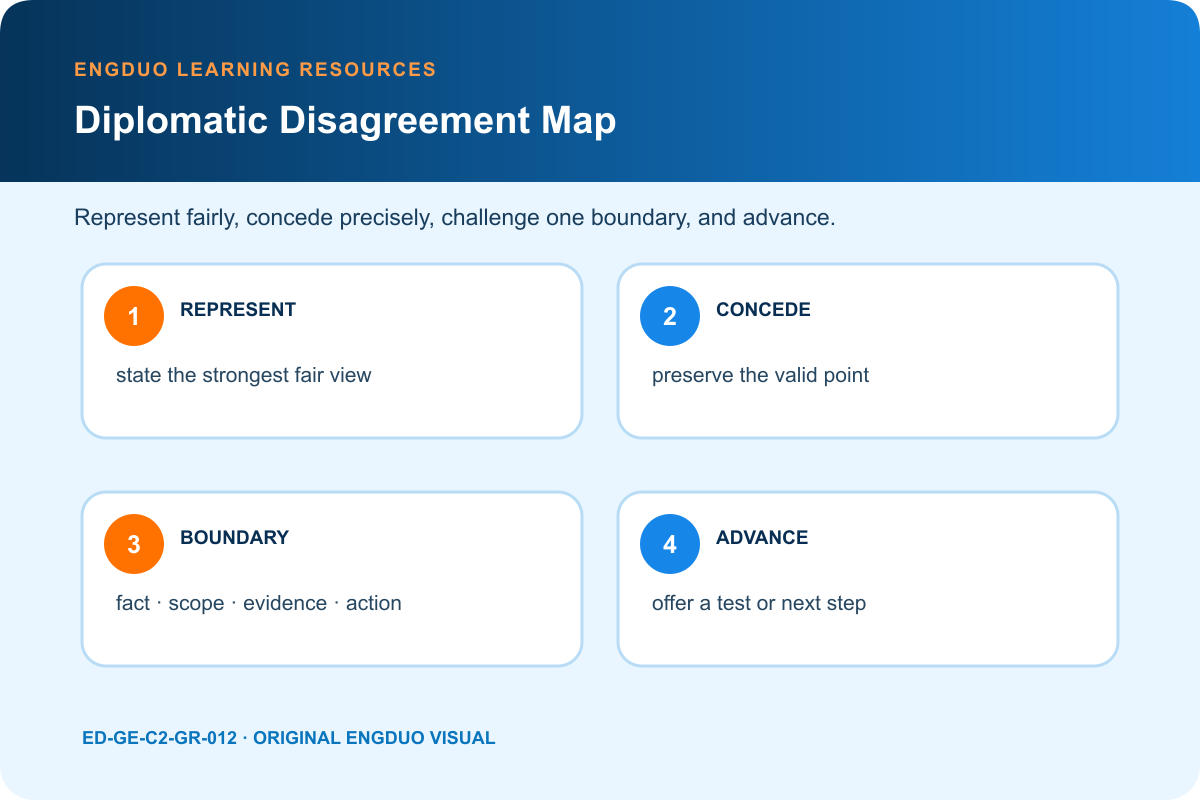
Classify eight disagreements as fact, scope, evidence, inference, priority, wording, or action and state the strongest fair version of the other position.
How to run Stage 1
3 min: Classify disagreement targets and steelman the other position.
Preserve the valid point and its scope
Complete six concession-counterclaim pairs using although, while, granted, admittedly, may well, or that said and reject acknowledgements that distort the original claim.
How to run Stage 2
5 min: Build genuine clause and stance concessions.
Control distance without becoming vague
Engduo Audio: Listen for meaning first. Audio never starts automatically.
Identify valid concessions, disagreement boundary, distancing, and reframing.
Compare formulaic acknowledgement with a genuine concession and decision-advancing counterproposal.
Repair five blunt or evasive responses using precise scope, modal distance, comparative reframing, evidence limits, and a condition or question that advances testing.
How to run Stage 3
5 min: Calibrate counterclaim scope, evidence, and diplomatic distance.
Judge fairness and logical connection
Listen to both clips, map concession, boundary, counterevidence, and next step, then explain why the formulaic first response fails despite sounding polite.
How to run Stage 4
6 min: Play both clips and evaluate fairness and decision value.
Deliver a decision-advancing disagreement
Respond to a proposal by representing it fairly, conceding its strongest point, challenging one defined boundary with evidence, and offering a testable condition or alternative.
How to run Stage 5
7 min: Run the two-minute decision-advancing disagreement.
Final practice: Challenge the right part and preserve the common ground
Task: Deliver a two-minute response that fairly represents another proposal, concedes its strongest valid point, identifies the exact boundary of disagreement, supports a counter-position, and proposes a testable next step.
Success: The other position is represented accurately, the concession is genuine and bounded, the counterclaim targets one explicit issue, evidence and stance are calibrated, and the response advances rather than closes the decision.
LC · Language Control
0 Frequent form problems obscure the intended meaning.
1 Meaning remains clear with some prompting or self-correction.
2 Controls concessive clauses, stance adverbials, modal acknowledgement, counter-positioning, comparative reframing, scope, and diplomatic distance as a coherent argument unit.
FP · Functional Performance
0 Does not yet complete the communication outcome.
1 Completes most of the outcome with visible prompts.
2 Produces an independent fair disagreement that preserves common ground, challenges a precise boundary with evidence, and offers a practical route toward decision or testing.
How to run Stage 6
4 min: Score LC and FP, repair one unfair or vague move, and retry it.
คำอธิบายภาษาไทย — เปิดเมื่อจำเป็นเท่านั้น
สรุปความเห็นอีกฝ่ายให้เขายอมรับก่อน แล้ววงส่วนที่เห็นด้วยและส่วนที่ต่างกัน เขียนว่า disagreement อยู่ที่ fact, scope, evidence, inference หรือ action จากนั้นเลือก concessive pattern และจบด้วยเงื่อนไข คำถาม หรือทางเลือกที่ทดสอบได้
Continue your learning path
Teaching references
CEFR Companion Volume — used for communication outcomes and observable progress.
Content and media rights
© 2026 Engduo Thailand. This lesson and its original instructional design, text, visuals, and prepared media are for authorized Engduo use. Do not copy, download, republish, sell, scrape, or use any part in another course, website, dataset, product, or AI system without written permission, except where applicable law permits.