
State the change and one clear alternative time.
← Back to General English lessons
Writing Practice · A1 Core → A2 Direction
A Friendly Message to Change Plans
Write a short message that helps the reader understand what changed, why, what alternative you suggest, and how to respond.
Your goal
By the end of this lesson, you can write and revise a friendly 50–70 word message that changes a plan, gives a brief reason, offers a specific alternative, and asks the reader to confirm.
ดูคำอธิบายเป้าหมายภาษาไทย — เปิดเมื่อจำเป็น
นักเรียนจะเขียนข้อความสั้นที่ผู้อ่านเข้าใจได้ทันทีว่าแผนเดิมเปลี่ยนอย่างไร เหตุผลโดยย่อคืออะไร มีเวลาใหม่ให้เลือกเมื่อไร และต้องตอบกลับอะไร จากนั้นตรวจในมุมของผู้อ่านและแก้ข้อความให้ชัดขึ้น
Progress focusWRLC
WR · Written CommunicationOrganise the message so the reader can identify the change, reason, alternative, and required response without guessing.
LC · Language ControlUse understandable sentences, suitable time expressions, and polite request forms with errors that do not obscure the intended action.
Your progress path
Add a brief reason, friendly opening, and confirmation request.
Control tone, remove unnecessary detail, and revise after a reader check.
30-minute lesson route
2 minReader & purpose
5 minNotice the model
5 minPlan four parts
6 minRepair weak messages
8 minWrite independently
4 minReader check & revise
Teacher Lesson Plan · Read before class
Writing Practice standard: Write for a real reader. Plan with keywords, draft once, check whether the reader can act, then revise. Do not correct every sentence before the message is complete.
Teacher: Set the reader, purpose and required response.
Student: Identifies who will read and what they must understand.
Required result: A real writing purpose.
Teacher: Use the model to notice the four message jobs.
Student: Labels change, reason, alternative and response.
Required result: A message structure.
Teacher: Limit planning to key words.
Student: Plans the four parts without writing full sentences.
Required result: Ideas before drafting.
Teacher: Let the student draft without interruption.
Student: Writes the complete first message.
Required result: One independent draft.
Teacher: Read as the intended reader and ask what is unclear.
Student: Checks clarity, tone and required action.
Required result: Reader-focused revision decisions.
Teacher: Give two priorities and request a final revision.
Student: Revises and submits the clearer message.
Required result: Visible writing progress.
Feedback rule: Let the learner complete the attempt first. Give one communication or task-success point and one language improvement, then run a short retry.
1. Start with the reader and purpose
Before choosing grammar, decide what the reader needs to understand and do.
Reader
Who will receive the message? Friend, classmate, teacher, or colleague?
Purpose
What plan must change, and what response do you need?
How to run Stage 1
Ask who will read the message and what response is needed. Keep the learner’s answer to one reader and one purpose before discussing language.
2. Notice the four jobs in a useful message
Model message
Hi May, I’m sorry, but I need to change our lesson on Friday. Something has come up at work. Could we meet at 11:00 on Saturday instead? If that doesn’t work, I’m free after 4:00 on Sunday. Please let me know which time works for you. Thanks for understanding.
- What plan is changing?
- How much reason does the writer give?
- Which two alternatives can the reader choose?
- What does the writer ask the reader to do?
Check the four jobs — open after marking the message
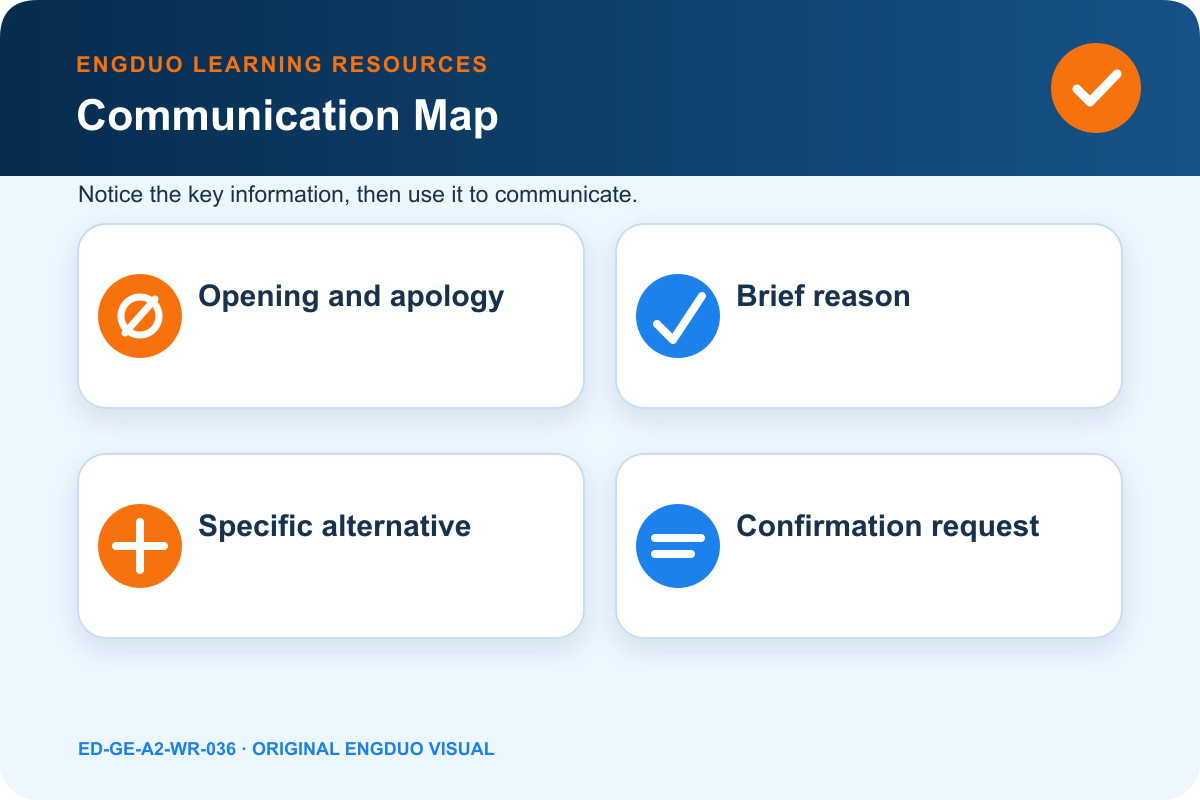
Change: Friday’s lesson · Reason: something at work · Alternatives: Saturday at 11:00 or Sunday after 4:00 · Response: choose a time.
Hear the complete message
Listen for the apology, alternative, and response request.
Hear another version
Notice which details change while the four message jobs remain.
How to run Stage 2
Read or play the model once. The learner identifies change, reason, alternative, and required response. Do not correct grammar yet.
3. Plan four parts with key words
Plan the information before writing full sentences. This prevents a polite message from becoming vague.
Planning rule: Be specific about the new plan, but keep private or unnecessary reasons brief.
How to run Stage 3
Require key words only, not full sentences. Check that all four message jobs have enough information before drafting.
4. Choose language for each job
Change
I’m sorry, but I need to change …
I’m afraid I can’t make …
Reason
Something has come up.
I have an appointment at that time.
Alternative
Could we meet at … instead?
Would … work for you?
Response
Please let me know.
Which time works better for you?
How to run Stage 4
Let the learner choose one useful phrase for each job, then personalise it. Avoid copying the complete model message.
5. Repair three weak messages
Too vague
“Can’t make it. Maybe later?” Add the plan and one specific alternative.
Too much detail
Reduce a long personal explanation to one reader-appropriate reason.
No alternative
Add a realistic day and time the reader can accept or decline.
No next action
Add a question or confirmation request so the reader knows how to respond.
How to run Stage 5
Give one weak message at a time. Ask what the reader cannot understand or act on, then repair only the missing job.
6. Write, test, and revise
Write a 50–70 word message for a real or realistic change. Then give it to a reader without explaining it aloud.
Reader test
- What plan is changing?
- What new option is available?
- What should I do next?
If the reader cannot answer one question, revise the missing or unclear part. Do not rewrite everything automatically.
How to run Stage 6
Let the learner finish the first draft before feedback. Run the reader test: identify the change, reason, alternative, and next action; revise the least clear part.
Final practice: Write for a real response
Complete the message from a short situation without copying the model. A reader checks whether the message provides enough information to respond before you revise one weak part.
Task: Write 50–70 words that change a plan, give a brief reason, offer a specific alternative, and ask for confirmation.
Success: The reader can identify what changed, choose or respond to the alternative, and understand the requested next action.
WR · Written Communication
2 The four message jobs are organised and complete enough for the reader to respond independently.
1 The reader understands the main change but needs one prompt about an alternative or next action.
0 An essential message job is missing or the required response is not yet clear.
LC · Language Control
2 Sentences, time expressions, and polite request forms keep the message clear and appropriate.
1 Meaning is clear after one language or time-expression prompt.
0 Form problems obscure the plan or requested response.
How to run Stage 7
Give a new situation without a complete model. Score WR and LC from 0–2, give one reader-focused point and one language improvement, then ask for one targeted revision.
คำอธิบายภาษาไทย — เปิดเมื่อจำเป็นเท่านั้น
เริ่มจากสิ่งที่ผู้อ่านต้องรู้และต้องทำ ไม่จำเป็นต้องอธิบายเหตุผลส่วนตัวยาว ๆ แต่ต้องระบุแผนที่เปลี่ยน เวลาใหม่ที่ชัดเจน และสิ่งที่ต้องการให้ผู้อ่านตอบ หลังเขียนให้คนอื่นอ่านโดยไม่อธิบายเพิ่ม หากเขาตอบคำถาม Reader test ไม่ได้ ให้แก้เฉพาะส่วนที่ขาดหรือไม่ชัด
Teacher guide · 30-minute delivery
- Give one realistic reader and situation. Confirm the response the writer needs.
- Use the model to identify four message jobs before discussing grammar.
- Ask the learner to plan key information only: change, reason, alternative, confirmation.
- Repair the weak messages by changing only the information that prevents a useful response.
- Let the learner write independently for eight minutes. Do not dictate complete sentences.
- Run the reader test before correcting language. Identify one communication gap and one language-control need.
- Give one focused correction and ask the learner to revise the weakest part.
- Record WR and LC separately from 1–3. WR records whether the written message works for the reader; LC records whether sentence and form control keep the intended meaning clear.
Continue your learning path
A Clear Follow-Up Email
Transfer the four-part structure into a professional message with actions and deadlines.
Write a Useful Recommendation
Develop a short opinion into a clear recommendation with reasons and useful detail.
Teaching references
- CEFR Companion Volume — Written interaction — Supports short functional messages, exchange of relevant information, and development toward clearer connected written interaction.
Content and media rights
© 2026 Engduo Thailand. This lesson and its original instructional design, text, visuals, and prepared audio are for authorized Engduo use. Do not copy, download, republish, sell, scrape, or use any part in another course, website, dataset, product, or AI system without written permission, except where applicable law permits.