
The speaker’s main claim is ___.

A Public Health Discussion
Follow a public health discussion by tracking claims, supporting evidence, limitations, stakeholder concerns, and the final recommendation.
Your goal
By the end of this lesson, you can identify two claims, the evidence offered, one limitation, and the speakers’ level of certainty..
Why this listening matters
Train the learner to understand the situation, collect useful spoken evidence and respond without depending on a transcript. The transcript stays closed until after the first listening attempt.
TF14 · Health, Body & WellbeingProgress Focus
Progress focus: LISTCM
Use the final independent attempt to apply the 0–2 scoring guide consistently.
30-minute lesson route
- Confirm the observable outcome and connect it to one realistic learner need.
- Use the visual and first audio or text for meaning before explaining language.
- Select only the useful-language items needed for this learner and this task.
- Run the supported rehearsal without reading every instruction aloud.
- Run the main task: Listen to an original town discussion about extending shaded walking routes during hot weather. Complete a claim–evidence–limitation–decision grid.
- Record focused evidence, give one meaning-focused and one language-focused correction at most, repeat the weakest part, and complete the exit check.
Engduo Audio: Licensed voices prepared for this lesson. Audio never starts automatically. Use the transcript after the first listening attempt.
1. Listen for the situation
Look at the visual, keep the transcript closed and listen once for the speaker, situation and main purpose.
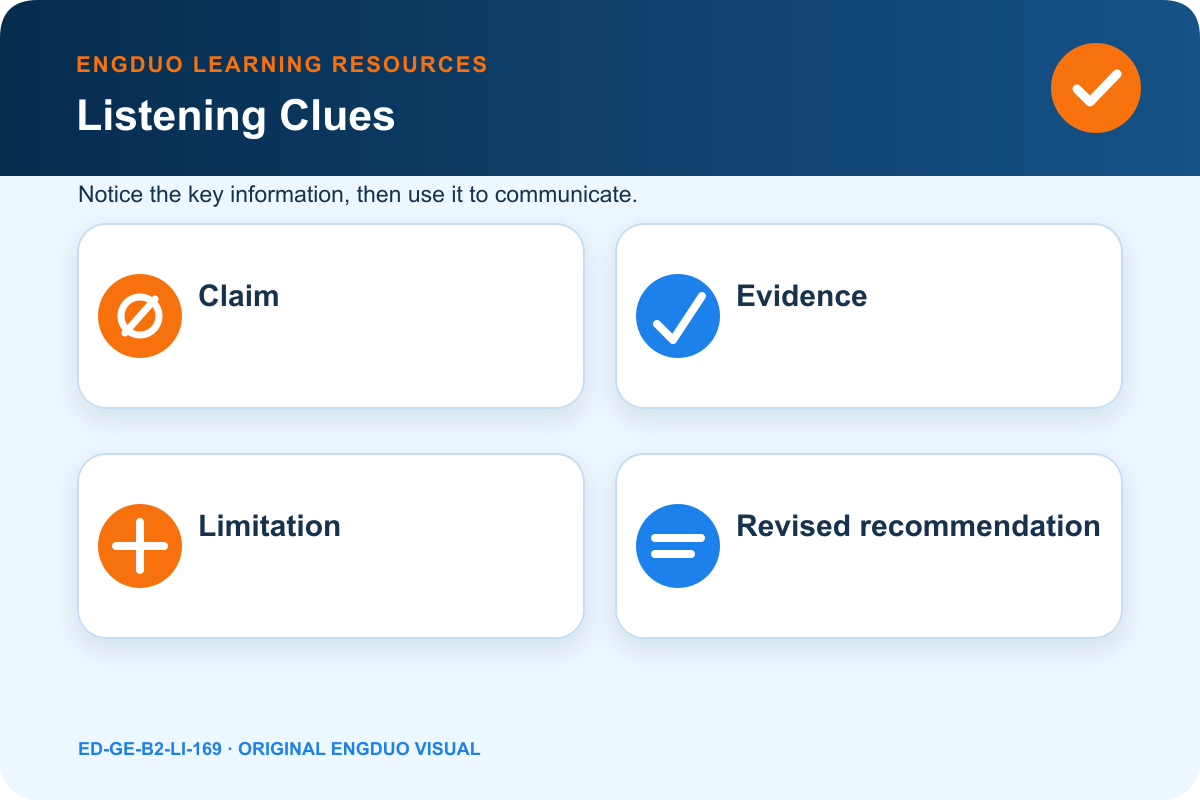
- claim
- evidence
- limitation
- revised recommendation
Engduo Audio • American English
Transcript — open after listening
The planner argues that shaded routes could support safer walking during hot periods. Her evidence comes from temperature measurements on two existing streets.
Engduo Audio • Australian English
Transcript — open after listening
Residents support the idea, but they are concerned about maintenance. The final recommendation is a one-year pilot near the clinic and bus station.
Teacher Help · Stage 1
Keep the transcript closed. Set one gist question, play the audio once without pausing and accept a short answer before discussing details.
2. Build a listening map
Identify the meaning categories or signal phrases that will help you recognise the important information.
The evidence comes from ___.
A limitation is ___.
Residents are concerned about ___.
The proposal was revised to ___.
The final recommendation is ___.
Teacher Help · Stage 2
Preview only the categories or signal words needed for the task. Do not explain every line or reveal the answers.
3. Listen again and collect evidence
Replay only as needed. Record the exact details that support each answer, then compare before opening the transcript.
- Separate claims from examples and evidence.
- Track which speaker introduces each concern.
- Update a recommendation when a limitation appears.
Teacher Help · Stage 3
Play again at natural speed. Ask what exact word, number, reason or change supports each answer; replay only an uncertain section.
4. Complete the listening task
Use the spoken evidence to choose, organise, clarify or respond to the real communication need in this lesson.
Listen to an original town discussion about extending shaded walking routes during hot weather. Complete a claim–evidence–limitation–decision grid.
Teacher Help · Stage 4
Require the learner to use the collected evidence to complete the lesson outcome. Prompt for clarification only when meaning breaks down.
5. Final practice: Listen and respond independently
Complete a fresh or less-supported listening attempt, give the required response and retry the weakest detail after one focused prompt.
Listen once to a new discussion, identify three viewpoints, two evidence points, two limitations, and the final recommendation; justify each with a listening clue.
Retry: Repeat once with clearer meaning, stronger evidence, more accurate listening, or less support.
Teacher Help · Stage 5
Use a fresh item or remove visible support. Observe without interrupting, give one listening-focused correction and ask for a short retry.
Exit check
Complete this without reading a model: Report one claim, its evidence, and its limitation.
Success looks like: The learner reconstructs how evidence and concerns shape the final recommendation.
Evidence: listening · Repeat the weakest part once after one meaning-focused and one language-focused correction at most.
LIST · Listening Comprehension
2: Understands and uses the required spoken evidence accurately.
1: Demonstrates the skill after one focused prompt, correction or self-repair.
0: Cannot yet demonstrate the skill clearly enough to complete the stated outcome.
CM · Communication Management
2: Organises ideas, turns, clarification and response coherently.
1: Demonstrates the skill after one focused prompt, correction or self-repair.
0: Cannot yet demonstrate the skill clearly enough to complete the stated outcome.
Use these scores after the independent attempt. Give one specific success note and choose one next practice focus.
Teacher Help · Stage 6
Score the stated Progress Focus from the independent attempt. Name one successful listening behaviour and one precise next practice focus.
คำอธิบายภาษาไทย — เปิดเมื่อจำเป็นเท่านั้น
ฟังให้แยก claim, evidence, limitation และ final recommendation ไม่เลือกคำตอบจาก keyword เดียว และตามให้ทันเมื่อข้อเสนอถูกปรับ
Teacher Guidance · How to conduct this class
30-minute must-do route
- Confirm the observable outcome and connect it to one realistic learner need.
- Use the visual and first audio or text for meaning before explaining language.
- Select only the useful-language items needed for this learner and this task.
- Run the supported rehearsal without reading every instruction aloud.
- Run the main task: Listen to an original town discussion about extending shaded walking routes during hot weather. Complete a claim–evidence–limitation–decision grid.
- Record focused evidence, give one meaning-focused and one language-focused correction at most, repeat the weakest part, and complete the exit check.
60-minute extension
- Add two similar statistics serving different claims and require precise matching.
- Change the role, information, listener, or constraint so the learner transfers the skill rather than repeating the same answer.
- Compare the first and second performance and record one specific improvement.
Make it easier
Use four labelled columns and replay each speaker turn once.
Make it harder
Add two similar statistics serving different claims and require precise matching.
Likely difficulty
The learner may record every detail equally or confuse an example with evidence.
Correction priority
Prioritise speaker stance, evidence source, limitation, and revised decision.
Thai support rule
Keep the Thai panel closed unless examples, visuals, replay, reformulation, and simpler English do not allow progress. Explain only the key distinction, then return to English.
Progress record
Use the 0–2 guide after the independent attempt and identify one recurring need for the next lesson.
Retry
Give one meaning-focused correction and one language-focused correction at most, then ask for a second attempt with fewer visible prompts.
- Council of Europe — CEFR Companion Volume — Supports action-oriented language learning through age- and level-appropriate interaction, descriptions, goal-oriented co-operation, written interaction, and observable communication outcomes.
- British Council LearnEnglish — Health vocabulary — Supports B1 topic vocabulary for discussing health, symptoms, treatment, and healthcare situations.
Content and media rights
© 2026 Engduo Thailand. Authorized Engduo use only. Copying, republishing, reselling, scraping, or reuse in another course, dataset, product, or AI system requires written permission except where applicable law permits.