
Decide whether the audience first needs the actor, affected participant, action, outcome, or responsibility.

Advanced Passive Choices
Choose active, be-passive, get-passive, result-oriented forms, and explicit agents according to responsibility, affectedness, formality, and information flow.
Advanced passive framing
UseControl whether a message foregrounds the actor, affected participant, action, resulting state, or unexpected involvement.
Core formactive · be + past participle · get + past participle
Agent and result choiceadd by + agent when responsibility matters · distinguish an event passive from an adjective-like resulting state
RememberRemoving the agent is an information choice, not a neutral operation; include responsibility when the audience needs it to understand or act.
ชื่อไวยากรณ์ภาษาไทย — เปิดเมื่อจำเป็น
Advanced passive ต้องเลือกว่าเน้นผู้กระทำ ผู้ได้รับผล การกระทำ หรือสภาพผลลัพธ์ be-passive เหมาะกับการรายงานทั่วไป get-passive มักเน้นการเข้าไปเกี่ยวข้องหรือเหตุการณ์ที่ไม่คาดคิด และควรใส่ by + agent เมื่อความรับผิดชอบสำคัญ
Your goal
By the end of this lesson, you can justify eight voice choices, distinguish event from result, repair three hidden-responsibility messages, and deliver an incident update with appropriate information focus.
คำอธิบายเป้าหมายภาษาไทย — เปิดเมื่อจำเป็น
บทนี้ฝึกเลือก active, be-passive, get-passive และสภาพผลลัพธ์ตามจุดเน้น รวมถึงตัดสินใจว่าจะเปิดเผย agent เมื่อใดเพื่อไม่ซ่อนความรับผิดชอบที่จำเป็น
Progress focus LCFP
LC · Language Control
Control the target pattern so the intended meaning remains clear.
Control the target pattern so the intended meaning remains clear.
FP · Functional Performance
Complete the lesson’s real communication outcome without teacher-supplied sentences.
Complete the lesson’s real communication outcome without teacher-supplied sentences.
Your grammar path
Use active, be-passive, or get-passive and distinguish a completed event from a current resulting state.
Place known information first, include the agent when actionable, and avoid passive wording that conceals a critical owner.
30-minute lesson route
3 minInformation-focus baseline
5 minActive be-passive and result
5 minGet-passive and agent choice
6 minListen and audit framing
7 minIncident-update task
4 minFeedback and retry
Rank actor, affected participant, action, and result
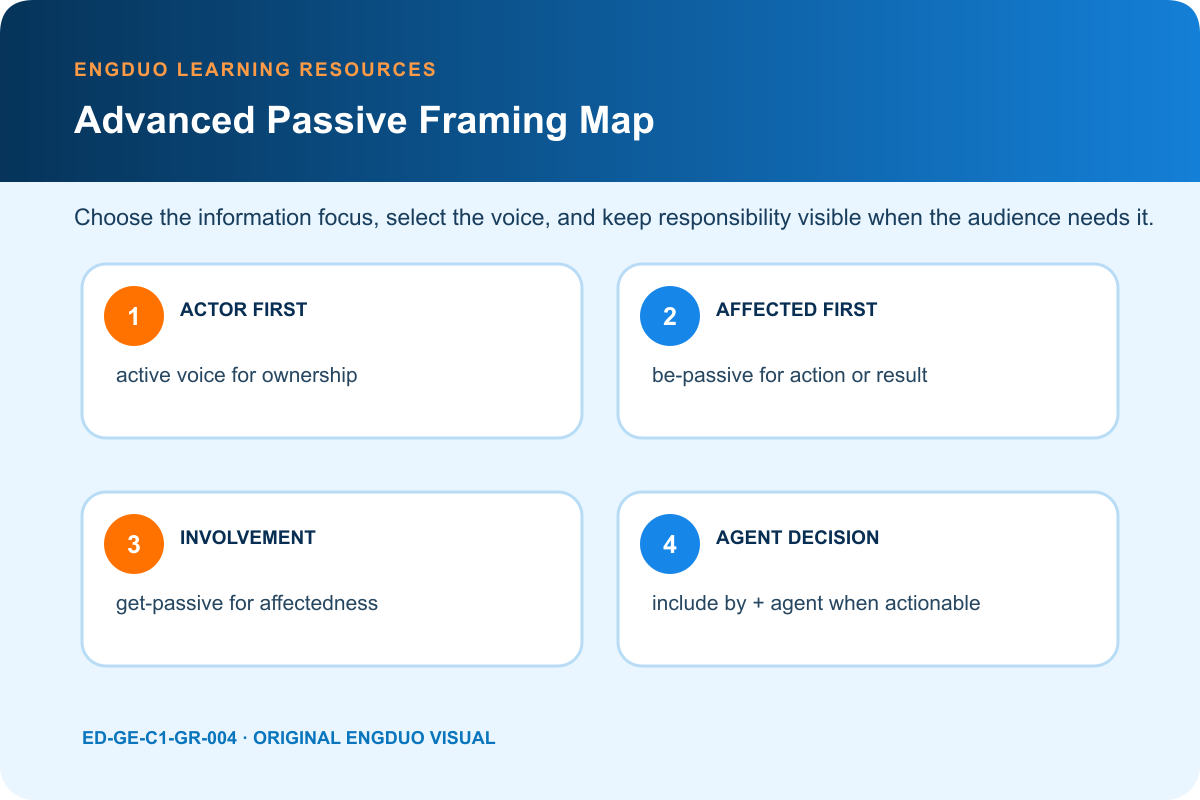
Use eight messages and identify what the audience needs first and whether responsibility must remain visible.
How to run Stage 1
3 min: Rank the information focus and accountability need in eight messages.
Frame events and resulting states
Transform messages while preserving information flow and distinguishing event meaning from adjective-like result.
How to run Stage 2
5 min: Contrast active, be-passive, event, and resulting-state readings.
Show unexpected involvement without hiding ownership
Engduo Audio: Listen for meaning first. Audio never starts automatically.
Explain why the agent is named once and backgrounded elsewhere.
Distinguish unexpected affectedness, resulting state, event passive, and ongoing review.
Use get-passive selectively and add, omit, or reposition agents according to relevance and accountability.
How to run Stage 3
5 min: Use get-passive and make explicit agent decisions.
Evaluate grammar and ethics of information choice
Listen to both updates and identify what each voice choice reveals, backgrounds, or risks concealing.
How to run Stage 4
6 min: Play both updates and audit what each framing reveals or conceals.
Deliver a responsibly framed incident update
Give a two-minute update using active, be-passive, get-passive, one result state, and two deliberate agent decisions.
How to run Stage 5
7 min: Run the responsibly framed incident update with required voice variety.
Final practice: Frame impact clearly without hiding responsibility
Task: Deliver a two-minute incident update using at least four voice choices and explain one decision to include or omit an agent.
Success: Voice choices support information flow, event and result meanings are distinct, and responsibility remains visible wherever the audience needs it.
LC · Language Control
0 Frequent form problems obscure the intended meaning.
1 Meaning remains clear with some prompting or self-correction.
2 Controls active, be-passive, get-passive, result interpretation, and agent expression according to information focus.
FP · Functional Performance
0 Does not yet complete the communication outcome.
1 Completes most of the outcome with visible prompts.
2 Frames a complex incident accurately, coherently, and responsibly without support.
How to run Stage 6
4 min: Score LC and FP, repair one focus or accountability problem, and retry it.
คำอธิบายภาษาไทย — เปิดเมื่อจำเป็นเท่านั้น
ถามก่อนว่าผู้ฟังต้องรู้ใครทำ ใครได้รับผล เกิดอะไร หรือผลเป็นอย่างไร หาก agent สำคัญต่อความรับผิดชอบให้กล่าวชัด ใช้ get-passive เมื่อเน้นผู้ที่เข้าไปเกี่ยวข้องหรือผลที่ไม่คาดคิด แต่ไม่ใช้เพื่อหลบเลี่ยงเจ้าของงาน
Continue your learning path
Teaching references
CEFR Companion Volume — used for communication outcomes and observable progress.
Content and media rights
© 2026 Engduo Thailand. This lesson and its original instructional design, text, visuals, and prepared media are for authorized Engduo use. Do not copy, download, republish, sell, scrape, or use any part in another course, website, dataset, product, or AI system without written permission, except where applicable law permits.