
Define evidence, source positions, uncertainty, responsible actors, alternatives, audience, and required decision before choosing grammar.

C1 Integrated Mastery: Control, Stance, and Flexibility
Integrate advanced grammar to analyse evidence, attribute positions, organise information, adapt register, and repair language during a complete real-world performance.
Integrated C1 grammar control
UseSelect and combine C1 structures according to meaning, evidence, information focus, source stance, audience, cohesion, and interpersonal purpose.
Core formaspect and viewpoint · modal and claim calibration · voice and information structure · cohesion and clause reduction
Flexible controlnominal and noun-phrase packaging · reporting stance · connectors · register shift · ambiguity repair
RememberMastery is not the number of advanced structures used; choose the least complex form that expresses the intended relationship precisely, then monitor and repair it independently.
ชื่อไวยากรณ์ภาษาไทย — เปิดเมื่อจำเป็น
บทสรุป C1 วัดการเลือก grammar ให้ตรง meaning, evidence, stance, focus, audience และความสัมพันธ์ระหว่างข้อมูล ไม่ได้วัดจากจำนวนโครงสร้างยาก ผู้เรียนต้องตรวจและแก้ภาษาของตนเองได้
Your goal
By the end of this lesson, you can plan from meaning, select structures from six C1 systems, deliver a three-minute decision briefing, adapt one section for another audience, and repair two weaknesses independently.
คำอธิบายเป้าหมายภาษาไทย — เปิดเมื่อจำเป็น
บทนี้รวมทักษะ C1 ให้ผู้เรียนวางแผนจากความหมาย เลือกโครงสร้างตามหลักฐานและผู้ฟัง นำเสนอ ตอบคำถาม ปรับ register และแก้ข้อผิดพลาดของตนเอง
Progress focus LCFP
LC · Language Control
Control the target pattern so the intended meaning remains clear.
Control the target pattern so the intended meaning remains clear.
FP · Functional Performance
Complete the lesson’s real communication outcome without teacher-supplied sentences.
Complete the lesson’s real communication outcome without teacher-supplied sentences.
Your grammar path
Choose only the aspect, stance, focus, cohesion, information-packaging, and register structures that serve each part of the message.
Deliver the briefing, answer a challenge, reformulate one section for a different audience, and repair two weaknesses using evidence from listener response.
30-minute lesson route
4 minMeaning-and-audience decision map
5 minC1 structure selection
4 minEvidence stance and cohesion rehearsal
5 minListen and critique model briefings
8 minDecision briefing and audience shift
4 minScored self-repair and retry
Plan meaning before language
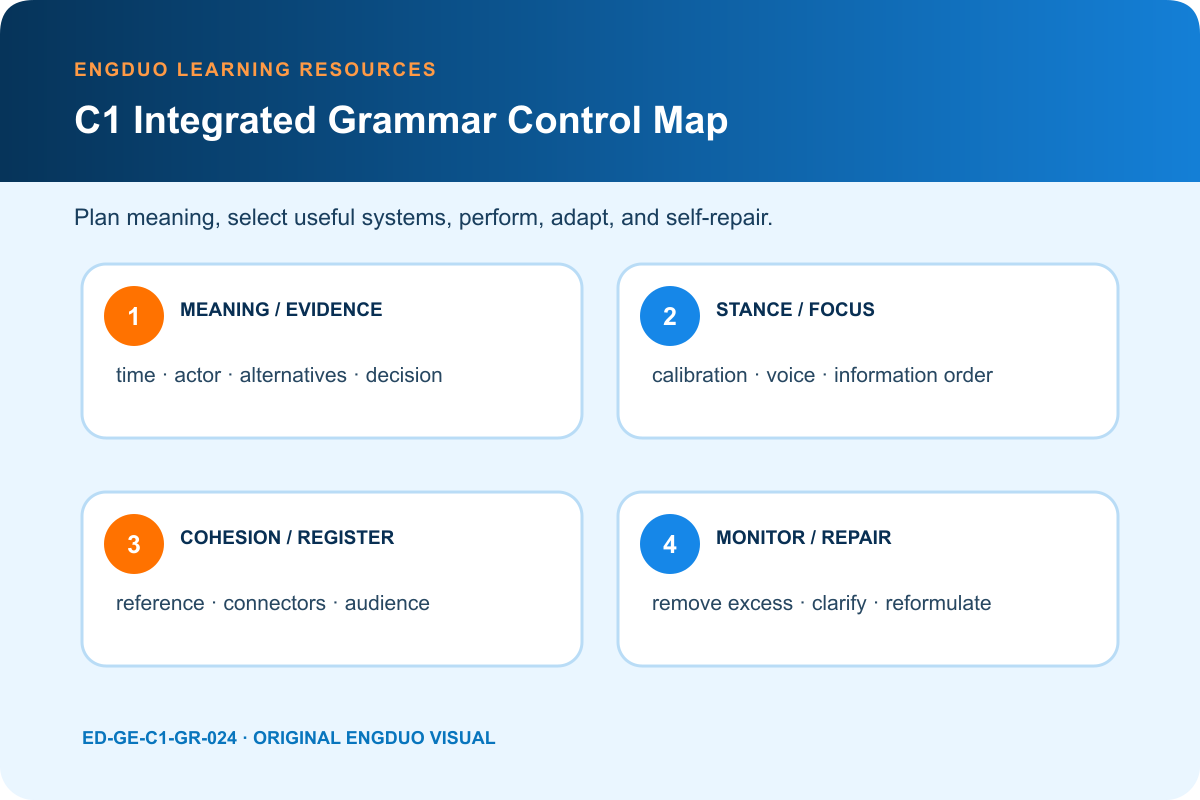
Record evidence, source positions, uncertainty, actors, alternatives, audience, and the decision required.
How to run Stage 1
4 min: Build the meaning, evidence, actor, and audience decision map.
Use complexity only where it adds precision
Choose structures from at least six systems and explain the meaning or discourse job of each choice.
How to run Stage 2
5 min: Select C1 structures and justify their functions.
Check stance, cohesion, focus, and ambiguity
Engduo Audio: Listen for meaning first. Audio never starts automatically.
Identify viewpoint, reporting stance, calibration, condition, focus, connector, nominalisation, and responsibility.
Compare register and structure while checking which facts, stance, condition, and action remain constant.
Run a ninety-second draft, remove one unnecessary complex structure, and repair one unclear reference or scope.
How to run Stage 3
4 min: Rehearse stance, cohesion, focus, and ambiguity control.
Compare two valid register solutions
Listen to both briefings, identify the systems used, and verify which meaning remains constant across the audience shift.
How to run Stage 4
5 min: Play both briefings and critique the audience shift.
Deliver, adapt, and self-repair
Give a three-minute decision briefing, answer one evidence challenge, adapt one section for a different audience, and repair two weaknesses independently.
How to run Stage 5
8 min: Run the decision briefing, challenge response, and reformulation.
Final practice: Choose, control, adapt, and repair C1 grammar
Task: Deliver a three-minute evidence-based decision briefing, answer a challenge, reformulate one section for another audience, and make two evidence-based self-repairs.
Success: Structures serve meaning rather than display complexity, evidence and stance are calibrated, information flow and register fit the audience, and self-repairs improve accuracy and clarity.
LC · Language Control
0 Frequent form problems obscure the intended meaning.
1 Meaning remains clear with some prompting or self-correction.
2 Selects and controls C1 grammar across viewpoint, stance, focus, cohesion, information packaging, register, and ambiguity repair.
FP · Functional Performance
0 Does not yet complete the communication outcome.
1 Completes most of the outcome with visible prompts.
2 Delivers, adapts, defends, and independently repairs a sustained C1 decision briefing with flexible audience-aware control.
How to run Stage 6
4 min: Score LC and FP, complete two self-repairs, and retry the weakest section.
คำอธิบายภาษาไทย — เปิดเมื่อจำเป็นเท่านั้น
วางแผนจาก evidence, stance, actor, audience และ decision ก่อน เลือกโครงสร้างยากเฉพาะจุดที่ช่วยความหมาย หากโครงสร้างง่ายชัดกว่าให้ใช้แบบง่าย หลังพูดให้เลือกสองจุดที่ต้องแก้และอธิบายว่าการแก้ทำให้ความหมายดีขึ้นอย่างไร
Continue your learning path
Teaching references
CEFR Companion Volume — used for communication outcomes and observable progress.
Content and media rights
© 2026 Engduo Thailand. This lesson and its original instructional design, text, visuals, and prepared media are for authorized Engduo use. Do not copy, download, republish, sell, scrape, or use any part in another course, website, dataset, product, or AI system without written permission, except where applicable law permits.