Listening: Check the Item, Price, and Purchase Details
Listen for purchase details before comparing
ฟังรายละเอียดการซื้อก่อนเปรียบเทียบ

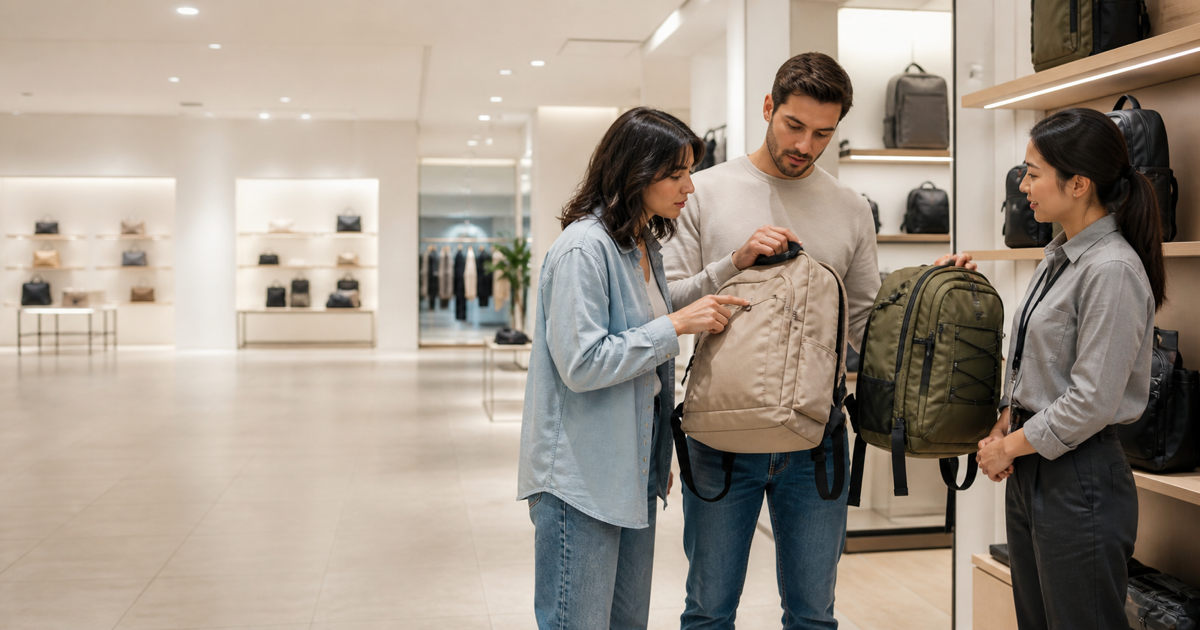
Match product evidence to a buyer’s needs, explain the trade-off and make a practical recommendation.
For learners: Compare product evidence, match a buyer need and defend a recommendation with a trade-off.
For teachers: Priorities and expressions lead to evidence comparison, recommendation, partner response, adaptation and final proof.
สำหรับผู้เรียน: เปรียบเทียบหลักฐานสินค้า จับคู่กับความต้องการผู้ซื้อ และปกป้องคำแนะนำพร้อมข้อแลกเปลี่ยน
สำหรับครู: เริ่มจากจัดลำดับความสำคัญและสำนวน แล้วเปรียบเทียบหลักฐาน แนะนำ โต้ตอบ ปรับแผน และพิสูจน์ผลลัพธ์
Compare two products across relevant criteria, connect evidence to a buyer profile, explain one trade-off, ask a useful follow-up question, and recommend the best fit independently.
เปรียบเทียบสินค้าสองชิ้นตามเกณฑ์ที่เกี่ยวข้อง เชื่อมข้อมูลกับความต้องการของผู้ซื้อ อธิบายข้อแลกเปลี่ยน ถามคำถามต่อยอด และแนะนำตัวเลือกที่เหมาะที่สุดได้ด้วยตนเอง
Do not reward a long list of features. Require every claim to connect to the buyer’s need, every recommendation to name a trade-off and every unknown to become a question.
| Time | Teacher does | Student does | Evidence |
|---|---|---|---|
| 0–3 | Assigns one buyer profile. | Ranks the buyer’s needs. | A priority order. |
| 3–8 | Elicits comparison and trade-off language. | Builds useful expressions. | A functional phrase set. |
| 8–12 | Reveals the product evidence. | Compares relevant criteria. | Traceable claims. |
| 12–17 | Models one recommendation route. | Builds a true recommendation. | Evidence + trade-off. |
| 17–21 | Runs a partner exchange. | Asks and answers follow-up questions. | Responsive speaking. |
| 21–27 | Changes one constraint. | Revises and defends the choice. | An adapted recommendation. |
| 27–30 | Runs a fresh profile and scores. | Proves the outcome independently. | COM/VR/FP. |
Laptop, crowded train, light bag, budget 1,700 baht.
Clothes, rain, long walks, budget 2,000 baht.
Ask ‘Which need would make the other features irrelevant?’ Keep this as a priority task, not a product discussion yet.
It is lighter than…
It offers more space.
The warranty is longer.
This matters because…
That fits the buyer’s need for…
Although it is…, it…
The main drawback is…
Elicit the function before the phrase. Correct one comparison form, then require the learner to reuse it with a different feature.
| Product | Capacity and weight | Useful features | Price and warranty |
|---|---|---|---|
| City Pack | 24 litres; 700 grams | Padded laptop sleeve; smooth back panel; recycled polyester | 1,590 baht; one-year zip warranty |
| Trail Flex | 30 litres; 1.1 kilograms | Water-resistant nylon; hip strap; external bottle pockets | 1,890 baht; two-year materials and zip warranty |
After each claim ask, ‘Which fact tells you that?’ Do not allow invented comfort, waterproofing or laptop-size information.
For Mina, I would recommend the City Pack. It is lighter, has a padded laptop sleeve, and stays within her budget. The Trail Flex carries more and has better rain protection, but it is heavier and costs three hundred baht more. I would check whether the City Pack is comfortable before buying it.
For Arun, the Trail Flex is the better fit. It has more space, a hip strap, water-resistant material, and a two-year warranty. The City Pack is cheaper and lighter, but it may not protect his things in heavy rain. I would ask how much the bag weighs when it is full.
Keep model audio closed until the learner completes the first recommendation. Use it as a comparison reference, not as a listening score.
Listen for response, not monologue. If the learner ignores a follow-up, ask them to answer the question first and return to the recommendation second.
Do not require a reversal if the learner can justify keeping the choice. Require an explicit condition and evidence either way.
Ploy carries a 15-inch laptop and lunch on a motorbike. She wants rain protection, has a 1,850-baht limit, and dislikes heavy bags.
Score the first unsupported performance, then score the focused retry separately.
Target: 5/6 overall with FP = 2 and no zero.
Score the first recommendation and the final budget adaptation. Give one specific success and one focused retry target.
Listen for purchase details before comparing
ฟังรายละเอียดการซื้อก่อนเปรียบเทียบ
Practise resolving a product problem
ฝึกแก้ปัญหาสินค้าในสถานการณ์จริง
Review precise item and feature vocabulary
ทบทวนคำศัพท์สินค้าและคุณลักษณะให้แม่นยำ
Choose, adapt and resolve a B2 shopping case
เลือก ปรับ และแก้โจทย์ซื้อของระดับ B2