
Separate individual items from substances, materials, and abstract information.
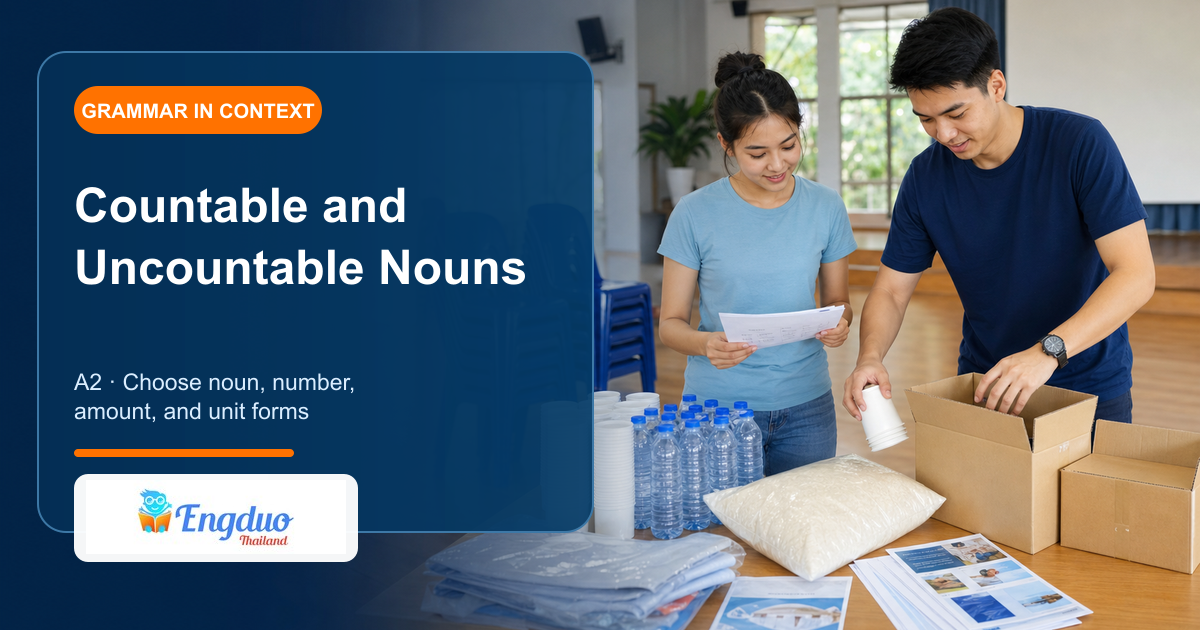
Countable and Uncountable Nouns
Classify everyday nouns by how English counts them, then ask for and confirm useful amounts in a real situation.
Countable and uncountable nouns
UseChoose singular, plural, or amount language according to how a noun is counted in English.
Core forma/an + singular countable · plural countable · uncountable noun
Amount questionHow many + plural? · How much + uncountable?
RememberSome nouns are counted through a unit: a bottle of water, two pieces of advice.
ชื่อไวยากรณ์ภาษาไทย — เปิดเมื่อจำเป็น
คำนามนับได้มีรูปเอกพจน์และพหูพจน์ เช่น a chair, two chairs ส่วนคำนามนับไม่ได้ใช้เป็นมวลหรือแนวคิด เช่น water, information และอาจนับผ่านหน่วย เช่น two bottles of water
Your goal
By the end of this lesson, you can classify common nouns, choose a/an or plural forms, use useful units, and complete an amount check without changing the intended meaning.
คำอธิบายเป้าหมายภาษาไทย — เปิดเมื่อจำเป็น
บทนี้ฝึกดูว่าภาษาอังกฤษมองคำนามนั้นเป็นสิ่งที่นับแยกชิ้นได้หรือเป็นมวล จากนั้นเลือก a/an รูปพหูพจน์ หรือหน่วยนับให้เหมาะสมกับสถานการณ์
Progress focus LCFP
LC · Language Control
Control the target pattern so the intended meaning remains clear.
Control the target pattern so the intended meaning remains clear.
FP · Functional Performance
Complete the lesson’s real communication outcome without teacher-supplied sentences.
Complete the lesson’s real communication outcome without teacher-supplied sentences.
Your grammar path
Use a/an, plural -s, or a useful unit expression.
Ask how many or how much and confirm what is still needed.
30-minute lesson route
3 minSupply baseline
5 minCountability decision
5 minNoun and unit forms
6 minListen and sort
7 minAmount check
4 minFeedback and retry
Identify items, substances, and ideas
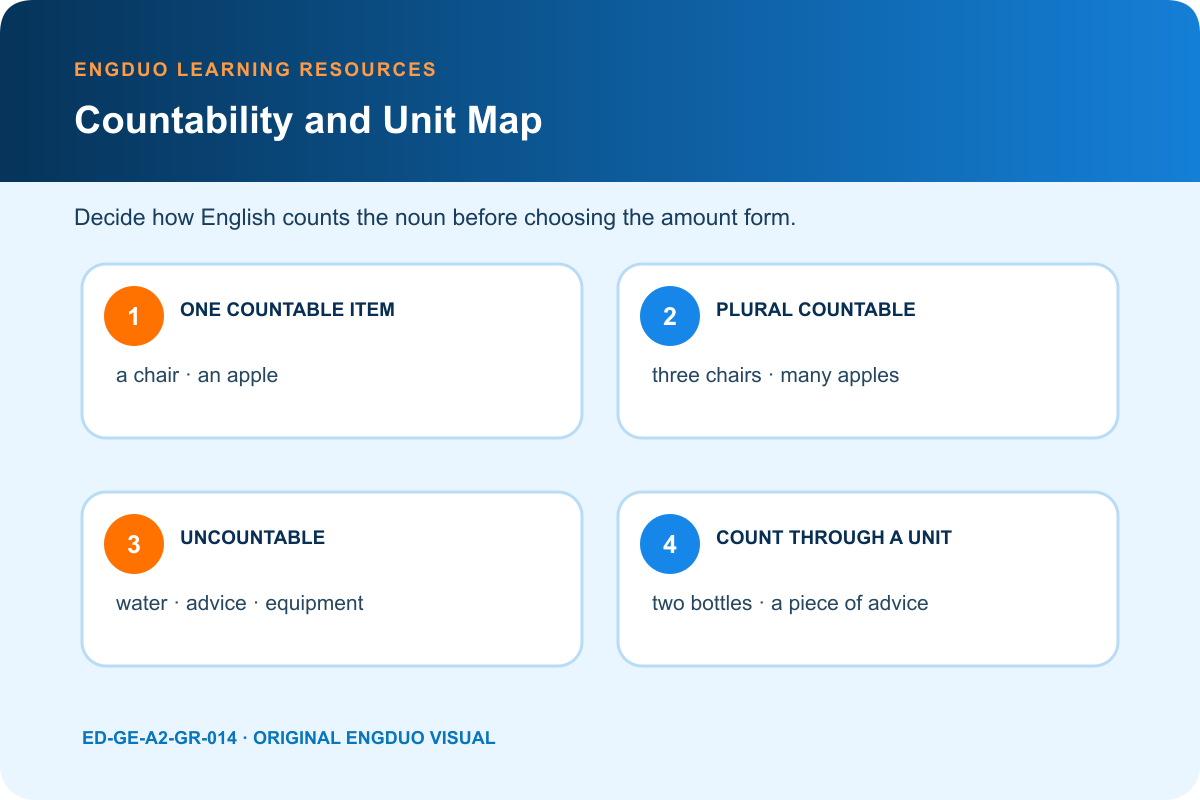
Use a practical list. Mark nouns that can be one or two, nouns normally treated as a mass, and nouns that need a unit to become countable.
How to run Stage 1
3 min: Build a practical list of items and substances.
Use a/an and plural forms with countable nouns
Say a chair or three chairs. Do not use a directly before common uncountable nouns such as information, advice, equipment, rice, or furniture.
How to run Stage 2
5 min: Classify nouns by English countability.
Count the container or piece
Engduo Audio: Listen for meaning first. Audio never starts automatically.
Sort individual items, uncountable nouns, and unit expressions.
Listen for how many, how much, and the units used with food nouns.
Use a bottle of water, a cup of rice, a loaf of bread, or a piece of advice when the situation needs an exact number.
How to run Stage 3
5 min: Add singular, plural, and useful unit forms.
Recover items and amounts
Listen to both recordings. Sort every noun, write its amount or unit, and identify what the speakers already have and still need.
How to run Stage 4
6 min: Play both recordings and sort the amounts and needs.
Complete a supply check
Choose a meal, event, trip, or workspace. Ask at least two how many questions and two how much questions, then agree on four items or amounts still needed.
How to run Stage 5
7 min: Run the supply check and agree on the final list.
Final practice: Check supplies for a practical plan
Task: Complete a supply check using two how many questions, two how much questions, two accurate units, and a final list of what is needed.
Success: Countability choices remain consistent and the final supply list can be acted on without clarification.
LC · Language Control
0 Frequent form problems obscure the intended meaning.
1 Meaning remains clear with some prompting or self-correction.
2 Controls singular, plural, uncountable, and unit forms across questions and answers.
FP · Functional Performance
0 Does not yet complete the communication outcome.
1 Completes most of the outcome with visible prompts.
2 Completes the supply check and confirms an actionable list independently.
How to run Stage 6
4 min: Score LC and FP, repair one countability choice, and retry the affected exchange.
คำอธิบายภาษาไทย — เปิดเมื่อจำเป็นเท่านั้น
อย่าแปลตรงตัวจากภาษาไทย ให้จำการใช้จริงเป็นกลุ่มคำ เช่น some information, a piece of advice, some furniture และ a bottle of water แล้วใช้ how many กับพหูพจน์นับได้ และ how much กับคำนามนับไม่ได้
Continue your learning path
Teaching references
CEFR Companion Volume — used for communication outcomes and observable progress.
Content and media rights
© 2026 Engduo Thailand. This lesson and its original instructional design, text, visuals, and prepared media are for authorized Engduo use. Do not copy, download, republish, sell, scrape, or use any part in another course, website, dataset, product, or AI system without written permission, except where applicable law permits.