
Do not give a finished past time in the present-perfect question.

Experiences with Present Perfect
Ask about life experiences, give useful details, and keep a real conversation moving with a past-simple follow-up.
Present perfect Part 1: life experiences
Use have/has + past participle to ask whether an experience happened at any time before now, then use past simple for the specific story.
Your goal
By the end of this lesson, you can ask and answer about four life experiences with ever and never, then switch to past simple for one specific event.
คำอธิบายเป้าหมายภาษาไทย — เปิดเมื่อจำเป็น
บทนี้ฝึกถามและตอบประสบการณ์ชีวิตด้วย present perfect และ ever/never จากนั้นเปลี่ยนเป็น past simple เมื่อต้องการเล่าเหตุการณ์ที่มีเวลาเฉพาะ
Progress focus LCFP
LC · Language Control
Control the target pattern so the intended time and meaning remain clear.
Control the target pattern so the intended time and meaning remain clear.
FP · Functional Performance
Complete the lesson’s real communication outcome without teacher-supplied sentences.
Complete the lesson’s real communication outcome without teacher-supplied sentences.
Your grammar path
Choose the helper for the subject and use the participle form.
After a yes answer, ask when, where, who, or what happened using past simple.
30-minute lesson route
3 minExperience scan
5 minMeaning & form
5 minEver, never & answers
6 minFollow-up ladder
7 minExperience interview
4 minFeedback & retry
Experience first, specific event second
Use present perfect for the life experience. Use past simple when the conversation moves to a finished time or event.
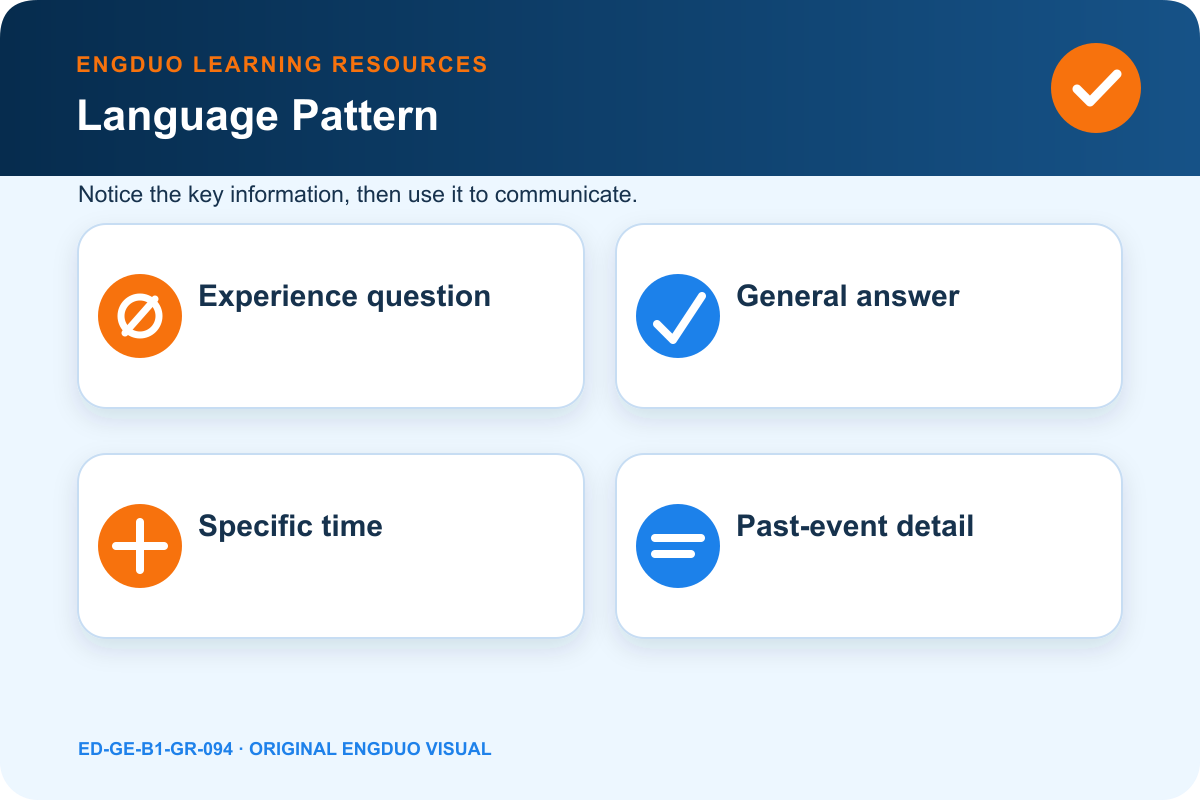
Experience
Have you ever travelled alone?
Have you ever travelled alone?
Specific event
Where did you go?
Where did you go?
Detail
I went to Chiang Mai last year.
I went to Chiang Mai last year.
How to run Stage 1
3 min: Let the learner choose four relevant experience topics.
Build have/has + past participle
Listen for the helper and the participle.
Engduo Audio: Listen for meaning first. Audio never starts automatically.
Listen for the present-perfect question and the past-simple follow-up.
Listen for never, a useful detail, and the next question.
How to run Stage 2
5 min: Play both models and identify experience questions versus specific follow-ups.
Know when to switch to past simple
| Present perfect | Past simple |
|---|---|
| Have you ever met a famous person? | Who did you meet? |
| I’ve never flown alone. | I flew with my family last month. |
Have you ever visited Japan last year?
Did you visit Japan last year?
Did you visit Japan last year?
How to run Stage 3
5 min: Build have/has + participle with ever, never, and short answers.
Build a follow-up ladder
- Have you ever ______?
- Yes, I have. / No, I haven’t. / I’ve never ______.
- When / Where / Who / What did you ______?
- How did you feel about it?
How to run Stage 4
6 min: Rehearse a four-step follow-up ladder using key words only.
Complete an experience interview
Choose four experience topics. Follow one yes answer into a short story and respond naturally to one no answer.
Required: four present-perfect questions, one never statement, three past-simple follow-ups, and one personal reaction.
How to run Stage 5
7 min: Run the experience interview without interruption.
Final practice: Continue a real experience conversation
Task: Ask four experience questions, develop one answer with three past-simple follow-ups, and summarise the most interesting experience you heard.
Success: Present perfect introduces general experience, past simple handles specific details, and the learner continues the interview without teacher-supplied questions.
LC · Language Control
0 Frequent form problems obscure the intended time or meaning.
1 Meaning remains clear with some prompting or self-correction.
2 Controls have/has + past participle and switches to past simple for finished details.
FP · Functional Performance
0 Does not yet complete the communication outcome.
1 Completes most of the outcome with visible prompts.
2 Completes a connected experience interview and summary independently.
How to run Stage 6
4 min: Score LC and FP, correct one tense switch, and retry the affected exchange.
คำอธิบายภาษาไทย — เปิดเมื่อจำเป็นเท่านั้น
ใช้ present perfect เมื่อถามประสบการณ์โดยไม่ระบุเวลาที่จบแล้ว เช่น Have you ever…? เมื่อได้คำตอบแล้ว ใช้ past simple ถามรายละเอียด เช่น Where did you go?
Continue your learning path
Teaching references
CEFR Companion Volume — used for communication outcomes and observable progress.
Content and media rights
© 2026 Engduo Thailand. This lesson and its original instructional design, text, visuals, and prepared media are for authorized Engduo use. Do not copy, download, republish, sell, scrape, or use any part in another course, website, dataset, product, or AI system without written permission, except where applicable law permits.