
Choose past memory, future duty, stopped activity, purpose, tested method, effort, past regret, or difficult news.

Gerund or Infinitive: Common Meaning Changes
Use remember, stop, try, and regret with -ing or to + verb to express different time relationships and intentions.
Gerund or infinitive with meaning-changing verbs
UseShow whether an action is remembered from the past, still needs to be done, ends, changes purpose, is tested as a method, or is introduced as difficult news.
Core formremember/stop/try/regret + verb-ing
Different relationshipremember/stop/try/regret + to + base verb
RememberLearn each verb as two meaning patterns; the form is not a style choice because it changes the message.
ชื่อไวยากรณ์ภาษาไทย — เปิดเมื่อจำเป็น
คำกริยา remember, stop, try และ regret เปลี่ยนความหมายตามรูปที่ตามหลัง เช่น remember doing คือจำเหตุการณ์ที่ผ่านมา แต่ remember to do คือจำว่าต้องทำสิ่งหนึ่ง
Your goal
By the end of this lesson, you can distinguish eight paired meanings, use four target verbs accurately in personal or work situations, and repair two meaning-changing form errors.
คำอธิบายเป้าหมายภาษาไทย — เปิดเมื่อจำเป็น
บทนี้ฝึกเรียนคำกริยาเป็นคู่ความหมาย ไม่ได้จำเพียงว่าตามด้วย -ing หรือ infinitive เพื่อให้เลือกใช้ได้ตรงว่าพูดถึงความทรงจำ หน้าที่ จุดประสงค์ วิธีทดลอง หรือข่าวที่ต้องแจ้ง
Progress focus LCFP
LC · Language Control
Control the target pattern so the intended meaning remains clear.
Control the target pattern so the intended meaning remains clear.
FP · Functional Performance
Complete the lesson’s real communication outcome without teacher-supplied sentences.
Complete the lesson’s real communication outcome without teacher-supplied sentences.
Your grammar path
Pair remember, stop, try, and regret with the form that expresses the intended relationship.
Build eight situations, clarify the intended meaning, and repair two messages that create the wrong action.
30-minute lesson route
3 minMeaning-pair baseline
5 minremember and stop
5 mintry and regret
6 minListen and disambiguate
7 minAction-intention scenarios
4 minFeedback and retry
Match eight action relationships
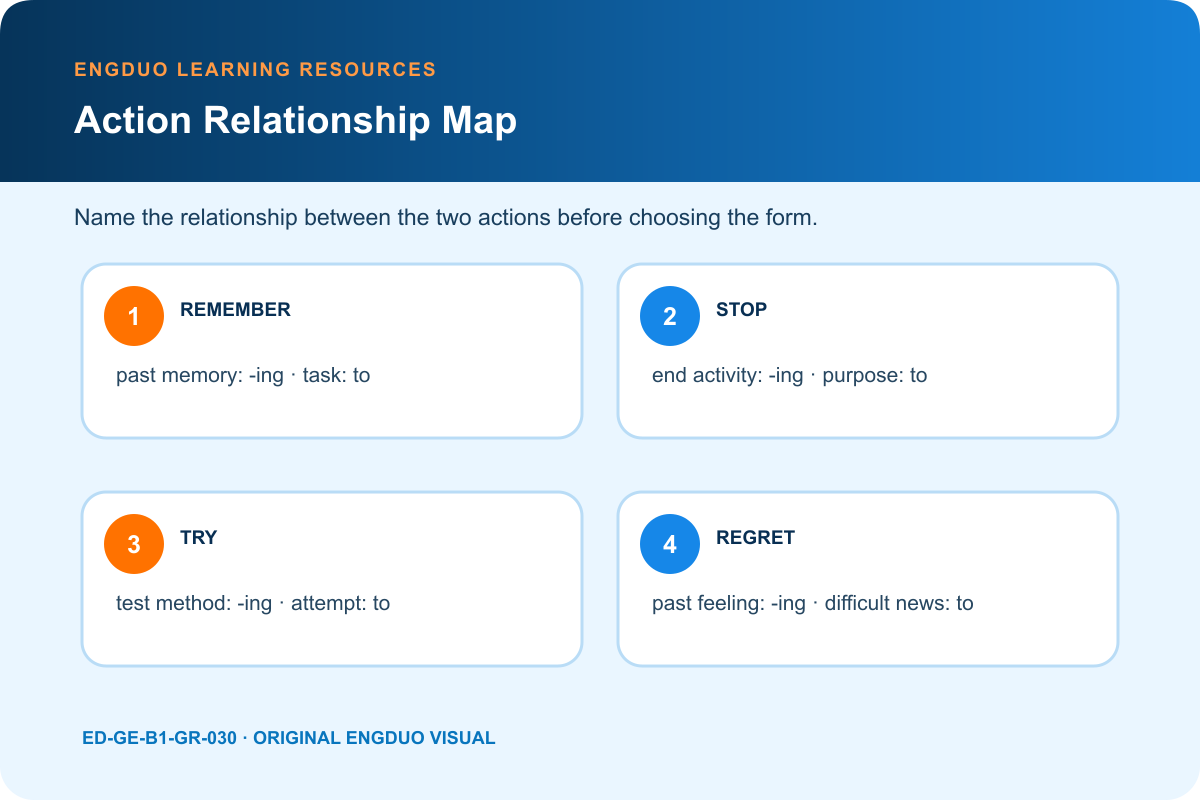
Use paired situations for remember, stop, try, and regret. Describe the time or intention relationship before choosing any form.
How to run Stage 1
3 min: Match eight situations to action relationships.
Contrast remember and stop
Use remember doing for a past memory, remember to do for a task, stop doing to end an activity, and stop to do to pause for a purpose.
How to run Stage 2
5 min: Contrast remember and stop meaning pairs.
Contrast try and regret
Engduo Audio: Listen for meaning first. Audio never starts automatically.
Explain the different action relationships after remember and stop.
Separate a tested method, attempted action, past regret, and difficult announcement.
Use try doing for a method, try to do for effort, regret doing for a past feeling, and regret to say for difficult news.
How to run Stage 3
5 min: Contrast try and regret meaning pairs.
Recover the intended action relationship
Listen to both updates. Record the first action, target verb, following form, second action, and resulting meaning.
How to run Stage 4
6 min: Play both updates and map action relationships.
Solve eight action-intention scenarios
Use all eight meaning patterns in work, study, travel, or daily-life situations. The partner identifies the meaning and repairs two deliberately incorrect forms.
How to run Stage 5
7 min: Run the eight-scenario action-intention task.
Final practice: Choose the form that creates the intended action
Task: Explain eight scenarios using the paired gerund and infinitive meanings of remember, stop, try, and regret, then repair two meaning-changing errors.
Success: Every form expresses the intended time or purpose relationship and the listener predicts the correct action and consequence.
LC · Language Control
0 Frequent form problems obscure the intended meaning.
1 Meaning remains clear with some prompting or self-correction.
2 Controls eight paired verb patterns and explains how -ing versus to + verb changes meaning.
FP · Functional Performance
0 Does not yet complete the communication outcome.
1 Completes most of the outcome with visible prompts.
2 Uses and repairs meaning-changing verb patterns in realistic scenarios independently.
How to run Stage 6
4 min: Score LC and FP, repair one form-to-meaning mismatch, and retry the affected scenario.
คำอธิบายภาษาไทย — เปิดเมื่อจำเป็นเท่านั้น
ให้ถามว่ากริยาสองตัวสัมพันธ์กันอย่างไร เช่นจำเหตุการณ์ที่ทำแล้วหรือจำหน้าที่ที่ต้องทำ หยุดกิจกรรมหรือหยุดเพื่อทำอีกอย่าง ทดลองวิธีหรือพยายามทำ แล้วเลือก -ing หรือ to + verb ตามความหมาย
Continue your learning path
Teaching references
CEFR Companion Volume — used for communication outcomes and observable progress.
Content and media rights
© 2026 Engduo Thailand. This lesson and its original instructional design, text, visuals, and prepared media are for authorized Engduo use. Do not copy, download, republish, sell, scrape, or use any part in another course, website, dataset, product, or AI system without written permission, except where applicable law permits.