
What are you going to do?
Hear the Connected Words
Use an original Engduo rhythm to hear connected words and transfer the same smooth timing to everyday speech.
Your goal
By the end of this lesson, you can reconstruct short connected phrases and perform them with clear key-word stress.
Progress focus: LISTPRONVR
Engduo Audio: Licensed voices prepared for this lesson. Audio never starts automatically. Use the transcript after the first listening attempt.
1. Notice the situation
Use the visual and model audio to identify the communication problem before studying the language.
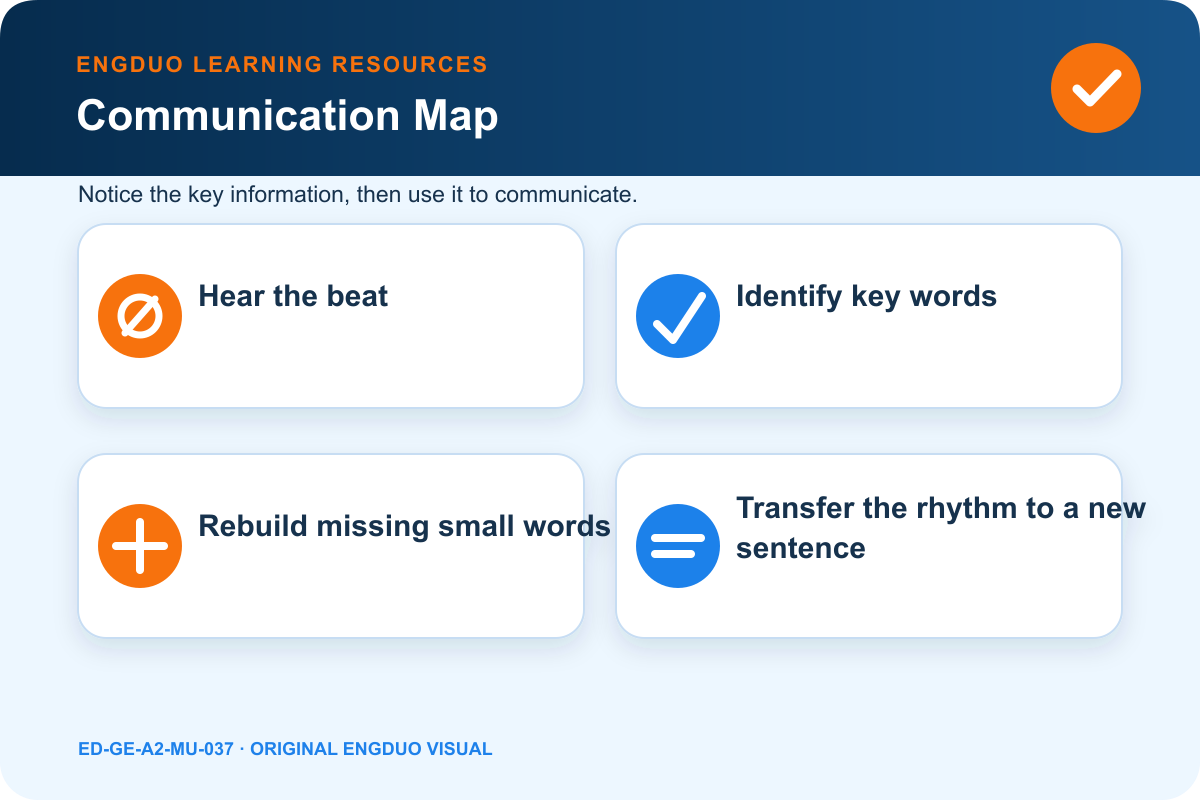
- hear the beat
- identify key words
- rebuild missing small words
- transfer the rhythm to a new sentence
Engduo Audio • British English
Transcript — open after listening
What are you going to do? I’m going to take the train.
Engduo Audio • Australian English
Transcript — open after listening
Could you send it to me? I’ll read it in the morning.
How to run Stage 1
Confirm the observable outcome and connect it to one real learner need.
2. Build useful language
Choose phrases for the meaning you need; do not read every phrase in the final task.
I’m going to take the train.
Could you send it to me?
I’ll do it in the morning.
Keep the key words strong.
Let the smaller words connect.
How to run Stage 2
Use the visual and first audio for meaning before explaining language.
3. Rehearse with support
Practise the decisions that make the final communication task successful.
- Tap only the stressed words.
- Choose which small words fit the rhythm and meaning.
- Shadow one line at slow and normal speed.
How to run Stage 3
Select only the useful-language items needed for this learner.
4. Complete the communication task
Exchange information or opinions until you reach a real outcome.
Teams reconstruct four original lyric lines from key words, then perform them and compare intelligibility.
How to run Stage 4
Run the guided rehearsal without reading every instruction aloud.
5. Perform, receive feedback, and retry
Complete the task with keywords only, receive focused feedback, and repeat the weakest part.
Create two new everyday lines with the same beat and perform them without reading every word.
Retry: Repeat once with clearer meaning, stronger evidence, or less support.
How to run Stage 5
Run the main task: Teams reconstruct four original lyric lines from key words, then perform them and compare intelligibility.
Exit check
Complete this without reading a model: Reconstruct one line, mark its key words, and deliver it with a steady rhythm.
Success looks like: All message words are understandable and the learner connects smaller words without losing the beat.
Evidence: speaking · Repeat the weakest part once after focused teacher or self-feedback.
LIST · Listening Comprehension
2: Understands and uses the required spoken evidence accurately.
1: Demonstrates the skill after one focused prompt, correction or self-repair.
0: Cannot yet demonstrate the skill clearly enough to complete the stated outcome.
PRON · Pronunciation
2: Remains intelligible with useful sounds, stress, rhythm or intonation.
1: Demonstrates the skill after one focused prompt, correction or self-repair.
0: Cannot yet demonstrate the skill clearly enough to complete the stated outcome.
VR · Vocabulary Resource
2: Uses suitable target vocabulary naturally in an original message.
1: Demonstrates the skill after one focused prompt, correction or self-repair.
0: Cannot yet demonstrate the skill clearly enough to complete the stated outcome.
Use these scores after the independent attempt. Record one recurring need in the Engduo app when lesson-result fields become available.
How to run Stage 6
Record focused feedback, repeat the weakest part, and complete the exit check.
คำอธิบายภาษาไทย — เปิดเมื่อจำเป็นเท่านั้น
กิจกรรมนี้ใช้เนื้อร้องต้นฉบับของ Engduo ไม่ใช้เพลงเชิงพาณิชย์ ให้จับคำสำคัญก่อนแล้วเติมคำสั้นที่เชื่อมจังหวะ
Teacher guide
30-minute must-do route
- Confirm the observable outcome and connect it to one real learner need.
- Use the visual and first audio for meaning before explaining language.
- Select only the useful-language items needed for this learner.
- Run the guided rehearsal without reading every instruction aloud.
- Run the main task: Teams reconstruct four original lyric lines from key words, then perform them and compare intelligibility.
- Record focused feedback, repeat the weakest part, and complete the exit check.
60-minute extension
- Remove the written line and require a new line with the same number of strong beats.
- Switch roles or conditions so the learner transfers the language rather than repeating the same answer.
- Compare the first and second performance and record one specific improvement.
Make it easier
Use slow audio, visible beat marks, and one line at a time.
Make it harder
Remove the written line and require a new line with the same number of strong beats.
Likely difficulty
The learner may stress every word equally or drop a small word needed for meaning.
Correction priority
Prioritise key-word clarity and rhythm before individual accent features.
Thai support rule
Keep the Thai panel closed unless examples, visuals, gestures, replay, and simpler English do not allow progress. Return to English after the key distinction is clear.
Progress record
Score LIST, PRON, VR from 0–2 and record one recurring need from: weak-forms, rhythm, key-word-stress.
Retry
Give one meaning-focused correction and one language-focused correction at most, then ask for a second attempt.
Continue your learning path
- Council of Europe — CEFR Companion Volume — Supports the communication-first level range, observable learner output, and interaction focus.
- British Council — English sentence stress — Supports listening for stressed meaning-carrying words and reconstructing the smaller words between them.
Content and media rights
© 2026 Engduo Thailand. Authorized Engduo use only. Copying, republishing, reselling, scraping, or reuse in another course, dataset, product, or AI system requires written permission except where applicable law permits.