Action Word Beat
Practise creative action words with a beat
ฝึกคำกริยากิจกรรมสร้างสรรค์กับจังหวะ

Build practical words for creative works, people, actions and descriptions, then use them in true preferences and recommendations.
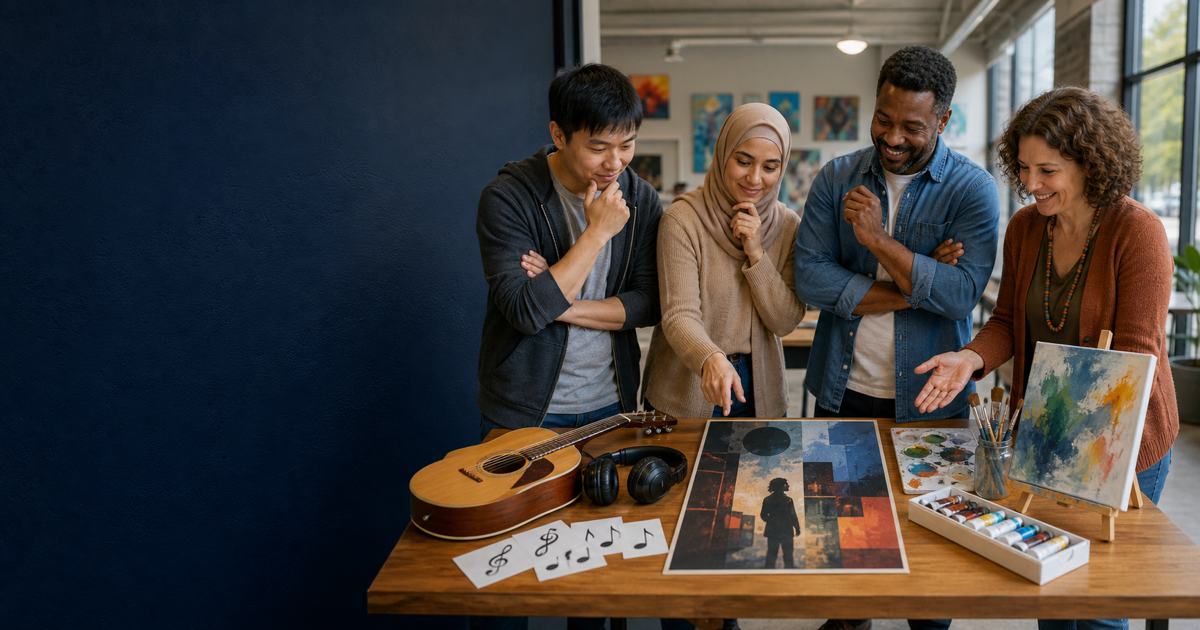
Build useful words for creative works, people, actions and preferences.
For learners: Build practical words for creative works, people, actions and descriptions, then use them in true preference and recommendation sentences.
For teachers: The lesson keeps vocabulary central: see the category, organise by word class, hear it, retrieve it, create true sentences, then recommend and adapt.
สำหรับผู้เรียน: สร้างคลังคำศัพท์เกี่ยวกับผลงานสร้างสรรค์ คน การกระทำ และคำบรรยาย แล้วใช้ในประโยคความชอบและคำแนะนำที่เป็นจริง
สำหรับครู: บทเรียนให้คำศัพท์เป็นเป้าหมายหลัก โดยเห็นหมวด แยกตามชนิดคำ ฟัง ดึงคำ แต่งประโยคจริง แล้วจึงแนะนำและปรับคำตอบ
Name common creative works, people, actions and descriptions, then use the new words in true preference and recommendation sentences.
เรียกชื่อผลงานสร้างสรรค์ คน การกระทำ และคำบรรยายที่พบบ่อย แล้วใช้คำใหม่ในประโยคความชอบและคำแนะนำที่เป็นจริง
For the learner: These words help you talk about music, film and art you really know and recommend something suitable to another person.
For the teacher: The lesson keeps vocabulary central by requiring original use from every word group before the final recommendation task.
เหตุผลภาษาไทย: ผู้เรียนแยกคำตามหน้าที่ ฝึกแต่งประโยคจริงจากแต่ละหมวด แล้วจึงรวมคำเพื่อแสดงความชอบและแนะนำผลงานสร้างสรรค์
Vocabulary is the primary target. Make the learner use every word group in an original sentence before combining the groups in a recommendation. Do not turn the lesson into film or art analysis.
| Time | Teacher does | Student does | Evidence |
|---|---|---|---|
| 0–3 | Uses the cover to elicit three creative choices. | Names one known work and one preference. | A meaningful work word. |
| 3–8 | Organises words by work, person, action and description. | Says a working set and creates four true sentences. | Correct word groups. |
| 8–12 | Plays two short preference examples. | Identifies work, person, action, description and feeling. | Ten heard details. |
| 12–16 | Hides the word bank and prompts retrieval. | Recalls at least twelve target items. | Independent recall. |
| 16–21 | Models one preference chain, then removes it. | Builds six original sentences from the new words. | Original vocabulary use. |
| 21–26 | Runs a choose-and-recommend exchange. | Recommends two different works for two people. | Connected mini-response. |
| 26–30 | Adds one changed preference and scores. | Adapts and retries without a script. | VR / FP evidence. |
song · concert · guitar
film · actor · story
painting · artist · colour
Use the cover and gesture for meaning. Accept familiar examples, but do not introduce copyrighted lyrics, scripts or copied artwork.
| Word group | Target language | Use it in a sentence |
|---|---|---|
| Nouns · works and places | song, film, painting, photo, dance, play, concert, museum | This painting is in the museum. |
| Nouns · creative people | singer, musician, actor, artist, dancer, audience | The singer has a beautiful voice. |
| Verbs · actions | listen, watch, sing, play, paint, dance, perform, recommend | We watch a film on Friday. |
| Adjectives · descriptions | funny, exciting, beautiful, relaxing, loud, colourful, quiet, surprising | The song is quiet and relaxing. |
| Preference chunks | I like…, I love…, I don’t like…, My favourite… is…, I recommend… because… | I recommend the play because it is funny. |
Keep word class explicit: nouns name works or people, verbs show actions, adjectives describe, and chunks express preference. Require immediate original use.
Lina likes music. Her favourite work is a quiet song. A singer performs it with a guitar. Lina listens at home because the song is relaxing and beautiful.
Noah likes films. He watches a funny short film with his sister. The actors are exciting, and the ending is surprising. He recommends it to friends.
Play each track once for meaning and once for checking. Keep the transcripts closed until the learner has attempted work, person, action, description and preference.
Give the word group, a gesture or first sound before supplying an answer. After recall, hide the support again.
My favourite ___ is ___.
It is ___ and ___.
A ___ performs or makes it.
I listen to / watch / see it ___.
I like it because ___.
I recommend it to ___.
Require the learner’s own content. Give one word-choice and one sentence-pattern correction at most, then elicit the corrected sentence again.
A: wants something funny · B: wants something quiet and relaxing · C: likes dancing · D: wants a colourful place to visit
Allow keywords during planning but no full script. Prompt with the missing word group rather than supplying a complete sentence.
A visitor wants one creative activity this afternoon. They like beautiful and relaxing things, but they do not like loud places.
Score the first unsupported performance, then score the focused retry separately.
Target: 3/4 overall with FP = 2 and no zero.
Score the unsupported recommendation before feedback. Give one vocabulary and one sentence correction at most, then rerun only the weak section.
เริ่มจากภาพและประเภทผลงาน แยกคำเป็นผลงานหรือคน การกระทำ คำบรรยาย และวลีความชอบ ให้ผู้เรียนแต่งประโยคจากแต่ละหมวดก่อน แล้วค่อยรวมเป็นคำแนะนำ
Practise creative action words with a beat
ฝึกคำกริยากิจกรรมสร้างสรรค์กับจังหวะ
Hear connected words in natural rhythm
ฟังคำเชื่อมต่อในจังหวะธรรมชาติ
Build stronger rhythm for longer speaking
ต่อยอดจังหวะเพื่อการพูดที่ยาวขึ้น
Explore metaphor, mood and voice at B2
สำรวจอุปมา อารมณ์ และน้ำเสียงระดับ B2