Choose the response that fits the speaker’s purpose—not the option that merely repeats a familiar word.
LevelB1
Time30 minutes
Lesson typeTOEIC Listening Part 2
Practice contentOriginal Engduo items
Your goal: Hear a prompt once, identify its function and implied meaning, choose the best of three spoken responses, and explain why distractors fail.Progress focus LISTSTRAT
LIST · Listening Comprehension Understand question type, tense, reference words, and indirect meaning after one listen.
STRAT · Test Strategy Select by conversational fit and reject lexical-overlap or wrong-function distractors.
30-minute lesson route
Understand the Part 2 task — 3 min
Hear direct and indirect responses — 5 min
Map prompt functions — 5 min
Diagnose distractors — 6 min
Complete a six-item timed set — 7 min
Review, score and retry — 4 min
1. Know the task
Official Part 2 format: You hear one question or statement and three responses. They are not printed and are spoken once. Choose the best response: A, B, or C.
Before listening, remember: the best response may answer indirectly. Matching one repeated word is not enough.
How to run Stage 1
Explain the format in under one minute. Read one simple prompt and three responses once only, then ask what made the best response conversationally suitable.
2. Hear the intention
Listen once. Identify the speaker’s function, then explain what the response implies.
Prompt form helps, but intended function and context decide the response.Engduo Audio • American EnglishTranscript — after listening
Could you send the revised schedule before lunch? — I have the final version open now.
Implication: The second speaker is working on it and can probably send it soon.
Engduo Audio • Australian EnglishTranscript — after listening
Why has the delivery been moved to Friday? — The loading area will be closed tomorrow.
Implication: The closure caused the schedule change.
How to run Stage 2
Keep transcripts closed for the first listen. Ask “What is the speaker doing?” and “What does the reply imply?” Replay once only if the learner can name the uncertain word or meaning.
3. Map the prompt function
Who / Where / When Listen for person, place, or time.
Why / How Listen for cause, method, or result.
Yes–No question A direct yes/no is possible, but an indirect action or reason may fit better.
Request / Suggestion / Statement Listen for acceptance, refusal, action, reaction, or next step.
Teacher says four short prompts. Student names the function before hearing any response choices.
How to run Stage 3
Use four original workplace prompts. Do not ask for answers yet. The learner labels the function and predicts what type of response would move the exchange forward.
4. Diagnose the distractor
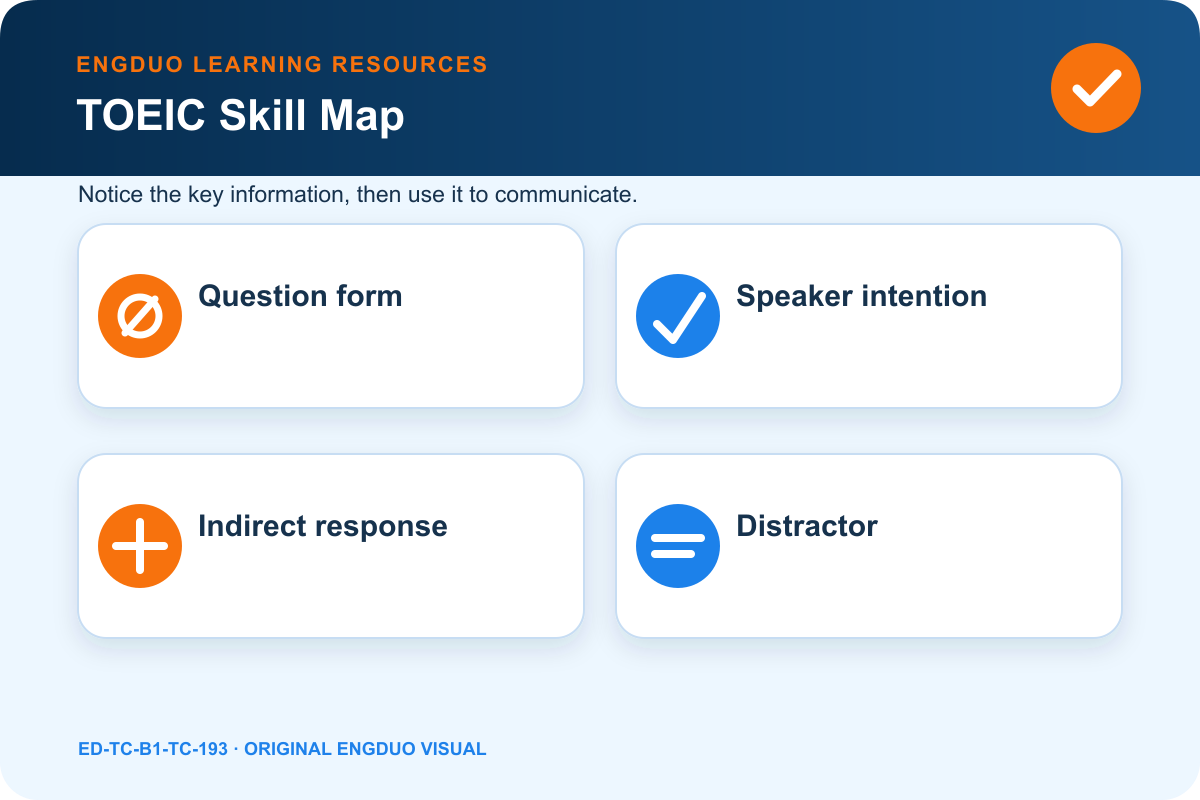
Lexical overlap Repeats a word but does not answer the intention.
Wrong function Answers where when the prompt asks why.
Wrong time or reference The tense, person, or object does not match.
Plausible but unrelated Sounds natural alone but does not continue this exchange.
Student explains: “B fits because ___. A fails because it only repeats ___. C fails because the prompt asks ___.”
How to run Stage 4
Read one prompt and three original responses. Require one reason for the correct answer and one distractor label. Stop the learner from using “It sounds right” without evidence.
5. Complete a six-item timed set
The teacher opens the script privately and reads each prompt plus A, B, and C once. The learner records only the letters.
1 ___
2 ___
3 ___
4 ___
5 ___
6 ___
Teacher script and answer key — keep closed for the learner
When will the updated report be ready? (A) It was updated yesterday. (B) By three this afternoon. (C) On the top shelf. Answer: B
Could you reserve the small meeting room for us? (A) I’ll check whether it’s available. (B) The meeting ended early. (C) A smaller chair. Answer: A
Why hasn’t the client signed the contract? (A) She asked for one more revision. (B) At the front desk. (C) A blue pen. Answer: A
The delivery entrance will be closed tomorrow. (A) Then we should use the north gate. (B) It closes at six. (C) I delivered it already. Answer: A
Who’s leading the product demonstration? (A) In the main showroom. (B) I think Priya volunteered. (C) The newest product. Answer: B
Didn’t you send the invoice yesterday? (A) Yes, but it bounced back. (B) To the accounting office. (C) The amount was correct. Answer: A
How to run Stage 5
Keep the script out of the learner’s view. Maintain one natural pace and do not repeat during the first set. Check letters only after all six, then analyse no more than two errors.
6. Final practice: Choose, explain and retry
Task: Complete two new one-listen items, then explain the prompt function, implied meaning, and one distractor reason.
Success: The response is chosen from meaning and conversational fit rather than repeated vocabulary.
LIST · Listening Comprehension
2: Understands both new prompts and intended responses after one listen.
1: Understands the key meaning after one replay or function prompt.
0: The prompt’s key function or implication is not yet understood.
STRAT · Test Strategy
2: Selects by conversational fit and accurately explains a distractor.
1: Selects correctly after one strategy cue but cannot fully explain the trap.
0: Relies mainly on repeated vocabulary or guessing.
How to run Stage 6
Create two fresh items using the same four distractor types. Score LIST and STRAT from 0–2, give one strategy cue, then repeat only the missed function with a new item.
Part 2 ต้องฟังคำถามหรือข้อความและตัวเลือกสามข้อเพียงครั้งเดียว ให้จับหน้าที่ของผู้พูดและความหมายที่สื่อโดยอ้อมก่อน ระวังตัวเลือกที่มีคำซ้ำแต่ตอบไม่ตรงเจตนา