
Identify which sound or stress pattern changes the message.
← Back to General English lessons
Pronunciation Lab · A1 Core → A2 Bridge
Pronunciation Lab: Can or Can’t?
Train your ears to use vowel quality, stress, sentence meaning, and the full phrase—not only the final letter—to distinguish can and can’t.
Your goal
By the end of this lesson, you can identify can or can’t in short ability statements and produce the contrast clearly enough for a listener to understand your meaning.
ดูคำอธิบายเป้าหมายภาษาไทย — เปิดเมื่อจำเป็น
คำว่า can ในประโยคบอกเล่ามักออกเสียงสั้นและเบาเป็น /kən/ ขณะที่ can’t มักได้รับน้ำหนักมากกว่า แต่รูปเสียงต่างกันตามสำเนียง อย่าฟังเฉพาะเสียง /t/ ท้ายคำ เพราะในคำพูดต่อเนื่องอาจไม่ชัด ให้ใช้เสียงสระ น้ำหนักคำ ความหมาย และบริบทของทั้งประโยคร่วมกัน
Progress focusLISTPRON
LIST · Listening ComprehensionIdentify the key meaning and important details, then use what you heard in the next communication task.
PRON · PronunciationProduce the target contrast or prominence clearly enough for a listener to understand the intended word or message.
Your progress path
Use the target feature in words and short phrases.
Apply the feature in a real message so the listener understands without guessing.
30-minute lesson route
3 minHear & predict
5 minNotice the contrast
5 minShape or stress
6 minControlled practice
7 minCommunicate meaning
4 minFeedback & retry
1. Listen to an American English contrast
Listen to the whole phrase. Notice that unstressed can is often shorter and weaker.
I can swim.
Typical clue: can may be weak /kən/; the main verb carries more stress.
I can’t swim.
Typical clue: can’t is usually clearer and more stressed; US vowel /æ/.
2. Listen to a British English contrast
The vowel in can’t may differ across accents. Focus on meaning, stress, and the phrase.
She can come today.
can: often weak /kən/ in the middle of a sentence
She can’t come today.
can’t: Cambridge records UK /kɑːnt/
Important: speakers and accents vary. A final /t/ may be less audible in connected speech, so do not use one sound as your only clue.
3. Use a stress map
Tap the large words. Keep unstressed can short.
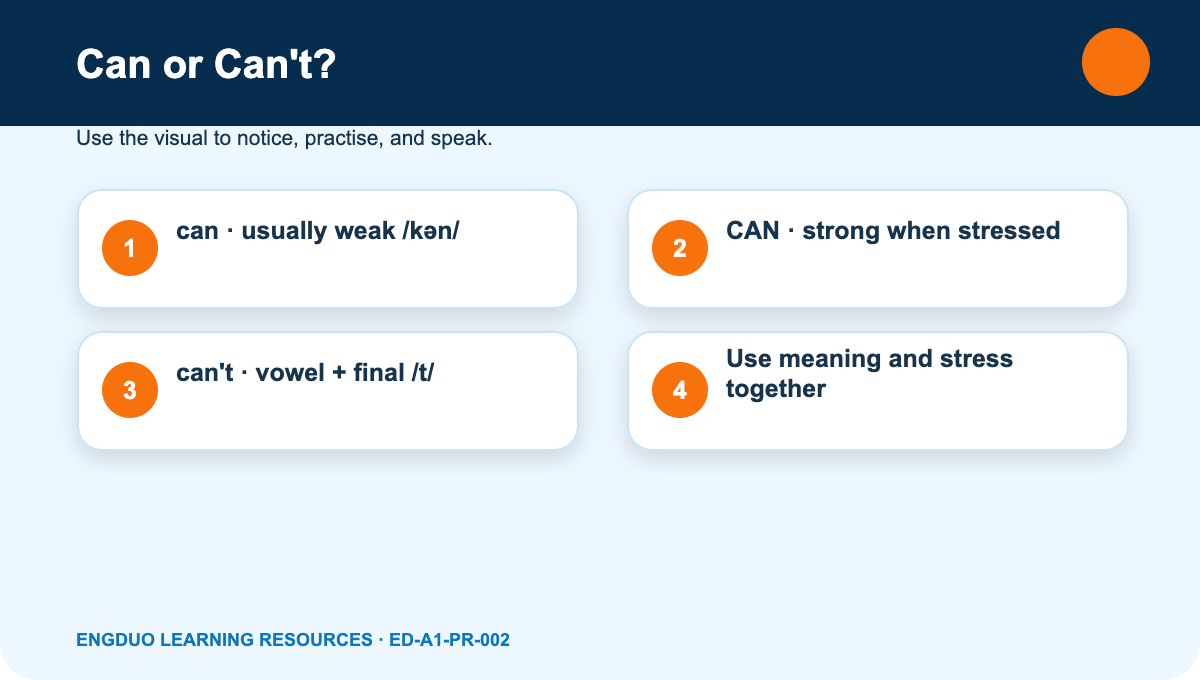
I can SWIM. → weak can, strong action
I CAN’T SWIM. → negative meaning is prominent
She can COME TODAY.
She CAN’T COME TODAY.
Practice: whisper the small word and tap the strong words, then speak normally.
4. Listening challenge
Choose the meaning you hear. Replay before checking.
5. Make the meaning necessary
Your partner needs the answer to complete a plan.
Choose: drive · cook · join on Friday · speak another language · meet after work
Ask: Can you ______?
Answer: Yes, I can. / No, I can’t, but I can ______.
Partner check: repeat the meaning: “So you can/can’t ______, right?”
Final practice: Hear and say the meaning clearly
Complete the task without copying a model. The teacher observes the communication outcome before giving one focused correction and asking for a shorter retry.
Task: Listen to four new ability statements and identify positive or negative meaning. Then produce two can and two can’t sentences for a partner.
Success: You identify at least three meanings correctly and your partner understands all four of your sentences without seeing the text.
LIST · Listening Comprehension
1 Misses the main meaning or most key details even after replay.
2 Understands the main meaning and most details with replay or support.
3 Understands and uses the key meaning and details with minimal replay.
PRON · Pronunciation
1 The listener frequently cannot identify the intended word or meaning.
2 Usually understandable, with some inconsistent target features.
3 Uses the target feature consistently enough for clear independent communication.
คำอธิบายภาษาไทย — เปิดเมื่อจำเป็นเท่านั้น
คำว่า can ในประโยคบอกเล่ามักออกเสียงสั้นและเบาเป็น /kən/ ขณะที่ can’t มักได้รับน้ำหนักมากกว่า แต่รูปเสียงต่างกันตามสำเนียง อย่าฟังเฉพาะเสียง /t/ ท้ายคำ เพราะในคำพูดต่อเนื่องอาจไม่ชัด ให้ใช้เสียงสระ น้ำหนักคำ ความหมาย และบริบทของทั้งประโยคร่วมกัน
Teacher guide · 30-minute delivery
- Confirm the learner outcome and connect it to one real use before opening every activity.
- Use the first visual or audio for meaning before explaining language.
- Select only the examples and phrases needed for this learner’s final task.
- Run the guided stage with reduced support rather than reading every instruction aloud.
- Complete Final Practice without interruption. Check perception before production, then correct the sound or prominence that has the greatest effect on meaning.
- Record LIST, PRON separately from 1–3, give one focused correction, and retry the weakest part.
Continue your learning path
Word Stress for Clear Messages
Progress from a sound contrast to prominence in longer messages.
Making Plans by Phone
Apply sound recognition inside a practical conversation.
Teaching references
- CEFR Companion Volume — Supports communication-first outcomes, observable performance, and progression through reception, production, and interaction.
Content and media rights
© 2026 Engduo Thailand. This lesson and its original instructional design, text, visuals, and prepared audio are for authorized Engduo use. Do not copy, download, republish, sell, scrape, or use any part in another course, website, dataset, product, or AI system without written permission, except where applicable law permits.