
Compare /ɪ/ and /iː/ before trying to copy the words.

Pronunciation Lab: Ship or Sheep?
Train your ears and voice to notice the difference between /ɪ/ in ship and /iː/ in sheep.
Your goal
By the end of this lesson, you can identify ship or sheep in a short listening task and produce the two vowel sounds clearly enough for a listener to distinguish the words.
Thai explanation of the goal — open only if needed
เมื่อจบบทเรียน นักเรียนจะฟังแยกเสียง /ɪ/ และ /iː/ ในคำที่ฝึก และออกเสียงให้ผู้ฟังแยกความหมายได้ โดยไม่จำเป็นต้องเลียนสำเนียงใดสำเนียงหนึ่งอย่างสมบูรณ์
Progress focusLISTPRON
LIST · Listening Comprehension
Identify the target sound and word without relying on the written answer.
Identify the target sound and word without relying on the written answer.
PRON · Intelligibility
Produce the contrast clearly enough for a listener to identify the intended word.
Produce the contrast clearly enough for a listener to identify the intended word.
Your pronunciation path
Listen without visible answers and decide which sound or word you hear.
Say the words and sentence so another person can identify them.
30-minute lesson route
2 minGoal & baseline
6 minHear the contrast
5 minBuild the map
5 minListening challenge
8 minProduce & compare
4 minFeedback & retry
Teacher Lesson Plan · Read before class
Pronunciation Lab standard: Follow the sound cycle: hear the contrast → notice the mouth and sound → identify → produce → use in a sentence. Never judge accent; measure intelligibility.
Teacher: Play the contrast without showing the answer first.
Student: Listens and notices whether the words sound the same.
Required result: Attention on the contrast.
Teacher: Show the sound map and model slowly once.
Student: Notices length, tongue and mouth position.
Required result: A usable production cue.
Teacher: Run a short identification challenge.
Student: Chooses the word heard and checks the evidence.
Required result: Reliable sound discrimination.
Teacher: Model, then fade the model.
Student: Produces words and minimal pairs.
Required result: Clearer target sounds.
Teacher: Move the sound into phrases and sentences.
Student: Speaks at a natural pace and keeps the contrast clear.
Required result: Transfer beyond isolated words.
Teacher: Use an unseen item and one retry.
Student: Hears, says and self-corrects once.
Required result: Intelligibility evidence.
Feedback rule: Let the learner complete the attempt first. Give one communication or task-success point and one language improvement, then run a short retry.
Engduo Audio: Use the audio buttons to compare the target sounds. Audio never starts automatically.
1. Listen to the contrast
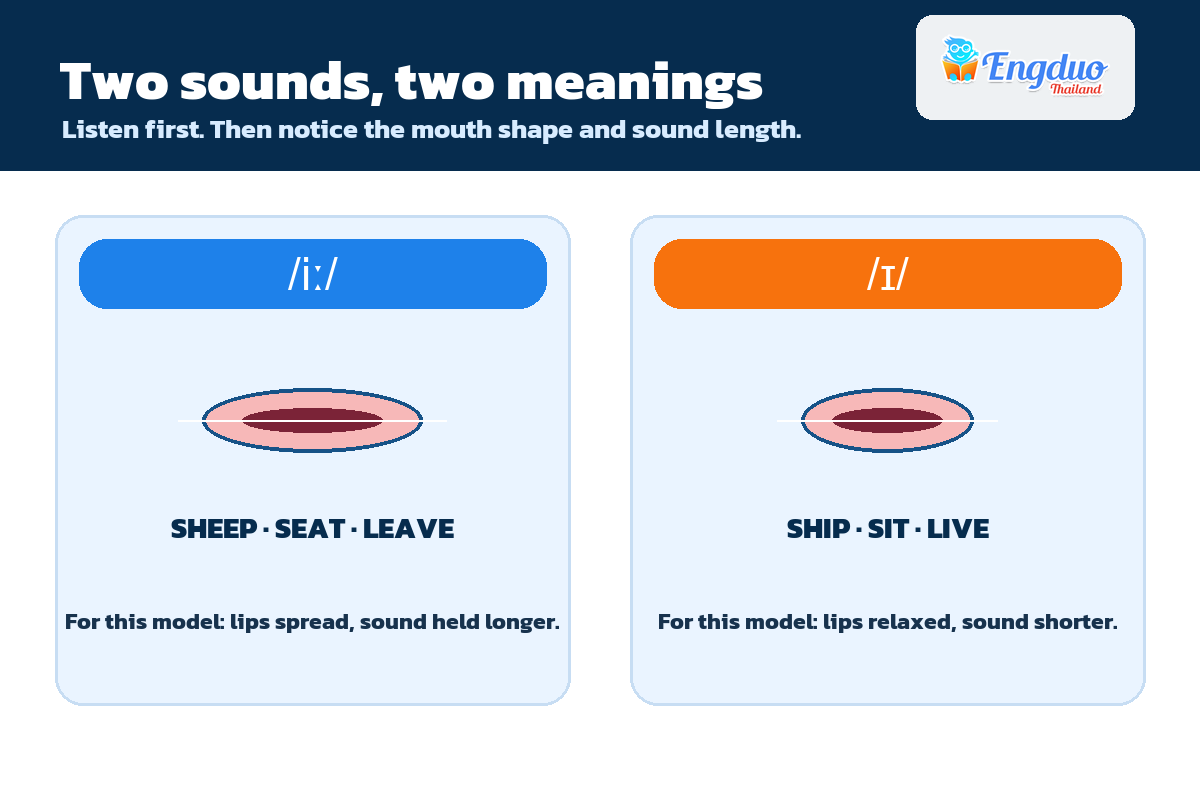
Listen with your eyes closed first. Then listen again while looking at the words.
How to run Stage 1
Play ship and sheep with the words hidden first. Ask whether the sounds are the same or different, then reveal the spellings and mouth cue. Model each word once; the learner listens before copying.
2. Build a sound map
Listen without reading the word. Choose /ɪ/ or /iː/, then open the answer map after all four items.
Check the sound map — open after listening
1 sit: /ɪ/ · 2 seat: /iː/ · 3 live: /ɪ/ · 4 leave: /iː/
How to run Stage 2
Keep written answers closed. Play each item once, let the learner choose the sound, then replay only uncertain items. Open the answer map after all four choices.
3. Listening challenge
Do not read the answer first. Play the sentence and choose the word you hear.
Sentence A
Sentence B
How to run Stage 3
Play each sentence without showing the answer. Ask which word changes the meaning and what sound evidence the learner heard. Use one replay if needed.
4. Accent variety
The vowel quality can vary across speakers and accents. Listen to the same sentence from two neural voices. Focus on understanding the whole sentence, not copying one “perfect” accent.
Please sit in this seat.
Please sit in this seat.
How to run Stage 4
Play both voices once. The learner identifies the target words and notices that intelligibility can remain clear across accents. Do not require imitation of one preferred accent.
5. Say it yourself
- Say ship—sheep slowly three times.
- Say sit—seat slowly three times.
- Say: Please sit in this seat.
- Ask your teacher or partner which word they heard.
Communication first: Your goal is a clear contrast that helps a listener understand you. You do not need to copy one speaker exactly.
How to run Stage 5
Model each pair once, then fade the model. The learner says a word secretly and the listener identifies it. Correct sound length or mouth position only when it changes intelligibility.
Final practice: Hear it and make it clear
Listening task: Hear four items without written answers and identify at least three correctly.
Speaking task: Say one word from each pair and the sentence “Please sit in this seat.” Your listener identifies the intended words.
Success: The learner identifies at least three of four listening items and produces the contrast clearly enough for the listener to distinguish the target words.
LIST · Listening Comprehension
2: Identifies at least three of four unseen items independently.
1: Identifies two or three items after one replay or sound prompt.
0: The contrast is not yet identified consistently.
PRON · Intelligibility
2: The listener distinguishes the intended words independently in words and the sentence.
1: The contrast becomes clear after one production cue or retry.
0: The listener cannot yet distinguish the intended word.
How to run Stage 6
Run one unseen listen-and-say attempt. Score LIST and PRON from 0–2, give one listening cue and one intelligibility cue, then repeat a shorter pair so the learner can improve immediately.
Thai support — open only if needed
คำแนะนำสำหรับครู: ให้ปิดส่วนนี้ไว้ก่อน เปิดเฉพาะเมื่อผู้เรียนยังแยกเสียงไม่ได้หลังจากฟังซ้ำ ดูภาพตำแหน่งปาก และเลียนเสียงช้า ๆ แล้ว
/iː/ ใน sheep ใช้เสียงยาวกว่าในตัวอย่างนี้ ส่วน /ɪ/ ใน ship สั้นและผ่อนคลายกว่า ให้ผู้เรียนเน้นฟังความต่างก่อน ไม่จำเป็นต้องอธิบายศัพท์สัทศาสตร์ทั้งหมด
Transcript and answer key
Sentence A: The ship is big. Answer: ship.
Sentence B: The sheep is eating. Answer: sheep.
Accent-variety sentence: Please sit in this seat.
Learning references and standards
These references support the teaching method and pronunciation notation. Engduo’s explanations, examples, activities, visuals, and audio production are original to this lesson.
- British Council TeachingEnglish — Minimal pair: supports using word pairs that differ by one sound to highlight a pronunciation contrast. View source.
- British Council TeachingEnglish — Short and long i: supports the sheep/ship contrast, mouth-position prompts, short practice, and example pair seat/sit. View source.
- Cambridge Dictionary — Pronunciation symbols: supports the IPA labels /iː/ for sheep and /ɪ/ for ship, including UK and US comparison. View source.
- Cambridge Dictionary — Sheep pronunciation: confirms the dictionary transcription of sheep as /ʃiːp/. View source.
Media note: This lesson does not copy or reuse British Council or Cambridge audio. Engduo prepared the playable clips separately with licensed neural text-to-speech voices.
Teacher guide · 30-minute delivery
- Goal and baseline (2 min): Play one unseen contrast and record what the learner hears without correction.
- Hear the contrast (6 min): Play ship and sheep first. Use the visual only after the learner has listened.
- Build the map (5 min): Complete four sound choices before opening the answer map.
- Listening challenge (5 min): Complete both sentence choices and replay only when necessary.
- Produce and compare (8 min): Practise the pairs, compare the two accent models, and use the sentence in a listener check.
- Feedback and retry (4 min): Correct one listening cue and one production cue, repeat the weakest item, and complete the final practice.
Progress record: Score LIST and PRON separately from 1–3. Record the weakest contrast and whether the learner improved after one focused cue.
Thai-support rule: Keep the Thai panel closed unless listening, modelling, gestures, and the visual guide do not allow progress.
Continue your learning path
Content and media rights
© 2026 Engduo Thailand. This lesson and its original instructional design, text, visuals, and prepared audio are for authorized Engduo use. Do not copy, download, republish, sell, scrape, or use any part in another course, website, dataset, product, or AI system without written permission, except where applicable law permits.