
Draw what happened, in what order, and from which now, then, or future point the account will be viewed.
Shift Tense and Aspect to Change Viewpoint
Reframe the same events from different temporal and discourse viewpoints, preserving the timeline while changing relevance, boundedness, phase, and narrative distance.
Advanced tense and aspect as viewpoint
UseSelect a temporal anchor and present events as bounded, unfolding, prior, current, recurrent, relevant now, or viewed retrospectively without altering the underlying sequence.
Core formsimple ↔ progressive · perfect ↔ non-perfect
Viewpoint shiftshistoric present · future perfect viewpoint · present relevance · narrative distance
RememberTense locates the viewpoint and aspect shapes how the event is viewed; define the timeline first, then choose whether the audience should see a whole event, its internal phase, its prior relation, or its present consequence.
ชื่อไวยากรณ์ภาษาไทย — เปิดเมื่อจำเป็น
กำหนด timeline ก่อน แล้วเลือก tense และ aspect เพื่อเปลี่ยนมุมมอง เช่นมองเหตุการณ์เป็นภาพรวม กำลังดำเนิน ก่อนจุดอ้างอิง หรือมีผลถึงปัจจุบัน โดยไม่เปลี่ยนลำดับเหตุการณ์จริง
Your goal
By the end of this lesson, you can map six event timelines, explain eight tense-aspect effects, detect four accidental timeline shifts, and present one event sequence from three controlled viewpoints.
คำอธิบายเป้าหมายภาษาไทย — เปิดเมื่อจำเป็น
บทนี้ฝึกใช้ tense และ aspect เป็นเครื่องมือเลือกมุมมองของเหตุการณ์ ไม่ใช่เพียงเลือกเวลาตามสูตร โดย timeline หลักต้องยังถูกต้อง
Progress focus LCFP
LC · Language Control
Control the target pattern so the intended meaning remains clear.
Control the target pattern so the intended meaning remains clear.
FP · Functional Performance
Complete the lesson’s real communication outcome without teacher-supplied sentences.
Complete the lesson’s real communication outcome without teacher-supplied sentences.
Your grammar path
Use simple, progressive, perfect, perfect progressive, historic present, or future-looking forms to create a defined viewpoint effect.
Produce operational, reflective, and vivid narrative versions and audit whether each form preserves sequence while serving its audience.
30-minute lesson route
3 minTimeline-and-anchor baseline
5 minSimple progressive and phase control
5 minPerfect viewpoint and temporal distance
6 minListen and compare three accounts
7 minThree-viewpoint retelling task
4 minTimeline audit and retry
Keep events separate from grammar choices
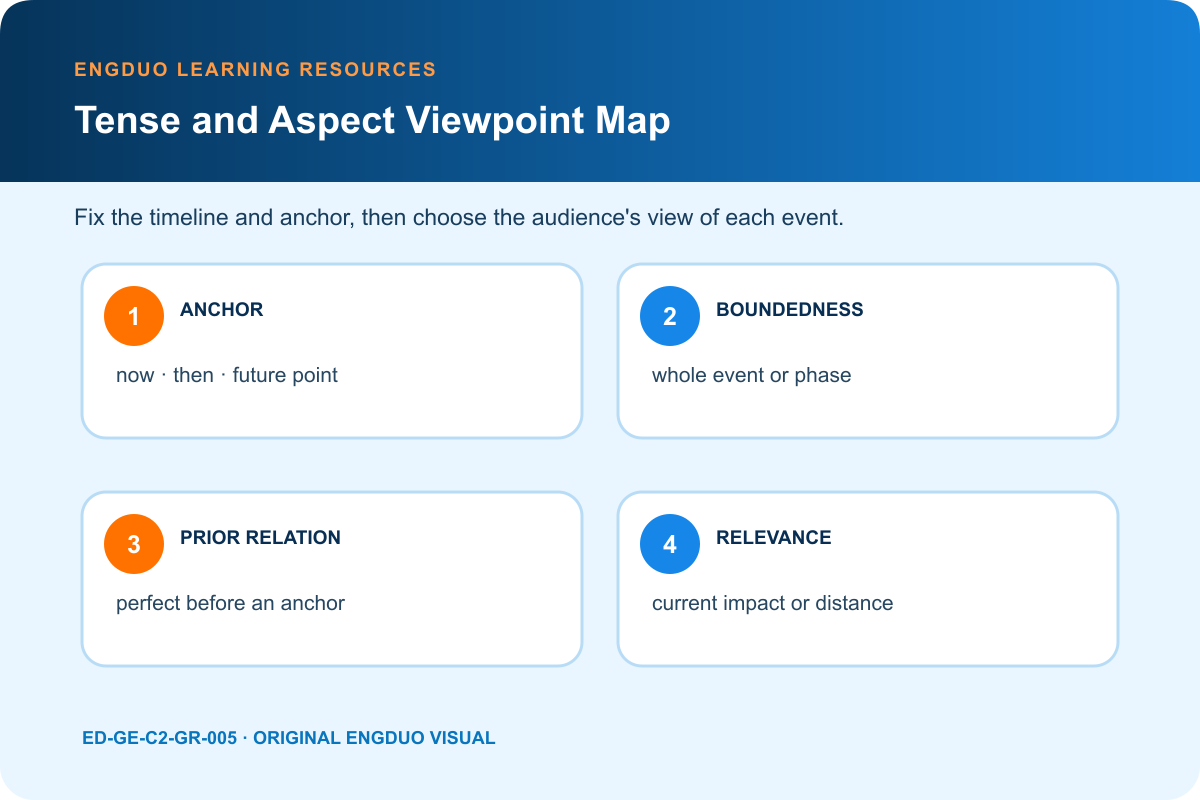
Map six short accounts with event order, duration, completion, and the speaker’s temporal anchor before selecting any tense.
How to run Stage 1
3 min: Draw timelines and identify temporal anchors.
Control whole-event and internal-phase viewpoints
Reframe four events with simple and progressive forms and explain whether the audience sees a bounded whole, an unfolding phase, background, recurrence, or temporary behaviour.
How to run Stage 2
5 min: Compare simple, progressive, bounded, and phase viewpoints.
Control perfect and perfect-progressive effects
Engduo Audio: Listen for meaning first. Audio never starts automatically.
Compare report sequence, present relevance, and retrospective narrative viewpoint.
Identify why the first version loses the future anchor and how the repair restores it.
Rebuild four accounts from present, past, and future anchors, preserving sequence while changing current relevance, prior completion, duration, or retrospective distance.
How to run Stage 3
5 min: Control perfect, perfect-progressive, present, past, and future viewing points.
Detect intended effect and accidental drift
Listen to both clips, reconstruct each timeline, and repair any version that changes completion, sequence, duration, or evidence rather than viewpoint alone.
How to run Stage 4
6 min: Play both clips and audit intended effect versus timeline drift.
Retell one sequence from three viewpoints
Present one project incident as a factual log, a current-impact update, and a reflective narrative, then identify the anchor and aspect effect in each version.
How to run Stage 5
7 min: Run the three-viewpoint retelling task.
Final practice: Change the viewpoint, preserve the timeline
Task: Present the same event sequence in operational, current-impact, and reflective-narrative versions using deliberate tense-aspect choices, then compare what each audience sees as complete, unfolding, prior, or relevant now.
Success: All versions preserve event order and evidence, each temporal anchor is stable, aspect creates the intended viewpoint, and no shift accidentally changes completion, duration, or present relevance.
LC · Language Control
0 Frequent form problems obscure the intended meaning.
1 Meaning remains clear with some prompting or self-correction.
2 Controls temporal anchors, simple-progressive contrast, perfect relations, phase, boundedness, present relevance, future viewpoint, and narrative distance.
FP · Functional Performance
0 Does not yet complete the communication outcome.
1 Completes most of the outcome with visible prompts.
2 Produces three independent audience-specific accounts of one timeline and explains the precise viewpoint effect of each tense-aspect choice.
How to run Stage 6
4 min: Score LC and FP, repair one anchor or aspect mismatch, and retry it.
คำอธิบายภาษาไทย — เปิดเมื่อจำเป็นเท่านั้น
วาดเส้นเวลาและวง viewing point ก่อน เช่น now, then หรือ by next Friday จากนั้นถามว่าต้องการเห็นเหตุการณ์ทั้งก้อน ภายในช่วงที่กำลังเกิด ก่อนจุดอ้างอิง หรือผลที่ยังเกี่ยวกับตอนนี้ แล้วตรวจว่า form ใหม่ไม่ได้เปลี่ยนว่าเหตุการณ์จบหรือยัง
Continue your learning path
Teaching references
CEFR Companion Volume — used for communication outcomes and observable progress.
Content and media rights
© 2026 Engduo Thailand. This lesson and its original instructional design, text, visuals, and prepared media are for authorized Engduo use. Do not copy, download, republish, sell, scrape, or use any part in another course, website, dataset, product, or AI system without written permission, except where applicable law permits.