
Keep only the actions the listener needs to understand the story.
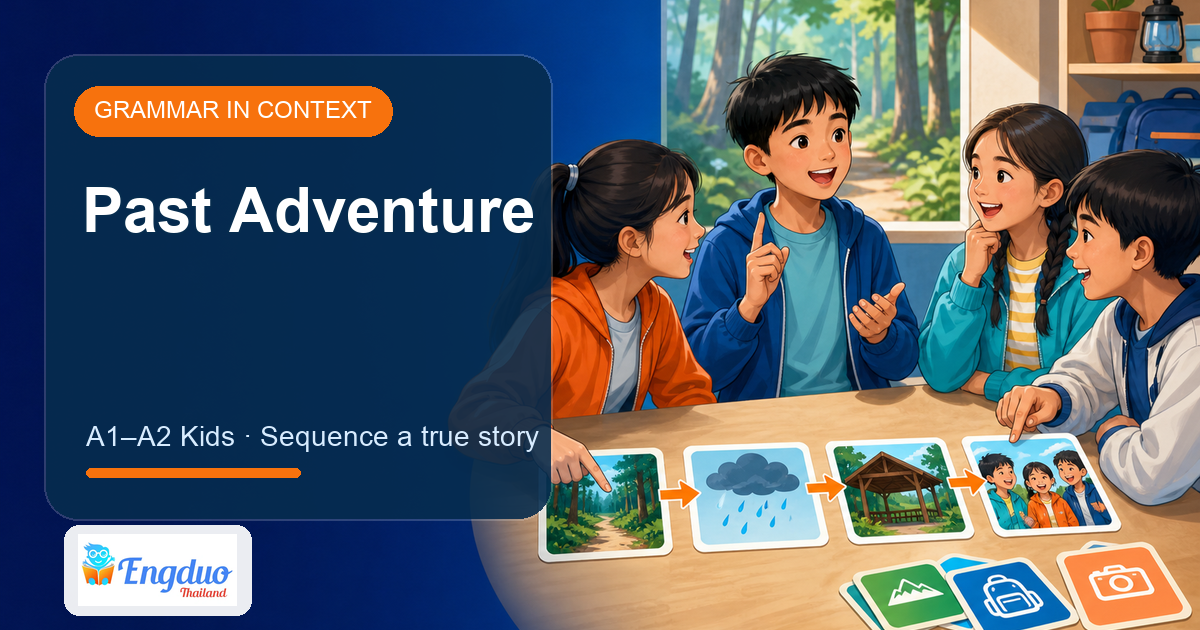
Tell a Past Adventure
Turn a set of adventure clues into a clear past story, then answer questions and repair one confusing event.
Past simple Part 2: irregular verbs and story sequence
Use past-simple verbs for the main events and sequence markers to help the listener follow what happened.
Your goal
By the end of this lesson, you can tell a six-event adventure with useful irregular past verbs, sequence markers, and a clear ending, then answer two follow-up questions.
คำอธิบายเป้าหมายภาษาไทย — เปิดเมื่อจำเป็น
บทนี้ฝึกเล่าเรื่องผจญภัยในอดีตหกเหตุการณ์ ใช้กริยาอดีตที่พบบ่อย คำบอกลำดับ และตอบคำถามต่อเนื่องสองคำถาม
Progress focus LCFP
LC · Language Control
Control the target pattern so the intended time and meaning remain clear.
Control the target pattern so the intended time and meaning remain clear.
FP · Functional Performance
Complete the lesson’s real communication outcome without teacher-supplied sentences.
Complete the lesson’s real communication outcome without teacher-supplied sentences.
Your grammar path
Use past simple for each completed event and the base verb after did.
Connect the setting, problem, action, turning point, and ending.
30-minute lesson route
3 minAdventure clues
5 minPast verb bank
5 minSequence & questions
6 minStory map
7 minTell the adventure
4 minFeedback & retry
Find the story shape
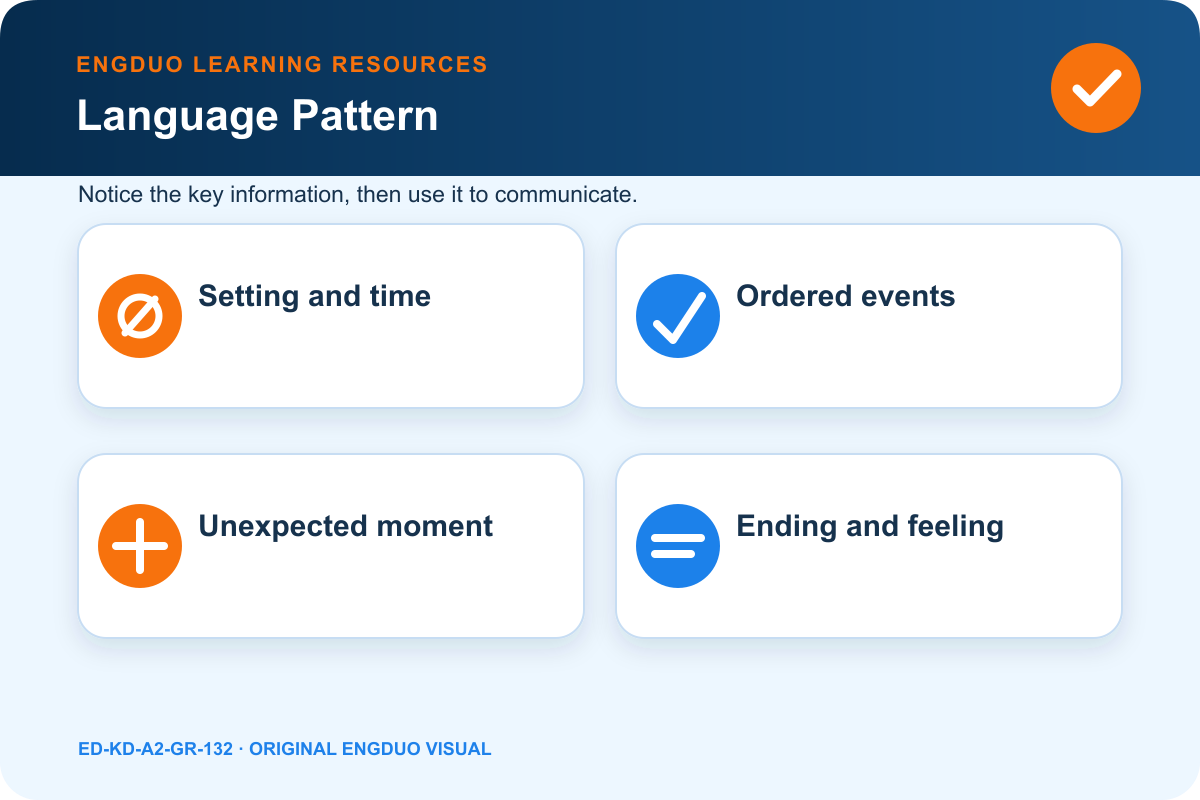
A clear adventure needs a setting, a problem, connected actions, and an ending.
Setting
where · when · who
where · when · who
Problem
lost · broke · could not find
lost · broke · could not find
Action
went · saw · took · found
went · saw · took · found
Ending
finally · in the end
finally · in the end
How to run Stage 1
3 min: Scan the clues and identify the setting, problem, and ending.
Use useful irregular past verbs
Listen and collect the verbs that move the story forward.
Engduo Audio: Listen for meaning first. Audio never starts automatically.
Listen for the setting, problem, and three main events.
Listen for the turning point, ending, and one past-simple question.
| Base | Past | Example |
|---|---|---|
| go / see | went / saw | We went inside and saw a map. |
| take / find | took / found | We took the path and found the bridge. |
| come / get | came / got | Help came and we got home safely. |
How to run Stage 2
5 min: Play both models and build a compact irregular past-verb bank.
Use sequence markers and did questions
What did you saw?
What did you see?
What did you see?
How to run Stage 3
5 min: Add sequence markers and practise did + base-verb questions.
Map six story events
- We were at ______.
- First, we ______.
- Then, we ______.
- Suddenly, ______.
- So we ______.
- Finally, ______.
Prepare key words only. Add one feeling and one reason.
How to run Stage 4
6 min: Map six events using key words rather than full written sentences.
Tell and repair the adventure
Tell the story from six picture clues. Your partner asks two did questions and deliberately checks one event incorrectly.
Repair: No, we didn’t cross the river first. We found the map first.
How to run Stage 5
7 min: Tell the adventure, answer two questions, and repair one event.
Final practice: Tell a complete past adventure
Task: Tell a six-event story with at least four irregular past verbs and five sequence markers. Answer two did questions and correct one mistaken event.
Success: Past events and sequence remain clear, verbs after did use the base form, and the listener can retell the main story without teacher support.
LC · Language Control
0 Frequent form problems obscure the intended time or meaning.
1 Meaning remains clear with some prompting or self-correction.
2 Controls useful irregular past forms and the base verb after did across the story and questions.
FP · Functional Performance
0 Does not yet complete the communication outcome.
1 Completes most of the outcome with visible prompts.
2 Tells, answers, and repairs a complete six-event adventure independently.
How to run Stage 6
4 min: Score LC and FP, correct one verb or sequence problem, and retry the weakest section.
คำอธิบายภาษาไทย — เปิดเมื่อจำเป็นเท่านั้น
ใช้ past simple กับเหตุการณ์ที่เกิดและจบแล้ว เช่น went, saw, found และหลัง did ใช้กริยารูปปกติ เช่น What did you see?
Continue your learning path
Teaching references
CEFR Companion Volume — used for communication outcomes and observable progress.
Content and media rights
© 2026 Engduo Thailand. This lesson and its original instructional design, text, visuals, and prepared media are for authorized Engduo use. Do not copy, download, republish, sell, scrape, or use any part in another course, website, dataset, product, or AI system without written permission, except where applicable law permits.