
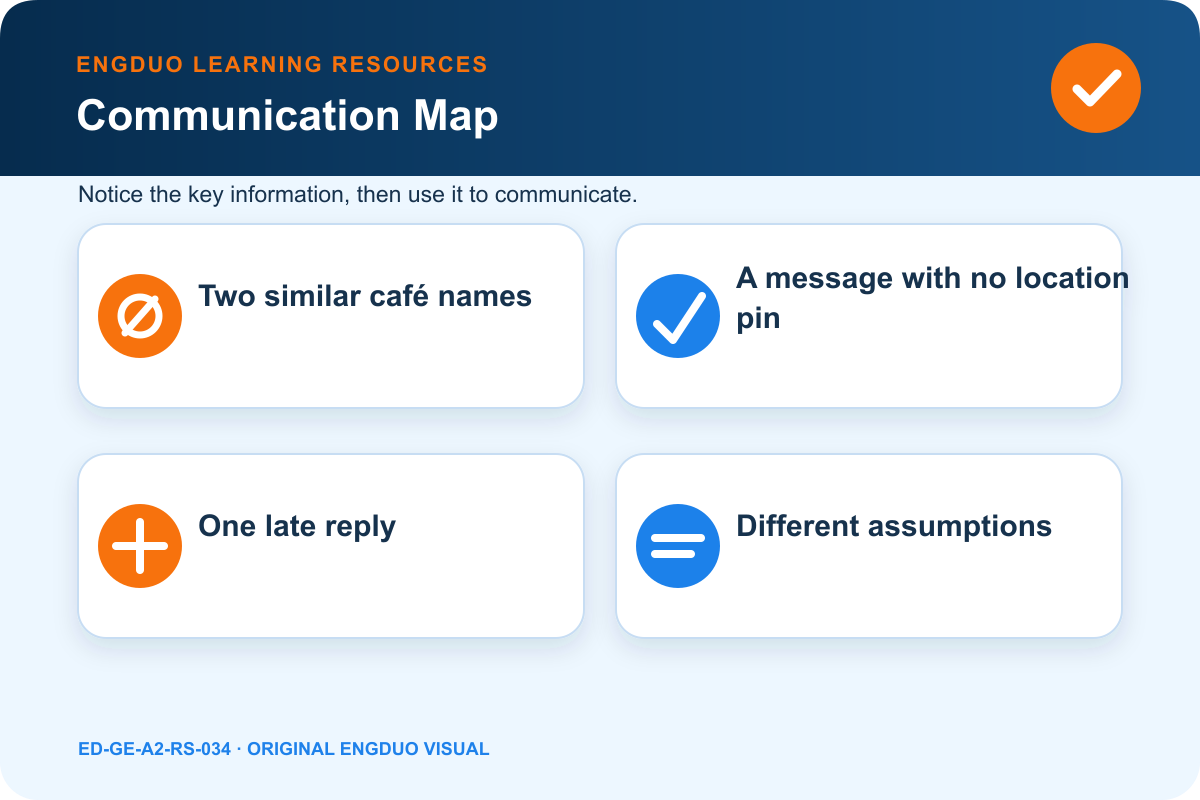
Identify who, where, when, and the main communication problem.
← Back to General English lessons
Reading & Story · A1 Core → A2 Direction
The Missed Meeting
Read a short misunderstanding in two passes: first understand the main problem, then use evidence to reconstruct the sequence and recommend a practical fix.
Your goal
By the end of this lesson, you can identify the misunderstanding, put the key events in order, support the explanation with story evidence, and retell the event with one useful prevention step.
ดูคำอธิบายเป้าหมายภาษาไทย — เปิดเมื่อจำเป็น
นักเรียนจะอ่านเพื่อเข้าใจปัญหาหลักก่อน จากนั้นอ่านซ้ำเพื่อหาข้อมูลว่าใครรู้อะไร เกิดอะไรขึ้นตามลำดับ และอะไรเป็นสาเหตุ สุดท้ายจึงเล่าเรื่องใหม่และเสนอวิธีป้องกันปัญหาที่ตรงกับสาเหตุจริง
Progress focus
READ
VR
READ · Reading Comprehension
Identify the main problem, follow the event sequence, and use a specific detail from the text to explain the cause.
Identify the main problem, follow the event sequence, and use a specific detail from the text to explain the cause.
VR · Vocabulary Range
Use time, assumption, cause, result, and recommendation language to retell the story clearly without relying only on and then.
Use time, assumption, cause, result, and recommendation language to retell the story clearly without relying only on and then.
Your progress path
Put events in order and separate facts from the characters’ assumptions.
Explain the cause, retell the event, and suggest a fix that prevents the same problem.
30-minute lesson route
2 minPreview & predict
5 minRead for the main idea
6 minRead for evidence
5 minSequence language
8 minReconstruct & retell
4 minFeedback & retry
1. Preview the situation
Look at the timeline before reading. Predict why two people could arrive on time but still miss each other.
2. First read: Find the main problem
Read once without stopping for every new word. Choose the sentence that best explains why the meeting failed.
The Missed Meeting
Pim and Arun planned to meet at 10:00 on Saturday. Pim sent a short message: “See you at Green Café.” She meant the café beside the park. However, Arun knew another place with a similar name near the station, so he went there.
At 10:10, Arun sent a message asking where Pim was. Pim’s phone had a weak signal, and the message arrived late. Both people assumed that the other person was late. At 10:25, they finally called each other and discovered the mistake. They met later that morning and agreed to share a full address or location pin next time.
- A. One person forgot the meeting time.
- B. The location message was not specific enough.
- C. Both people decided to cancel the meeting.
Check the main idea — open after choosing
Answer: B. The location message was not specific enough.
3. Second read: Build the evidence timeline
Return to the story and find the exact detail for each stage. Separate what happened from what each person assumed.
Evidence rule: A good explanation connects a conclusion to a detail from the story: “The message was unclear because it gave the café name but not the full address.”
4. Use language for sequence and cause
Choose the phrase that matches the job in your retelling. You do not need to use every phrase.
Start
At first, …
They planned to …
Parallel event
Meanwhile, …
At the same time, …
Assumption
Arun assumed that …
Pim thought that …
Cause and result
Because …
As a result, …
Repair
They realised that …
They solved the problem by …
Prevention
Next time, they should …
To prevent this, …
5. Hear two details, then connect them to the text
The audio adds pronunciation and listening support, but the written story remains the main source of evidence.
The unclear message
Which sentence in the story contains the same information?
The result and fix
Which prevention step does the speaker recommend?
6. Reconstruct and retell the story
Round 1 · Evidence
Partners find one detail each for plan, message, assumption, delay, and repair.
Round 2 · Timeline
Combine the details and agree on the correct order.
Round 3 · Retell
Retell the story using key words only. Include the cause and result.
Respond
Choose one prevention step and explain how it addresses the real cause.
Final practice: Explain the story from evidence
Complete the task without reading a model answer. This shows whether you can understand, organise, and communicate the important information before receiving one focused correction and trying again.
Task: Retell the story in about 90 seconds. Include the plan, missing information, wrong assumption, result, and one prevention step.
Success: The sequence is clear, the explanation uses a specific story detail, and the prevention step addresses the information gap rather than blaming one person.
READ · Reading Comprehension
1 Identifies some facts but the main cause or event order remains unclear.
2 Identifies the main problem and most events, with one prompt to find or connect evidence.
3 Explains the main problem, correct sequence, and cause using a specific detail from the story.
VR · Vocabulary Range
1 Relies mainly on and then, with unclear cause, assumption, or result.
2 Uses some time and cause phrases, with occasional repetition or searching.
3 Uses suitable sequence, assumption, cause, result, and recommendation language to make the retelling easy to follow.
คำอธิบายภาษาไทย — เปิดเมื่อจำเป็นเท่านั้น
ให้อ่านรอบแรกเพื่อหาปัญหาหลักโดยไม่หยุดแปลทุกคำ แล้วอ่านรอบสองเพื่อหาหลักฐานและลำดับเหตุการณ์ แยก “สิ่งที่เกิดขึ้นจริง” ออกจาก “สิ่งที่ตัวละครคิดเอง” ก่อนเล่าใหม่ พร้อมเสนอวิธีป้องกันที่แก้สาเหตุเรื่องข้อมูลสถานที่ไม่ชัดเจน
Teacher guide · 30-minute delivery
- Use the visual for a short prediction. Do not confirm the full story before the first read.
- Set one gist question and let the learner read without stopping for every unknown word.
- For the second read, ask the learner to underline evidence for message, assumption, delay, and repair.
- Teach only the sequence and cause phrases needed for this retelling.
- Run the evidence and timeline rounds before asking for a complete retell.
- During the first retell, do not interrupt for grammar. Note one comprehension gap and one language need.
- Give one focused correction, reduce visible support, and repeat the weakest part.
- Record READ and VR separately from 1–3. READ records understanding supported by textual evidence; VR records the usable language that makes the sequence and cause clear.
Continue your learning path
A Small Act of Kindness
Read another short story and explain how one action changes the situation.
A Friendly Message to Change Plans
Transfer the lesson into a clear message with the information another person needs.
Teaching references
- CEFR Companion Volume — Reading for orientation and information — Supports locating relevant information, understanding connected narrative, and using comprehension for a purposeful follow-up task.
Content and media rights
© 2026 Engduo Thailand. This lesson and its original instructional design, text, visuals, and prepared audio are for authorized Engduo use. Do not copy, download, republish, sell, scrape, or use any part in another course, website, dataset, product, or AI system without written permission, except where applicable law permits.