IDEA · Interpretation and thinking · 0–2
0 The talk remains a list or copied prompts.
1 One idea develops with support.
2 Original ideas, reasons, alternatives and consequences develop clearly.

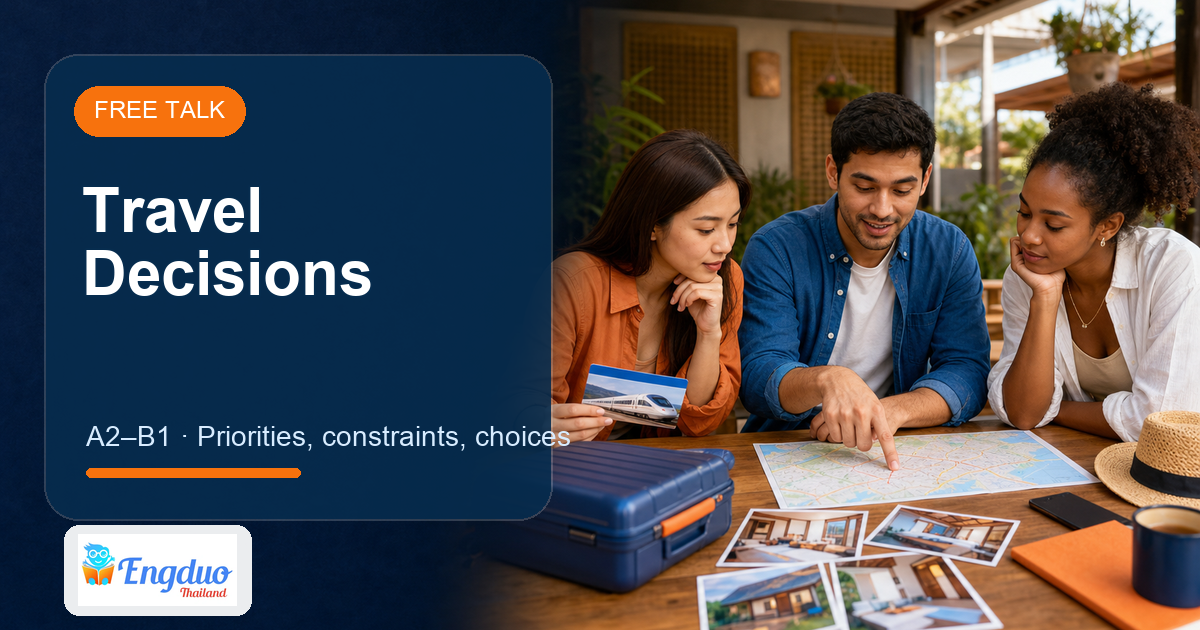
Topic FamilyTF12 · Travel & Tourism
Read a travel-choice scene, weigh competing priorities, and negotiate a decision that could work in real life.
For learners: Use a travel-choice visual to compare priorities, question assumptions, negotiate a plan and add a workable fallback.
For teachers: The visual leads. Learners observe, select optional language, imagine beyond the frame, challenge assumptions and sustain an unscripted discussion. No listening audio or model answer.
สำหรับผู้เรียน: ใช้ภาพตัวเลือกการเดินทางเพื่อเปรียบเทียบลำดับความสำคัญ ตั้งคำถามต่อสมมติฐาน เจรจาแผน และเพิ่มแผนสำรอง
สำหรับครู: ภาพเป็นแกนหลัก ผู้เรียนสังเกต เลือกภาษาที่ต้องการ จินตนาการ คิดต่าง และสนทนาโดยไม่มีบทตายตัว ไม่มีเสียงฟังหรือคำตอบตัวอย่าง
By the end of this lesson, you can interpret travel evidence, compare priorities and trade-offs, ask clarifying questions, and agree on a feasible travel decision.
ใช้ภาพเพื่อสังเกต สร้างความคิดของตนเอง เลือกภาษาที่ช่วยความหมาย ตั้งคำถามต่อยอด และสนทนาโดยไม่ท่องบท
The picture and learner ideas lead. Optional language supports meaning. Do not add listening audio, a model answer or a choice-card funnel.
| Stage | Teacher move | Evidence |
|---|---|---|
| 1 | Elicit visible details before interpretation. | Observation + inference |
| 2 | Let the learner select only useful language. | Meaningful choices |
| 3 | Accept possibilities connected to evidence. | Coherent possibility |
| 4 | Challenge one assumption or trade-off. | Reasoned judgement |
| 5 | Follow the learner’s last idea. | Learner-led exchange |
| 6 | Score IDEA/LANG/TALK and retry one part. | Independent improvement |
Choose your own direction: Follow another idea if it grows naturally from the picture.
4 min. Ask for three visible details before interpretation. Require the learner to distinguish “I can see” from “I think”.
You do not need every item. Select only the language that makes your own meaning clearer.
Language note: Choose one or two phrases, or replace them with better language for your idea.
5 min. Ask the learner to choose useful language, explain why it fits and use it in an original sentence.
Optional starters: One possibility is… · The picture suggests…, but does not prove… · If that changed…
5 min. Accept more than one coherent story. Ask which visual detail or real-world condition supports each possibility.
Useful thinking language: It depends on… · We may be assuming… · The benefit is…, whereas the risk is…
5 min. Use one prompt that creates depth. Ask for a reason, a counterpoint and one consequence.
Choose a real or realistic trip. Let the discussion move through cost, time, comfort, local impact and uncertainty.
Freedom rule: Leave the picture once the conversation has a clear real-life direction.
5 min. Facilitate rather than lead. Build each follow-up from the learner’s last idea; do not force every visible prompt.
Task: Agree on one travel plan with a clear priority, two supporting reasons and one trade-off, respond to two objections, then add a fallback if one key condition changes.
Success: The discussion sounds like the learner’s thinking—not a completed worksheet or memorised model.
0 The talk remains a list or copied prompts.
1 One idea develops with support.
2 Original ideas, reasons, alternatives and consequences develop clearly.
0 General language repeatedly blocks meaning.
1 Selected language helps after a prompt.
2 Language choices make the learner’s meaning precise.
0 The teacher manages most of the exchange.
1 The learner continues with one reminder.
2 The learner develops, responds, questions and extends independently.
Target: Aim for at least 5/6 with TALK = 2.
Feedback + improved retry: Keep the first score. Choose one target—deeper idea, more precise language or more independent interaction—and retry only the weakest part.
6 min. Observe without interruption. Score IDEA/LANG/TALK 0–2, give one precise target and run a focused retry.
Free Talk ใช้ภาพเป็นแรงกระตุ้น ไม่ได้กำหนดคำตอบเดียว เลือกภาษาที่ช่วยความคิด จินตนาการสิ่งที่ภาพไม่ได้บอก และปล่อยให้บทสนทนาดำเนินไปตามความหมายจริง
Build travel language for routes, cost, time and comfort.
สร้างภาษาการเดินทางเรื่องเส้นทาง ค่าใช้จ่าย เวลา และความสะดวก
Listen for travel constraints and changing priorities.
ฝึกฟังข้อจำกัดและลำดับความสำคัญที่เปลี่ยนไปในการเดินทาง
Negotiate a travel decision in a guided speaking task.
เจรจาตัดสินใจเดินทางในบทพูดแบบมีแนวทาง
Review travel evidence and fallback planning in mastery.
ทบทวนหลักฐานและแผนสำรองการเดินทางในบท Mastery
CEFR Companion Volume — interaction, turn-taking and observable outcomes.
© 2026 Engduo Thailand. Authorised Engduo use.