
Connect each animal to actions it can or cannot do.
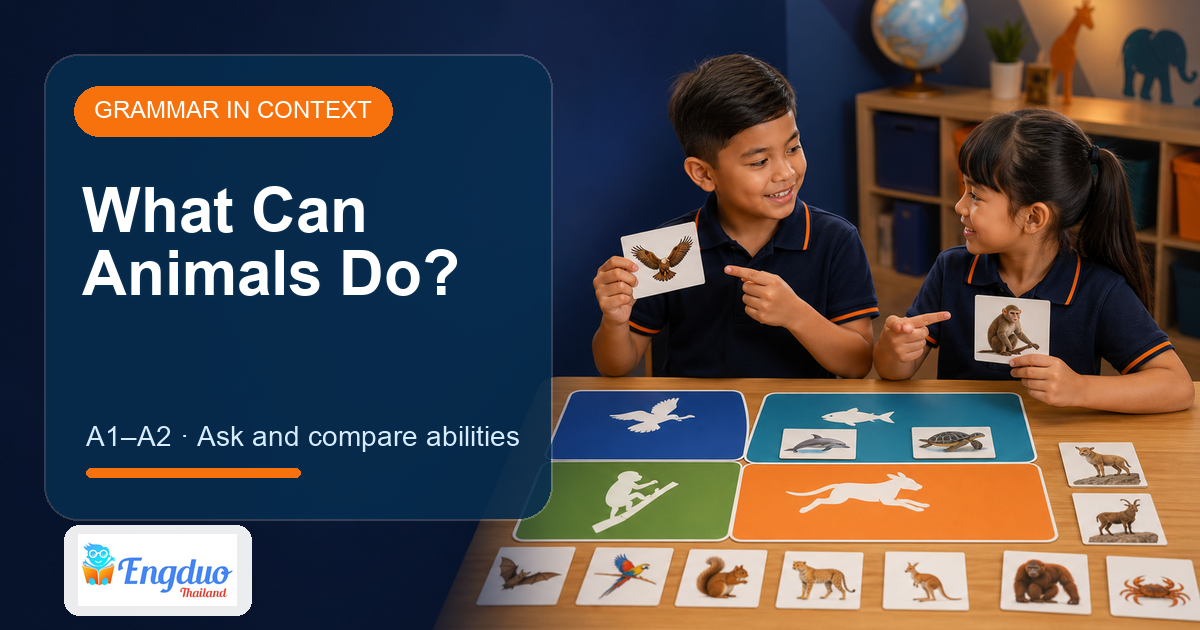
What Can Animals Do?
Ask and answer about animal abilities, compare evidence, and solve a playful classification challenge.
can / can’t for ability
Ask about ability, give a clear answer, and support a choice with observable evidence.
Your goal
By the end of this lesson, you can use can and can’t with a base verb, ask ability questions, compare two animals, and use evidence to place an animal in a suitable habitat.
คำอธิบายเป้าหมายภาษาไทย — เปิดเมื่อจำเป็น
บทนี้ฝึกใช้ can/can’t กับกริยารูปปกติเพื่อถามและตอบเรื่องความสามารถ เปรียบเทียบสัตว์ และใช้ข้อมูลสนับสนุนการจัดกลุ่ม
Progress focus LCFP
LC · Language Control
Control the target pattern so the intended time and meaning remain clear.
Control the target pattern so the intended time and meaning remain clear.
FP · Functional Performance
Complete the lesson’s real communication outcome without teacher-supplied sentences.
Complete the lesson’s real communication outcome without teacher-supplied sentences.
Your grammar path
Keep the verb unchanged in statements, negatives, and questions.
Ask, compare, give a reason, and choose a suitable habitat.
30-minute lesson route
3 minAbility scan
5 minCan + base verb
5 minQuestions & answers
6 minCompare animals
7 minHabitat challenge
4 minFeedback & retry
Match animals to observable abilities
Use what the animal normally does, not what you imagine it doing.
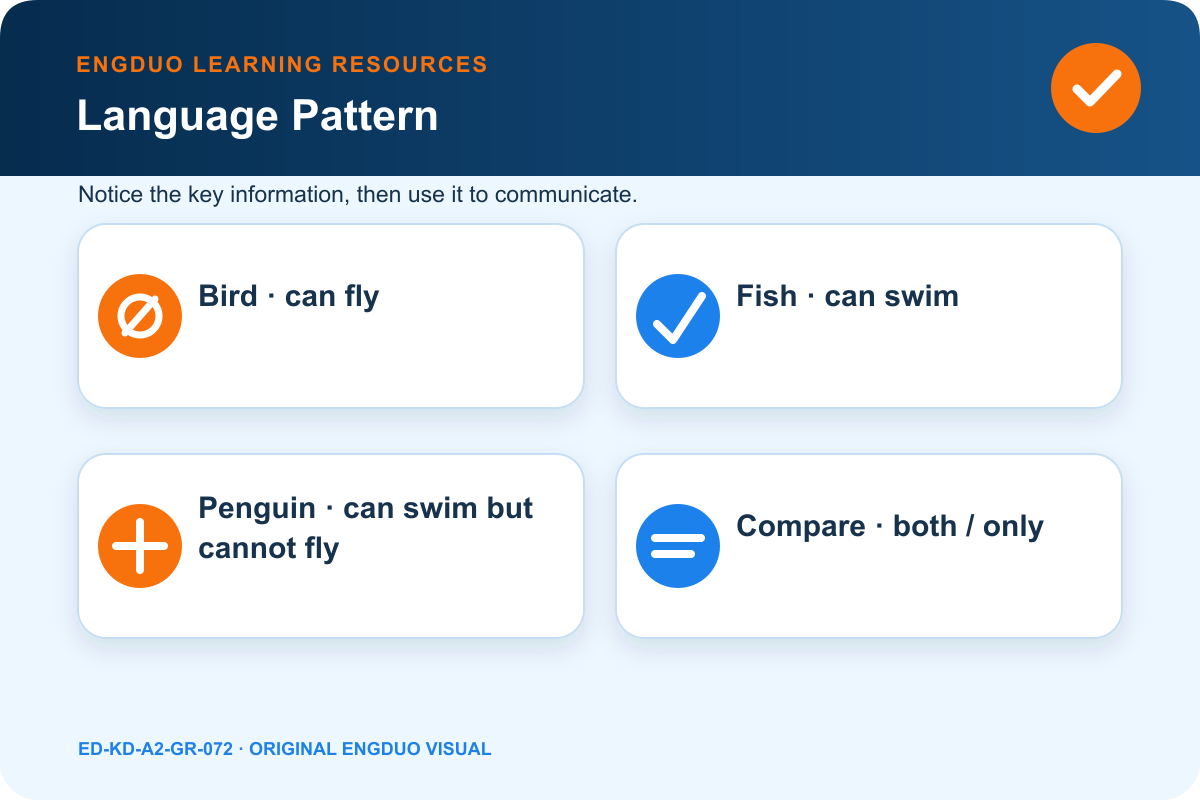
Movement
fly · swim · run · climb · jump
fly · swim · run · climb · jump
Other abilities
see in the dark · carry things · live underwater
see in the dark · carry things · live underwater
Evidence
wings · fins · strong legs · claws
wings · fins · strong legs · claws
How to run Stage 1
3 min: Match four animals to familiar abilities and collect the learner’s baseline language.
Keep the main verb in its base form
Listen and notice that the main verb does not change.
Engduo Audio: Listen for meaning first. Audio never starts automatically.
Listen for the question, negative ability, and contrasting positive ability.
Listen for an ability shared by two animals and an ability only one has.
A bird can flies.
A bird can fly.
A bird can fly.
How to run Stage 2
5 min: Play the first model and establish can/can’t + base verb.
Give more than yes or no
| Question | Short answer | Useful detail |
|---|---|---|
| Can a penguin fly? | No, it can’t. | But it can swim. |
| Can a duck swim? | Yes, it can. | It can also fly. |
How to run Stage 3
5 min: Build questions, short answers, and one contrasting detail.
Compare two animals
- Both animals can ______.
- Only the ______ can ______.
- The ______ can’t ______, but it can ______.
- Can either animal ______?
Add one reason based on a visible feature.
How to run Stage 4
6 min: Compare two animals using both, only, can, and can’t.
Solve the habitat challenge
Ask questions until you have enough evidence to place each fictional animal in the air, land, water, or mixed habitat zone.
Required: two ability questions, two can statements, one can’t contrast, one comparison, and one evidence-based choice.
How to run Stage 5
7 min: Run the habitat classification challenge without interruption.
Final practice: Classify an animal with evidence
Task: Compare two new animals with three can/can’t facts, ask two ability questions, and recommend a suitable habitat with one evidence-based reason.
Success: The main verb stays in the base form, answers include useful detail, and the classification follows from the stated abilities.
LC · Language Control
0 Frequent form problems obscure the intended time or meaning.
1 Meaning remains clear with some prompting or self-correction.
2 Controls can/can’t + base verb and ability questions accurately across the comparison.
FP · Functional Performance
0 Does not yet complete the communication outcome.
1 Completes most of the outcome with visible prompts.
2 Asks, compares, and classifies an animal with evidence independently.
How to run Stage 6
4 min: Score LC and FP, correct one verb-form problem, and retry the recommendation.
คำอธิบายภาษาไทย — เปิดเมื่อจำเป็นเท่านั้น
หลัง can หรือ can’t ใช้กริยารูปปกติเสมอ เช่น can swim และ can’t fly คำถามใช้ Can + ประธาน + กริยา เช่น Can a penguin swim?
Continue your learning path
Teaching references
CEFR Companion Volume — used for communication outcomes and observable progress.
Content and media rights
© 2026 Engduo Thailand. This lesson and its original instructional design, text, visuals, and prepared media are for authorized Engduo use. Do not copy, download, republish, sell, scrape, or use any part in another course, website, dataset, product, or AI system without written permission, except where applicable law permits.