Transcript — open after listening
I work as an operations coordinator in the service team. I’m mainly responsible for scheduling and supplier follow-up, and I work closely with finance to confirm costs.

← Back to Business English Lessons

Turn a job title into a useful professional explanation: what you own, who you work with, and how your work contributes.
For learners: Explain your role, responsibilities and contribution for a specific listener.
For teachers: The lesson moves from a workplace model to supported language, interaction and a listener-focused independent scenario.
สำหรับผู้เรียน: อธิบายบทบาท หน้าที่ และผลงานของตนให้เหมาะกับผู้ฟังแต่ละกลุ่ม
สำหรับครู: บทเรียนเริ่มจากตัวอย่างสถานการณ์งาน ต่อด้วยภาษาช่วย การโต้ตอบ และสถานการณ์อิสระที่คำนึงถึงผู้ฟัง
The same job should not sound identical to every person. Choose one listener and identify what that person needs to understand.
Student says: “I’m explaining my role to ___, so I should focus on ___.”
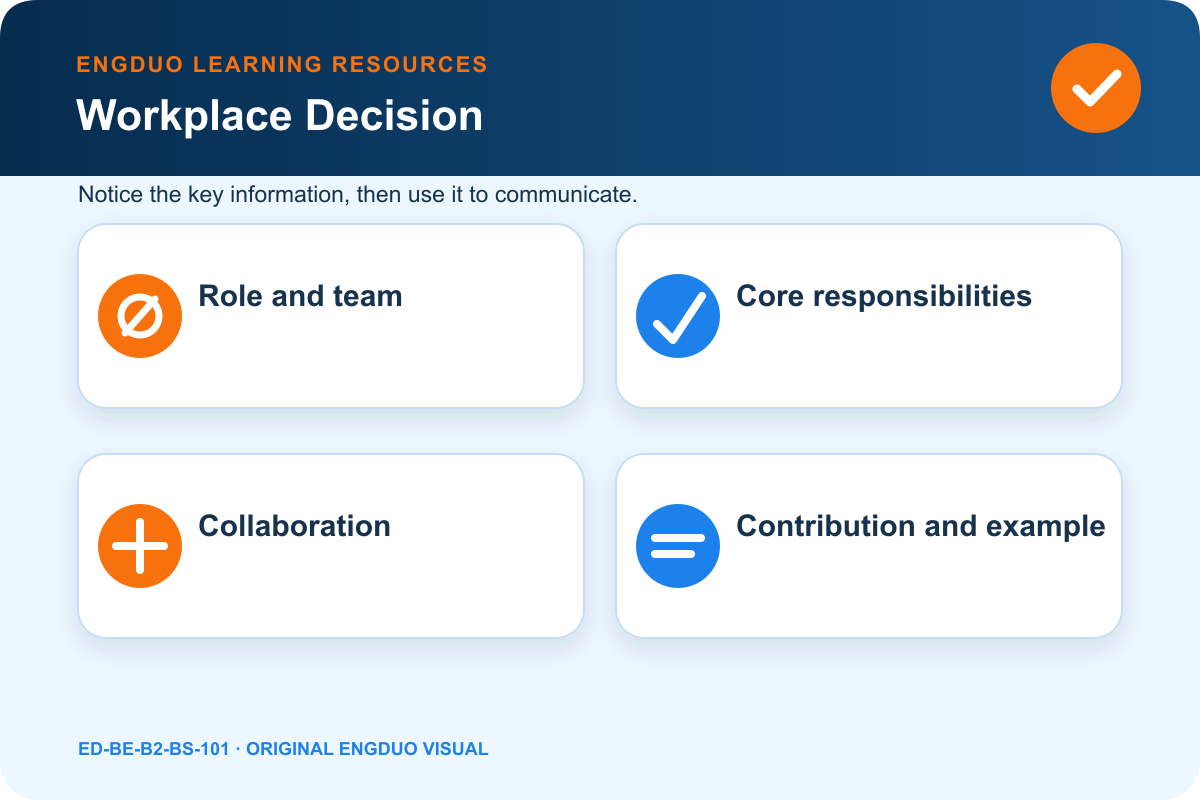
Listen once without the transcript. For each speaker, note: role/team → responsibility → collaboration or example → result.
I work as an operations coordinator in the service team. I’m mainly responsible for scheduling and supplier follow-up, and I work closely with finance to confirm costs.
A typical part of my role is checking delivery risks. For example, I recently reorganised a handover so the client received the updated plan on time.
Write key words, not a complete script. Replace vague verbs such as do and help with a precise work verb.
| Job of the sentence | Useful language | Your key words |
|---|---|---|
| Role and team | I work as… / My role focuses on… | ______ |
| Ownership | I’m responsible for… / I oversee… | ______ |
| Collaboration | I coordinate with… to… | ______ |
| Contribution | I contribute by… / This helps us… | ______ |
| Evidence | For example, I recently… | ______ |
Precise work verbs: coordinate · analyse · monitor · resolve · schedule · advise · improve · deliver · oversee · support
Keep the same role but change the emphasis for the listener selected in Stage 1.
New colleague: add ownership and collaboration.
Client: add relevance and result; remove internal detail.
Senior manager: add priority, risk, or measurable impact.
Say a 30-second version. Your partner identifies the intended listener and explains which detail made it suitable.
Speaker: Give your 60–90 second role explanation using key words only.
Listener: Ask two questions: “What is your current priority?” and “Can you give me a recent example?”
Speaker: Answer directly, then connect the answer back to the listener’s need.
Switch roles or change to a fictional position: Operations Coordinator, Customer Success Specialist, or Marketing Analyst.
Task: Explain a role to a named listener, include responsibility, collaboration and contribution, give one concrete example, and answer two follow-up questions.
Success: The listener understands what you own, who you work with, why the role matters, and how your example supports the claim.
2: Role, ownership, collaboration, and contribution form a clear connected explanation.
1: The role is understandable after one prompt for connection or evidence.
0: The listener cannot yet identify what the speaker owns or why it matters.
2: Adapts to the listener and answers both follow-ups independently.
1: Completes the outcome after one key-word or audience prompt.
0: Relies on a full script or does not yet answer the follow-up questions.
บทนี้ฝึกอธิบายงานให้เหมาะกับผู้ฟัง ไม่ใช่เพียงบอกชื่อตำแหน่ง นักเรียนควรเชื่อมหน้าที่ ผู้ร่วมงาน ผลลัพธ์ และตัวอย่างเข้าด้วยกัน หากข้อมูลจริงเป็นความลับสามารถใช้บทบาทสมมติได้
© Engduo Thailand · For Engduo learning use