LIST · Listening
2 Finds the target words and time phrase at natural speed with no more than one replay.
1 Finds most targets after slow audio, replay, or visible support.
0 The key routine meaning is not yet identified.


Topic FamilyTF06 · Daily Routines, Habits & Time
Turn eight routine words into language you can predict, hear, place on the beat, remember, and change for your own life.
For learners: Use a routine chant to predict and catch key words, hear content-word stress, and turn the pattern into a short personal performance.
For teachers: Visual prediction prepares the listening set; slow audio reveals word boundaries; natural audio confirms evidence; the beat supports stress and recall; personal substitutions turn recognition into usable language. Each audio track has one distinct teaching job.
สำหรับผู้เรียน: ใช้บทจังหวะเรื่องกิจวัตรเพื่อคาดเดาและจับคำสำคัญ ฟังการเน้นคำ แล้วนำรูปแบบไปสร้างการแสดงสั้น ๆ ที่เป็นเรื่องของตนเอง
สำหรับครู: เริ่มจากภาพเพื่อเตรียมคำที่อาจได้ยิน ใช้เสียงช้าแยกขอบเขตคำ ใช้เสียงธรรมชาติตรวจหลักฐาน ใช้จังหวะช่วยเน้นคำและจำ แล้วเปลี่ยนรายละเอียดเพื่อใช้ภาษาเป็นเรื่องของตนเอง เสียงแต่ละชุดมีหน้าที่การสอนต่างกัน
By the end of this lesson, you can catch eight routine words and one time phrase, keep the important words clear on the beat, and perform a short verse with two details changed for your own routine.
คาดเดาคำจากภาพ ฟังเสียงช้าเพื่อจับคำ ฟังความเร็วธรรมชาติเพื่อตรวจหลักฐาน ฝึกเน้นคำสำคัญตามจังหวะ แล้วเปลี่ยนสองรายละเอียดให้เป็นกิจวัตรของตนเอง
Music Challenge rule: Music is the learning tool, not decoration. Use the sequence predict → hear slowly → confirm naturally → place meaning words on the beat → perform → personalise. Singing ability is not assessed.
| Stage | Teacher move | Evidence |
|---|---|---|
| 1 · 0–3 | Use the lyric map and first sounds to elicit possible words. Do not reveal answers. | A useful prediction set |
| 2 · 3–9 | Play the slow chant once; replay only an uncertain line and ask for sound evidence. | Eight gaps attempted |
| 3 · 9–14 | Play the natural version without stopping; check the words, time phrase, and one rhyme. | Natural-speed confirmation |
| 4 · 14–19 | Tap a steady beat, mark content words, and model one line only. | Clear stress on meaning words |
| 5 · 19–26 | Move from visible verse to hidden words, then require two real-life substitutions. | Personalised performance |
| 6 · 26–30 | Score LIST/PRON/VR 0–2, give one cue, and retry the shortest weak part. | Focused improvement |
Student task: Look at the eight picture clues, say one possible word for each, and notice the first sound before listening.
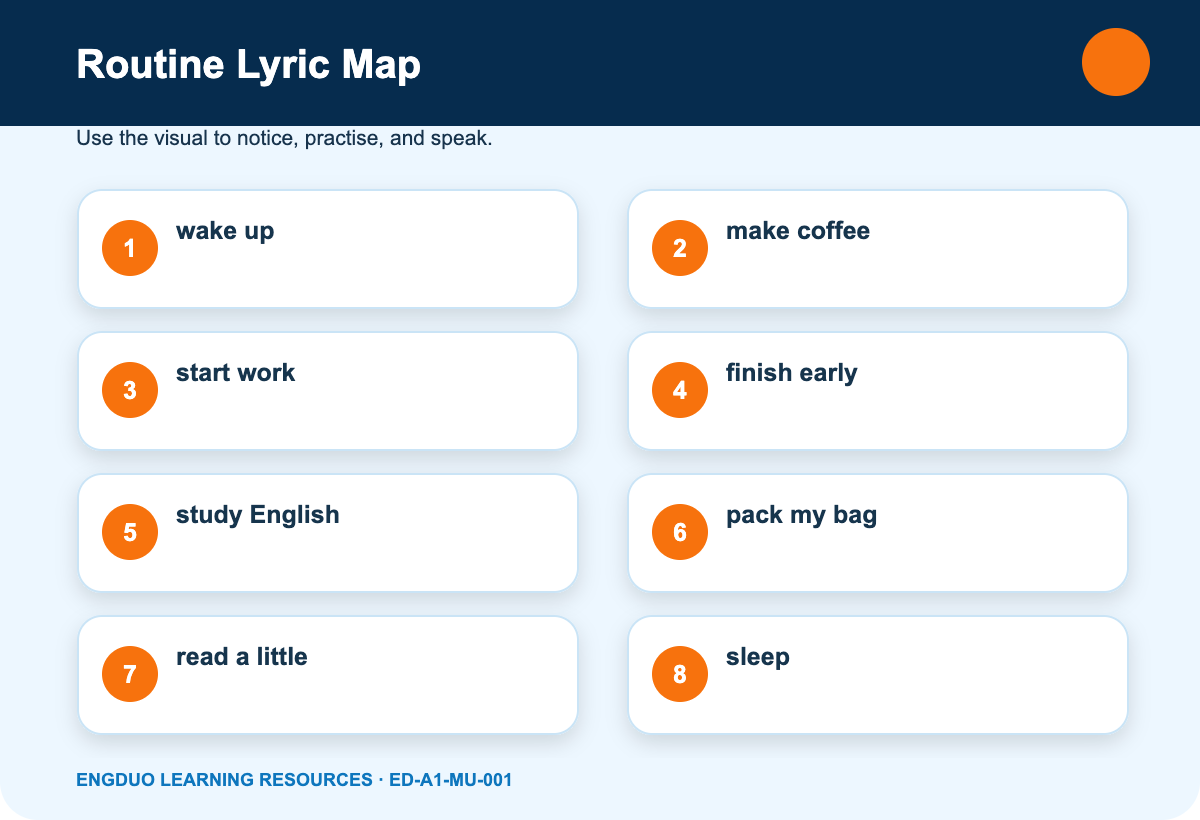
Say the words once: Which begin with /w/, /k/, /s/, /f/, /st/, /b/, /r/, or /sl/?
3 min. Accept alternative words when the picture supports them. Ask the learner to say every prediction aloud, then keep the answer set closed.
Student task: Listen once from beginning to end and complete as many gaps as possible. Replay only the line that remains uncertain.
wake · coffee · start · finish · study · bag · read · sleep
6 min. Play the full slow version once. For an uncertain gap, replay only that line and ask, “What sound did you hear?” or “Which word fits the meaning?”
Student task: Listen without pausing. Confirm the eight words, identify the time phrase, and find the two line endings that rhyme.
Time phrase: half past eight. Rhyme: light / goodnight.
5 min. Do not stop the first natural-speed play. Ask the learner to point to each confirmed gap, then give no more than one full replay before checking the extra details.
Student task: Tap a steady beat. Make the important routine words clearer and let smaller words fit around them.
Rhythm tip: A steady beat matters more than speed. Clear meaning matters more than singing.
5 min. Model only one line. Tap or clap a slow beat, then let the learner repeat four lines. Correct one unclear content word, not every accent difference.
Student task: Complete four short rounds. In the final two rounds, replace two details with true choices from your own routine.
7 min. Run Read → Recall → Change → Share in order. Allow the learner to change grammar around a new word when needed. A natural personal line is better than forcing an exact rhyme.
Task: Complete the eight gaps at natural speed, identify the time phrase, then perform one verse with four words hidden and two routine details changed.
Success: The words match the audio, the important routine words stay clear on the beat, and the two new details fit your meaning.
2 Finds the target words and time phrase at natural speed with no more than one replay.
1 Finds most targets after slow audio, replay, or visible support.
0 The key routine meaning is not yet identified.
2 Content words stay clear and consistently stressed on a steady beat.
1 Meaning becomes clear after one stress or rhythm cue.
0 The target words are not yet understandable in the line.
2 Recalls the targets and independently makes two suitable personal changes.
1 Recalls most targets and makes one suitable change with support.
0 Cannot yet recall or substitute a suitable routine word.
Result: 0–2 Rebuild · 3–4 Developing · 5–6 Pilot evidence.
Feedback + retry: Keep the first score. Choose one target—hear one difficult line, clarify one stressed word, or improve one personal substitution—and retry only that part.
4 min. Record LIST, PRON, and VR from 0–2 before feedback. Give one precise cue and repeat the shortest weak section; do not restart the entire activity.
บทนี้ไม่ได้วัดความสามารถในการร้องเพลง แต่ใช้จังหวะช่วยให้ฟัง จำ และพูดคำศัพท์กิจวัตรได้ชัดขึ้น ให้คาดเดาก่อนฟัง ฟังเสียงช้าเพื่อจับคำ ฟังความเร็วธรรมชาติเพื่อตรวจคำ แล้วเปลี่ยนสองรายละเอียดให้ตรงกับชีวิตจริง
Start with a short guided talk about your daily routine.
เริ่มจากบทพูดแบบมีโครงเกี่ยวกับกิจวัตรประจำวัน
Transfer key-word listening to a practical phone conversation.
นำทักษะจับคำสำคัญไปใช้กับบทสนทนาทางโทรศัพท์
Use routine and free-time language in a real question exchange.
นำภาษากิจวัตรและเวลาว่างไปใช้ถาม–ตอบจริง
Review how frequency words make routines more precise.
ทบทวนการใช้คำบอกความถี่เพื่อเล่ากิจวัตรให้ชัดขึ้น
CEFR Companion Volume — used for listening for specific information, phonological control, and observable language performance.
© 2026 Engduo Thailand. This lesson and its original instructional design, text, visuals, and prepared media are for authorized Engduo use. Do not copy, republish, sell, scrape, or use any part in another course, website, dataset, product, or AI system without written permission, except where applicable law permits.