
Place events in real time before selecting tense.
Narrative Tenses for Historical Stories
Control three past-time viewpoints so a listener can reconstruct a historical sequence accurately.
Narrative tenses Part 2: integrated past timelines
Keep past simple as the main story line, use past continuous for background, and past perfect only for an earlier cause or event.
Your goal
By the end of this lesson, you can tell a two-minute historical account with past simple for main events, past continuous for background, and past perfect for two earlier links.
คำอธิบายเป้าหมายภาษาไทย — เปิดเมื่อจำเป็น
บทนี้ฝึกควบคุมเส้นเวลาในการเล่าเรื่องประวัติศาสตร์ ใช้ past simple เป็นเหตุการณ์หลัก past continuous เป็นฉากหลัง และ past perfect เฉพาะเหตุการณ์ที่เกิดก่อน
Progress focus LCFP
LC · Language Control
Control the target pattern so the intended time and meaning remain clear.
Control the target pattern so the intended time and meaning remain clear.
FP · Functional Performance
Complete the lesson’s real communication outcome without teacher-supplied sentences.
Complete the lesson’s real communication outcome without teacher-supplied sentences.
Your grammar path
Main events, background, and earlier causes need different viewpoints.
Signal changes clearly and keep the main sequence easy to follow.
30-minute lesson route
3 minTimeline baseline
5 minThree tense jobs
5 minEarlier links
6 minReconstruct events
7 minHistorical account
4 minFeedback & retry
Separate timeline from storytelling order
What happened first in reality may be mentioned later in the story.
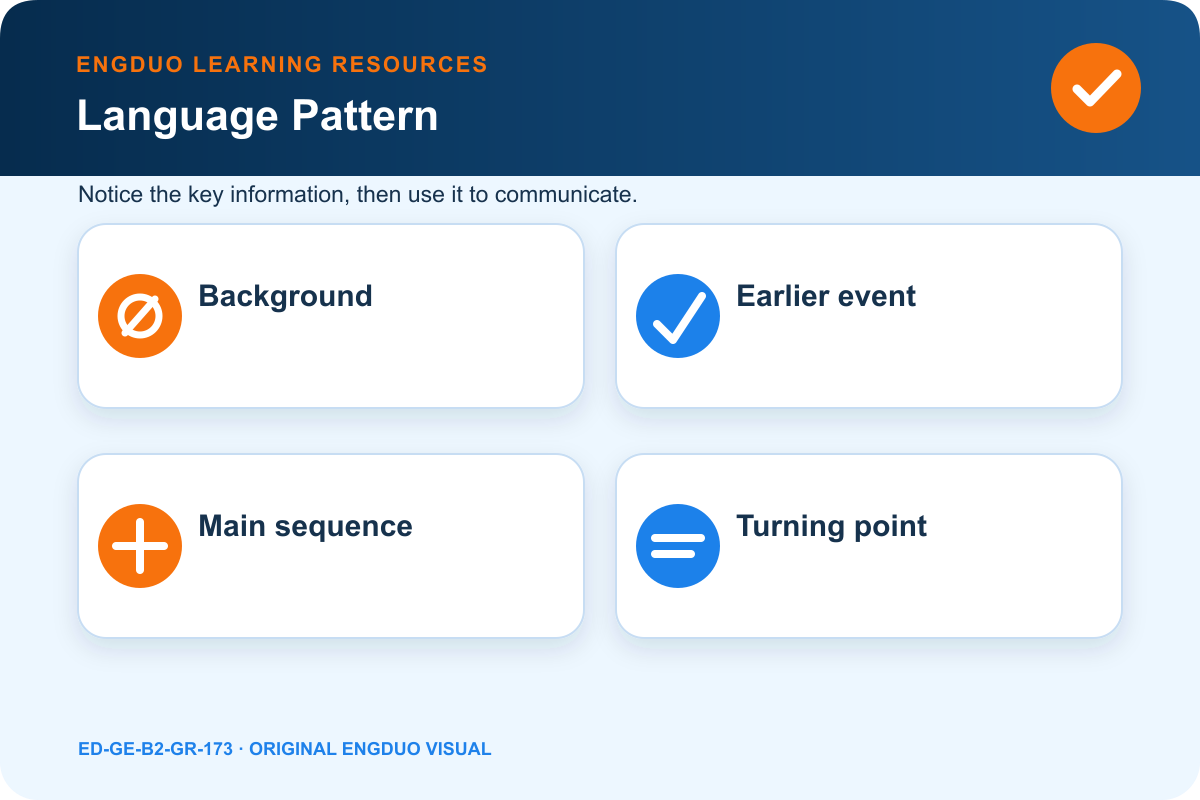
Main line
Past simple
Past simple
Background in progress
Past continuous
Past continuous
Earlier event or cause
Past perfect
Past perfect
How to run Stage 1
3 min: Order the event cards by actual time before discussing tense.
Give each tense a clear job
Listen and label each clause by its function.
Engduo Audio: Listen for meaning first. Audio never starts automatically.
Listen for background activity and the main turning point.
Listen for what had happened before the main event.
| Job | Form | Example |
|---|---|---|
| Main event | past simple | The river reached the town. |
| Background | was/were + -ing | Volunteers were moving equipment. |
| Earlier cause | had + participle | Rain had continued for three days. |
How to run Stage 2
5 min: Play both models and identify the three timeline functions.
Use past perfect only when the earlier link matters
By the time the power failed, the team had prepared a battery transmitter.
Once the earlier relationship is clear, return to past simple for the main sequence.
How to run Stage 3
5 min: Practise two earlier links and return to past simple for the main line.
Reconstruct eight event cards
- Order eight events by actual time.
- Mark four main events, two background actions, and two earlier links.
- Add by the time, while, because, until then, and finally where useful.
- Check that past perfect is not used for every old event.
How to run Stage 4
6 min: Reconstruct eight event cards with five useful connectors.
Tell the historical account
Reconstruct an original account about a town radio station during a flood. Your listener draws the timeline and asks one clarification question.
Required: four past-simple events, two background clauses, two past-perfect links, and one clear turning point.
How to run Stage 5
7 min: Tell the historical account while the listener draws the timeline.
Final practice: Control a complex past timeline
Task: Tell a two-minute historical story from key words. The listener draws the sequence, asks one timeline question, and explains which event happened first.
Success: The listener reconstructs the timeline accurately, the main story line remains clear, and past perfect is reserved for meaningful earlier links.
LC · Language Control
0 Frequent form problems obscure the intended time or meaning.
1 Meaning remains clear with some prompting or self-correction.
2 Controls past simple, past continuous, and past perfect according to their timeline functions.
FP · Functional Performance
0 Does not yet complete the communication outcome.
1 Completes most of the outcome with visible prompts.
2 Delivers a coherent historical account and answers a timeline question independently.
How to run Stage 6
4 min: Score LC and FP, correct one viewpoint choice, and retry the weakest link.
คำอธิบายภาษาไทย — เปิดเมื่อจำเป็นเท่านั้น
วางเส้นเวลาก่อนเลือก tense: past simple เป็นเหตุการณ์หลัก past continuous เป็นฉากหลังที่กำลังดำเนิน และ past perfect เป็นเหตุการณ์ที่เกิดก่อนอีกเหตุการณ์หนึ่งในอดีต
Continue your learning path
Teaching references
CEFR Companion Volume — used for communication outcomes and observable progress.
Content and media rights
© 2026 Engduo Thailand. This lesson and its original instructional design, text, visuals, and prepared media are for authorized Engduo use. Do not copy, download, republish, sell, scrape, or use any part in another course, website, dataset, product, or AI system without written permission, except where applicable law permits.