MEAN · Meaning
2 Certainty consistently matches evidence.
1 Meaning is mostly clear after one prompt.
0 Certainty remains unclear or misleading.


Topic FamilyTF21 · Technology & Digital Life
Future language is not one form. Choose will, may/might, be likely to, or be expected to according to how strong your evidence really is.
For learners: Use future forms to calibrate claims, support predictions with evidence, and revise responsibly after a challenge.
For teachers: Meaning-first Grammar in Context: evidence strength → form–stance contrast → controlled reasons → supported forecasts → repair → independent forecast and retry.
สำหรับผู้เรียน: ใช้รูปแบบอนาคตให้ตรงกับระดับความมั่นใจ สนับสนุนคำคาดการณ์ด้วยหลักฐาน และปรับคำกล่าวอย่างรับผิดชอบเมื่อถูกท้าทาย
สำหรับครู: ไวยากรณ์แบบเริ่มจากความหมาย: ระดับหลักฐาน → เปรียบเทียบรูปแบบ → เลือกพร้อมเหตุผล → สร้างคำคาดการณ์ → ซ่อมคำกล่าว → ปฏิบัติจริงและลองใหม่
By the end of this lesson, you can make four future predictions with suitable certainty, support two with evidence, and revise one after a counterargument.
ผู้เรียนจะเลือกโครงสร้างอนาคตให้ตรงกับระดับความมั่นใจ ใช้หลักฐานรองรับ และปรับคำคาดการณ์เมื่อมีข้อโต้แย้ง ไม่ใช่เลือก will เพียงเพราะกำลังพูดถึงอนาคต
Strong claims sound confident, but they become misleading when the evidence is weak. Calibrated grammar lets you sound clear, credible, and open to revision.
Meaning-first rule: ask how certain the speaker is and what evidence exists before naming a future form.
| Stage | Teacher move | Evidence to collect |
|---|---|---|
| 1 · Meaning | Rank evidence strength and place claims on a certainty line. | Four meaning matches |
| 2 · Notice | Elicit the meaning question before showing the form map. | Completed form–stance map |
| 3 · Control | Require a certainty reason after each choice. | Five choices + reasons |
| 4 · Build | Check evidence and time horizon before correcting minor form. | Four supported forecasts |
| 5 · Repair | Challenge one exaggerated claim and elicit a measured rewrite. | One repaired claim |
| 6 · Perform | Score first attempt, target one change, then allow a focused retry. | Forecast + answer + retry |
Student Task: Rank four evidence sources from weak to strong, then match each one to a prediction strength.
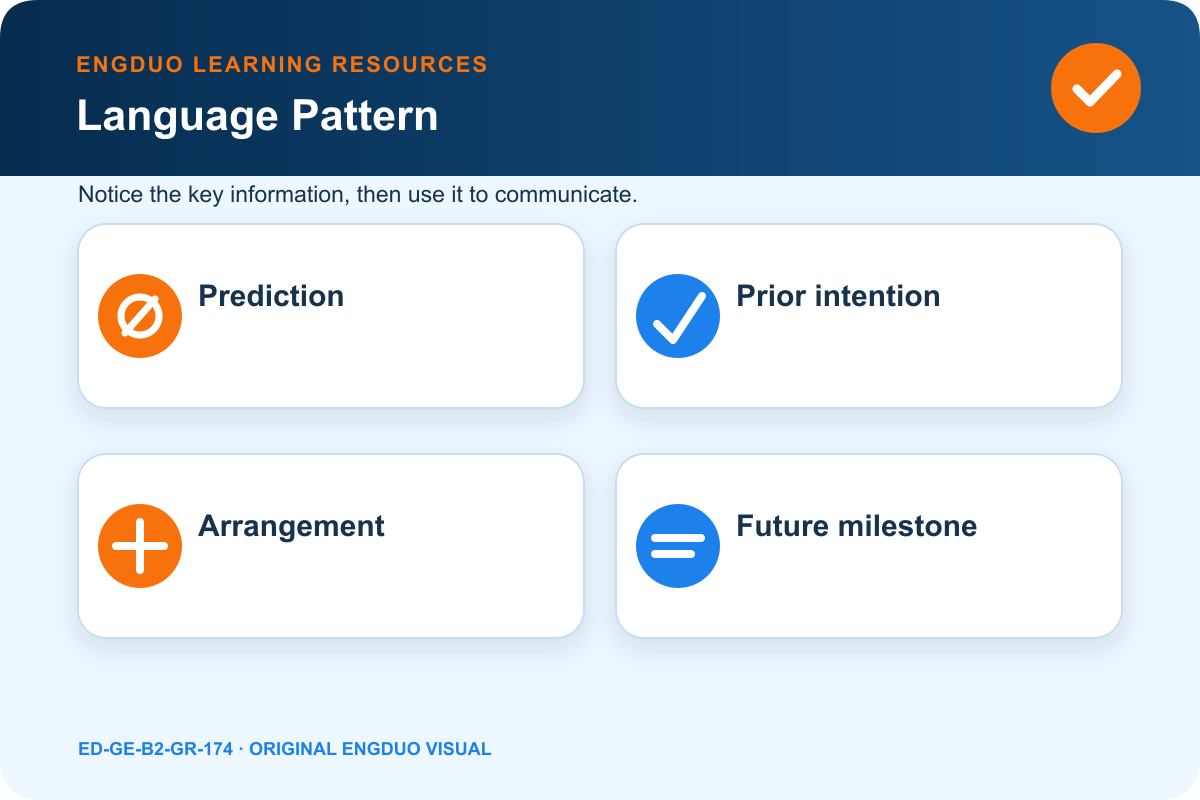
Finish evidence: Four evidence cards placed on a certainty line with a spoken reason.
Do not introduce forms yet. Ask, “How sure are you?” and “What evidence supports that?” Accept different rankings when the learner can justify them.
Student Task: Complete the form–meaning map, then say what changes between the four examples.
| Stance | Pattern | Example |
|---|---|---|
| Strong forecast | will + base verb | AI will change routine support work. |
| Evidence-based expectation | is expected to + verb | Battery costs are expected to fall. |
| Probable | is likely to + verb | Remote care is likely to expand. |
| Possible | may/might + verb | Some roles might disappear. |
Finish evidence: A completed four-form map and one spoken contrast.
Keep the labels practical: strong, expected from evidence, likely, and possible. Contrast meaning before drilling the form. Do not treat the four options as interchangeable synonyms.
Student Task: Choose the best form and explain why the evidence supports that level of certainty.
Finish evidence: Five choices with a certainty reason, not only a correct form.
If the learner guesses, cover the options and ask for the stance first. Then reveal the forms. Accept an alternative when the learner changes the evidence or time horizon coherently.
Student Task: Choose one field—health, education, transport, or work—and create four predictions at different certainty levels.
Add a time horizon to every claim. Support at least two with a trend, policy, cost change, research result, or observed behaviour.
Finish evidence: Four forecasts, two evidence links, and one limitation.
Check whether the evidence and time horizon are believable before polishing grammar. Ask the learner to weaken or strengthen one form when the evidence changes.
Student Task: Read the exchange, identify the overconfident claim, and repair it with a more accurate form.
Use this repair sequence: acknowledge → recalibrate → support.
“That claim is too broad. Some well-funded schools are likely to expand AI tutoring, but adoption may remain uneven because access and policy differ.”
Finish evidence: One repaired claim with a measured form, evidence, and limitation.
Focus on communication repair, not winning the debate. Require one acknowledgement phrase, one changed certainty choice, and one reason for the change.
Task: Give a 90-second forecast with four predictions at different certainty levels, support two with evidence, answer one challenge, and revise one claim.
Success: The listener can hear the intended certainty, the strongest claims have evidence, and the speaker adjusts language after a valid challenge.
2 Certainty consistently matches evidence.
1 Meaning is mostly clear after one prompt.
0 Certainty remains unclear or misleading.
2 Controls all four target patterns accurately.
1 Meaning stays clear with occasional repair.
0 Form problems repeatedly obscure the stance.
2 Supports, answers, and revises independently.
1 Completes most steps with visible support.
0 Does not yet complete the forecast exchange.
Result: 0–2 Rebuild · 3–4 Developing · 5–6 Independent evidence.
Feedback + retry: Keep the first score. Choose one target—certainty, form, evidence, or revision—and retry only the weakest forecast sentence and its answer.
Finish evidence: First forecast + challenge answer + revised sentence + focused retry.
Score the first independent attempt before feedback. Give one precise target, preserve the original score, and note whether the short retry improves that target.
ให้คิดจากระดับความมั่นใจและหลักฐานก่อนเลือกโครงสร้าง: will ใช้เมื่อมั่นใจสูง, expected to เมื่อตั้งอยู่บนข้อมูลหรือความคาดหมาย, likely to เมื่อมีแนวโน้ม และ may/might เมื่อเป็นเพียงความเป็นไปได้ จากนั้นฝึกปรับประโยคให้แม่นขึ้นเมื่อมีคนท้าทายหลักฐาน
Follow app instructions first
เริ่มจากการฟังและทำตามขั้นตอน
Guide someone through a digital solution
นำไปใช้ช่วยแก้ปัญหาดิจิทัล
Discuss technology choices freely
อภิปรายทางเลือกเทคโนโลยีอย่างอิสระ
Complete the TF21 privacy and responsible-choice mastery
ทำบทสรุป TF21 เรื่องความเป็นส่วนตัวและการตัดสินใจ
CEFR Companion Volume — used for B2 argument, qualification, interaction, and observable performance outcomes.
© 2026 Engduo Thailand. This lesson and its original instructional design, text, visuals, and prepared media are for authorized Engduo use. Do not copy, republish, sell, scrape, or use any part in another course, website, dataset, product, or AI system without written permission, except where applicable law permits.