
Ask whether the choice is being made now, was intended earlier, or has arranged details.

Will, Going To, or Present Continuous?
Choose a future form from the planning situation and negotiate one realistic schedule change.
Future-form contrast: decision, intention, or arrangement
Use will for a decision made now, going to for an existing intention, and present continuous for an arranged event with practical details.
Your goal
By the end of this lesson, you can distinguish decisions, intentions, and arrangements, use all three future forms accurately, and renegotiate one plan.
คำอธิบายเป้าหมายภาษาไทย — เปิดเมื่อจำเป็น
บทนี้ฝึกเลือก will สำหรับการตัดสินใจตอนพูด going to สำหรับความตั้งใจที่มีอยู่แล้ว และ present continuous สำหรับนัดหมายที่จัดไว้แล้ว
Progress focus LCFP
LC · Language Control
Control the target pattern so the intended time and meaning remain clear.
Control the target pattern so the intended time and meaning remain clear.
FP · Functional Performance
Complete the lesson’s real communication outcome without teacher-supplied sentences.
Complete the lesson’s real communication outcome without teacher-supplied sentences.
Your grammar path
Control will + verb, be going to + verb, and be + -ing.
Explain, change, and confirm practical details.
30-minute lesson route
3 minPlanning stage
5 minWill decisions
5 minIntention vs arrangement
6 minSchedule repair
7 minPlan negotiation
4 minFeedback & retry
Recognise the planning stage
All three forms refer to the future, but they show different relationships to the plan.
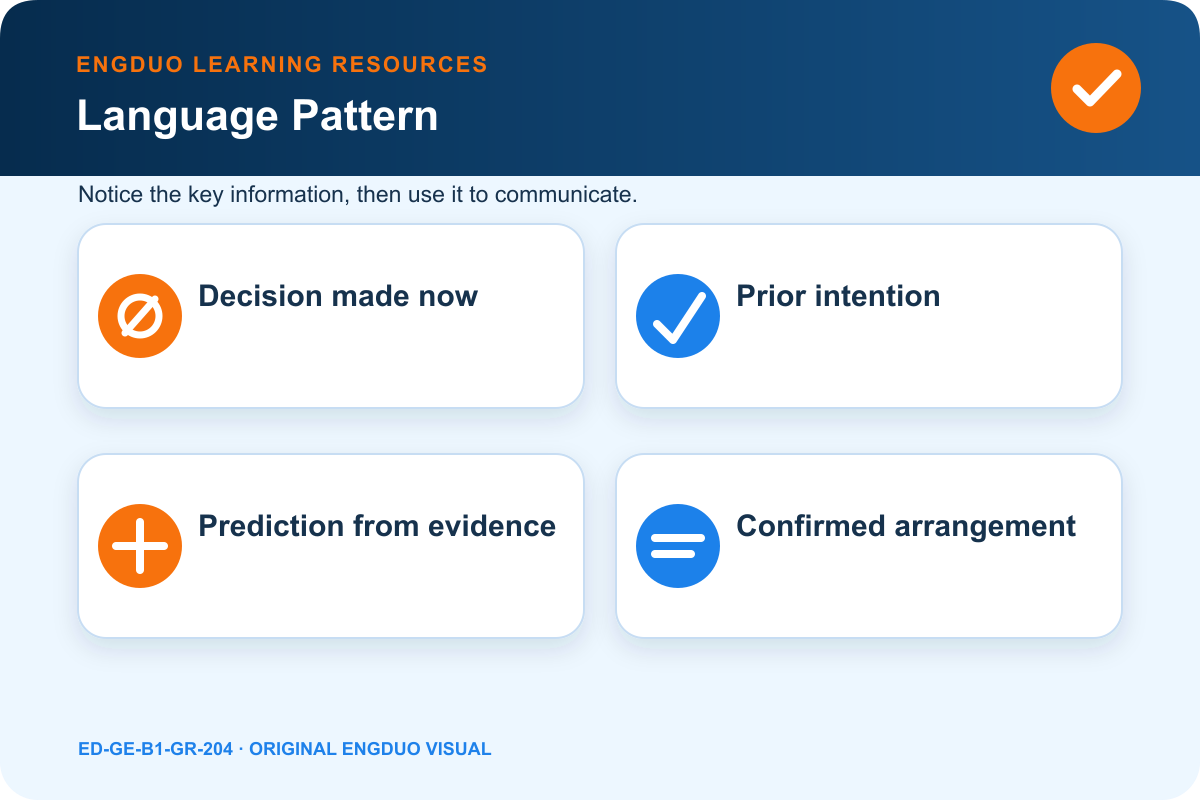
Decision now
I’ll call her now.
I’ll call her now.
Existing intention
I’m going to apply.
I’m going to apply.
Arrangement
I’m meeting them at two.
I’m meeting them at two.
Repair
I’ll change the booking.
I’ll change the booking.
How to run Stage 1
3 min: Sort six future statements by planning stage.
Match form to meaning
Listen for when the plan was decided and whether details are arranged.
Engduo Audio: Listen for meaning first. Audio never starts automatically.
Listen for a new decision and an earlier intention.
Listen for arranged details and a changed schedule.
| Meaning | Pattern | Example |
|---|---|---|
| Decision now | will + verb | I’ll take the later train. |
| Intention | be going to + verb | I’m going to visit Nina. |
| Arrangement | be + -ing | I’m meeting Nina at six. |
How to run Stage 2
5 min: Play the first model and contrast new decision with existing intention.
Separate intention from arrangement
An arrangement normally includes agreed or booked details such as time, place, or another person.
How to run Stage 3
5 min: Play the second model and identify arranged details.
Build and change one plan
- State one existing intention with going to.
- Add an arranged time or place with present continuous.
- Respond to a new problem with will.
- Confirm the new arrangement in one sentence.
How to run Stage 4
6 min: Build one plan and introduce one schedule problem.
Renegotiate the schedule
Plan a short trip, meeting, or study session. Receive one problem card and agree on a revised arrangement.
Required: one going to intention, two present-continuous arrangements, two will decisions, one reason, and a final confirmation.
How to run Stage 5
7 min: Run the negotiation and confirm the revised arrangement.
Final practice: Choose and renegotiate future plans
Task: Explain an intention and arrangement, respond to two new problems, and confirm the revised plan with accurate future forms.
Success: Each future form matches the planning stage and the final schedule is clear without teacher-supplied sentences.
LC · Language Control
0 Frequent form problems obscure the intended time or meaning.
1 Meaning remains clear with some prompting or self-correction.
2 Controls all three forms consistently with decision, intention, and arrangement meanings.
FP · Functional Performance
0 Does not yet complete the communication outcome.
1 Completes most of the outcome with visible prompts.
2 Explains, changes, and confirms a practical plan independently.
How to run Stage 6
4 min: Score LC and FP, correct one recurring choice, and retry the weakest section.
คำอธิบายภาษาไทย — เปิดเมื่อจำเป็นเท่านั้น
will คือการตัดสินใจตอนพูด going to คือความตั้งใจที่มีอยู่แล้ว และ present continuous คือแผนที่มีรายละเอียดนัดหมายแล้ว
Continue your learning path
Teaching references
CEFR Companion Volume — used for communication outcomes and observable progress.
Content and media rights
© 2026 Engduo Thailand. This lesson and its original instructional design, text, visuals, and prepared media are for authorized Engduo use. Do not copy, download, republish, sell, scrape, or use any part in another course, website, dataset, product, or AI system without written permission, except where applicable law permits.