
Choose I, you, he, she, it, we, or they.
Subject Pronouns and Possessive Adjectives
Choose the right subject pronoun and possessive adjective so listeners know who you mean and whose thing you are describing.
Subject pronouns and possessive adjectives
UseRefer to people or things and show who a following noun belongs to.
Core formI/you/he/she/it/we/they + verb · my/your/his/her/its/our/their + noun
ContrastShe works here. · Her office is upstairs.
RememberA possessive adjective comes before a noun; it does not replace the noun.
ชื่อไวยากรณ์ภาษาไทย — เปิดเมื่อจำเป็น
Subject pronoun ใช้เป็นประธาน ส่วน possessive adjective วางหน้าคำนามเพื่อบอกว่าเป็นของใคร เช่น She works here. Her office is upstairs.
Your goal
By the end of this lesson, you can replace names with subject pronouns and use possessive adjectives to describe people, relationships, and everyday things.
คำอธิบายเป้าหมายภาษาไทย — เปิดเมื่อจำเป็น
บทนี้ฝึกเลือกคำแทนประธาน เช่น he, she, they และคำแสดงความเป็นเจ้าของ เช่น his, her, their เพื่อไม่พูดชื่อซ้ำและทำให้ผู้ฟังรู้ว่าสิ่งของหรือความสัมพันธ์นั้นเป็นของใคร
Progress focus LCFP
LC · Language Control
Control the target pattern so the intended meaning remains clear.
Control the target pattern so the intended meaning remains clear.
FP · Functional Performance
Complete the lesson’s real communication outcome without teacher-supplied sentences.
Complete the lesson’s real communication outcome without teacher-supplied sentences.
Your grammar path
Use my, your, his, her, its, our, or their before the noun.
Avoid unclear references and unnecessary repetition.
30-minute lesson route
3 minWho is who
5 minPronoun map
5 minPossession map
6 minListen and track
7 minPeople introduction
4 minFeedback and retry
Identify people and owners
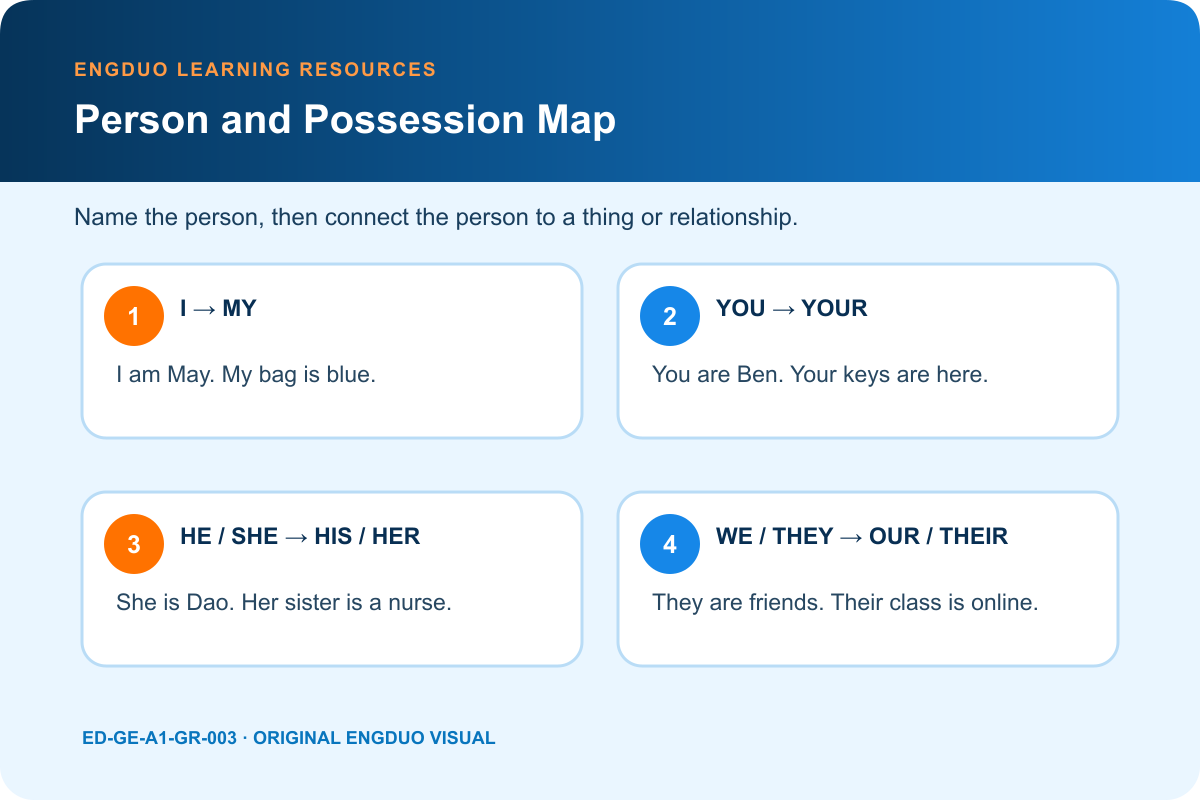
Use real photos or names. Say who each person is and choose one thing or relationship connected to that person.
How to run Stage 1
3 min: Establish three people and one object or relationship for each.
Separate subject pronouns from possessive adjectives
Subject pronouns do the action or come before be: She works here. Possessive adjectives come before a noun: Her office is upstairs. Compare: They are friends. Their class starts at six.
How to run Stage 2
5 min: Replace names with subject pronouns while keeping the reference clear.
Track who each word means
Engduo Audio: Listen for meaning first. Audio never starts automatically.
Track who she, her, we, and our refer to.
Track the people and the owner of each noun.
Listen to both models. Draw a line from each pronoun or possessive adjective to the correct person or group. Explain one answer using the noun that follows the possessive adjective.
How to run Stage 3
5 min: Match each subject pronoun to its possessive adjective.
Replace repetition and remove ambiguity
Improve short messages such as Mina is my friend. Mina is a designer. Mina’s office is nearby. Use she and her without losing the meaning. Practise with a man, a group, and you plus another person.
How to run Stage 4
6 min: Play both audio models and track every reference.
Introduce three people and their connections
Introduce three real or imagined people. Use at least four subject pronouns and four possessive adjectives. Your partner asks one question when a reference is unclear.
How to run Stage 5
7 min: Run the three-person introduction and clarification question.
Final practice: Make people and ownership clear
Task: Give a one-minute introduction to three people. Use at least four subject pronouns, four possessive adjectives, and one sentence with we or our.
Success: The listener can identify every person and owner, and the learner avoids unnecessary name repetition without creating unclear references.
LC · Language Control
0 Frequent form problems obscure the intended meaning.
1 Meaning remains clear with some prompting or self-correction.
2 Chooses subject pronouns and possessive adjectives accurately before the relevant verb or noun.
FP · Functional Performance
0 Does not yet complete the communication outcome.
1 Completes most of the outcome with visible prompts.
2 Introduces the people and their relationships clearly and responds to one clarification question.
How to run Stage 6
4 min: Score LC and FP, repair one unclear reference, and repeat the shortest section.
คำอธิบายภาษาไทย — เปิดเมื่อจำเป็นเท่านั้น
Subject pronoun ใช้แทนคนหรือสิ่งที่เป็นประธาน เช่น She works here. Possessive adjective วางหน้าคำนามเพื่อบอกว่าเป็นของใคร เช่น Her office is here. คำว่า her ในตัวอย่างนี้ต้องมีคำนามตามหลัง
Continue your learning path
Teaching references
CEFR Companion Volume — used for communication outcomes and observable progress.
Content and media rights
© 2026 Engduo Thailand. This lesson and its original instructional design, text, visuals, and prepared media are for authorized Engduo use. Do not copy, download, republish, sell, scrape, or use any part in another course, website, dataset, product, or AI system without written permission, except where applicable law permits.