
Confirm a fact or make a useful correction.
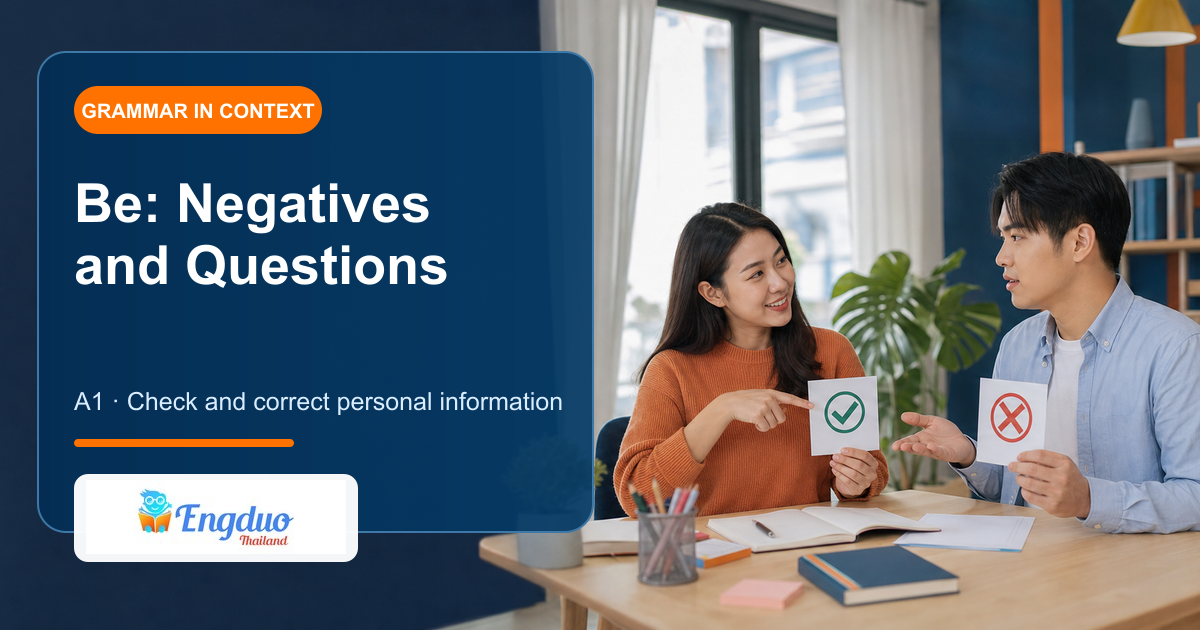
Be: Negatives and Questions
Use am, is, and are to correct personal information, check details, and give clear short answers.
Why this lesson matters · เหตุผลที่เรียนบทนี้
For learners: Use familiar am, is, and are forms to correct information, ask questions, and give natural short answers.
For teachers: Move from meaning to form, listening, supported practice, and an independent six-turn conversation, removing support at each stage.
สำหรับผู้เรียน: นำ am, is และ are ที่คุ้นเคยมาใช้แก้ข้อมูล สร้างคำถาม และตอบสั้น ๆ อย่างเป็นธรรมชาติ
สำหรับครู: เรียงกิจกรรมจากความหมาย รูปประโยค การฟัง และการฝึกแบบมีตัวช่วย ไปสู่บทสนทนา 6 ช่วงพูด โดยลดตัวช่วยลงทีละขั้น
Present Simple of be: negatives and questions
UseCorrect personal information and check whether a detail is true.
Core formsubject + am/is/are + not + information
Question formam/is/are + subject + information?
RememberMove be before the subject in a question; do not add do or does.
ชื่อไวยากรณ์ภาษาไทย — เปิดเมื่อจำเป็น
Present Simple of be รูปปฏิเสธและคำถาม ใช้แก้หรือเช็กข้อมูล โดยเติม not หลัง am/is/are และย้าย am/is/are ไว้หน้าประธานเมื่อสร้างคำถาม
Your goal
By the end of this lesson, you can make negative sentences with be, ask yes-or-no questions, and correct personal information in a short conversation.
คำอธิบายเป้าหมายภาษาไทย — เปิดเมื่อจำเป็น
บทนี้ฝึกใช้ am, is และ are เพื่อบอกว่าอะไรไม่จริง ถามเพื่อตรวจสอบข้อมูล และตอบสั้น ๆ ได้ถูกต้อง เช่น I’m not…, Are you…?, Yes, I am.
Progress focus LCFP
LC · Language Control
Control the target pattern so the intended meaning remains clear.
Control the target pattern so the intended meaning remains clear.
FP · Functional Performance
Complete the lesson’s real communication outcome without teacher-supplied sentences.
Complete the lesson’s real communication outcome without teacher-supplied sentences.
Your grammar path
Use not for negatives and place am/is/are before the subject in questions.
Ask, answer, correct, and continue the conversation.
30-minute lesson route
3 minTrue or false
5 minNegative forms
5 minQuestion pattern
6 minListen and correct
7 minInformation check
4 minFeedback and retry
Confirm or correct the information
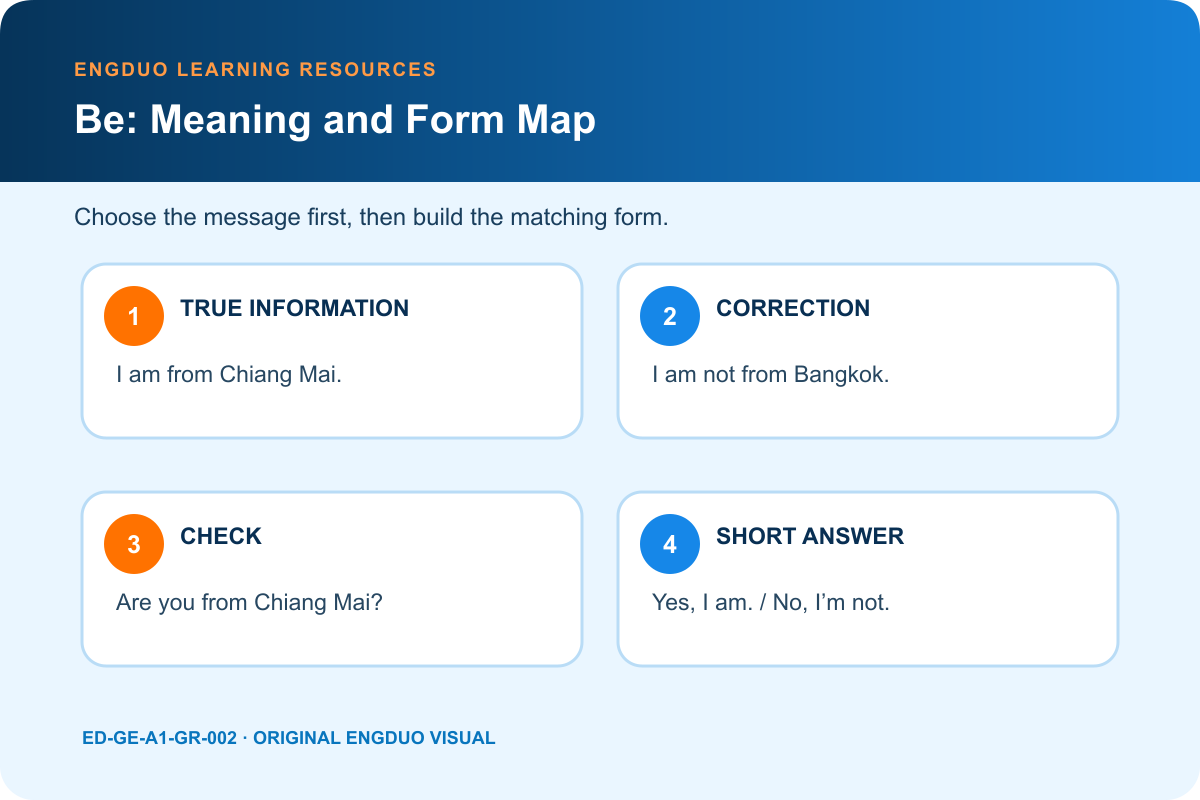
Look at six personal details. Decide which are true for you. For each false detail, say a useful correction: I’m not from Bangkok. I’m from Khon Kaen.
How to run Stage 1
3 min: Show six personal details and collect true or false responses.
Build negatives and questions with be
Negative: subject + am/is/are + not. Question: am/is/are + subject. Short answer: Yes, subject + am/is/are; or No, subject + am/is/are + not. Compare: You are a designer. You aren’t a designer. Are you a designer?
How to run Stage 2
5 min: Build one negative form with am, is, and are.
Find the checked and corrected details
Engduo Audio: Listen for meaning first. Audio never starts automatically.
Listen for the correction and the short answers.
Listen for is, are, isn’t, and the corrected details.
Listen to both information checks. Note the first idea, the correction, and the final confirmed detail. Then repeat the short answers with natural rhythm.
How to run Stage 3
5 min: Move be before the subject and practise short answers.
Turn statements into useful checks
Use these topics: name, hometown, job or study, class time, favourite activity, and one family detail. Make three questions, two negative corrections, and three short answers.
How to run Stage 4
6 min: Play both audio models and identify each correction.
Complete a six-turn information check
Your partner guesses three details about you. Confirm or correct each detail, add one new fact, and ask one question back. Change roles without reading complete sentences.
How to run Stage 5
7 min: Run the six-turn information check without interruption.
Final practice: Check and correct personal information
Task: Complete six connected turns. Ask at least two be questions, give two short answers, make one negative correction, and add one true detail.
Success: The forms of be match the subjects, the questions use question word order, and the learner corrects information without a teacher-supplied sentence.
LC · Language Control
0 Frequent form problems obscure the intended meaning.
1 Meaning remains clear with some prompting or self-correction.
2 Controls affirmative, negative, question, and short-answer forms of be across the conversation.
FP · Functional Performance
0 Does not yet complete the communication outcome.
1 Completes most of the outcome with visible prompts.
2 Completes the information check, correction, and return question independently.
How to run Stage 6
4 min: Score LC and FP, correct one form problem, and retry the affected turns.
คำอธิบายภาษาไทย — เปิดเมื่อจำเป็นเท่านั้น
ประโยคปฏิเสธเติม not หลัง am/is/are เช่น She isn’t a teacher. คำถามย้าย am/is/are ไว้หน้าประธาน เช่น Is she a teacher? คำตอบสั้นต้องใช้ be ซ้ำ เช่น Yes, she is.
Continue your learning path
Introduce Yourself with am, is, and are
Build confident affirmative forms before adding corrections and questions.
ใช้รูปบอกเล่าให้คล่องก่อนเพิ่มการแก้ข้อมูลและคำถาม
Listening Lab: Meeting Someone New
Notice the same personal-information language in a listening task.
ฟังภาษาเกี่ยวกับข้อมูลส่วนตัวในอีกทักษะหนึ่ง
Subject Pronouns and Possessive Adjectives
Make people and ownership clear in longer personal exchanges.
ทำให้ผู้ฟังเข้าใจบุคคลและความเป็นเจ้าของชัดขึ้น
A1 Grammar Mastery: Introduce, Ask, Describe, and Respond
Combine statements, negatives, and questions in a mixed conversation.
รวมประโยคบอกเล่า ปฏิเสธ และคำถามในบทสนทนาเดียว
Teaching references
CEFR Companion Volume — used for communication outcomes and observable progress.
Content and media rights
© 2026 Engduo Thailand. This lesson and its original instructional design, text, visuals, and prepared media are for authorized Engduo use. Do not copy, download, republish, sell, scrape, or use any part in another course, website, dataset, product, or AI system without written permission, except where applicable law permits.